

The quasi-Riemann hypothesis is a relaxed version of the 1859 Riemann hypothesis. While the full conjecture claims every non-trivial zero of the Riemann zeta function sits on a single vertical line at 1/2, the quasi-Riemann hypothesis only asks for a fixed vertical wall strictly below 1 that no zero can cross.
ContentsToggle
How does the quasi-Riemann hypothesis differ from the full problem?
To picture the problem, think of the Riemann zeta function as a mathematical machine that takes complex numbers as inputs and spits out complex numbers as outputs. Every complex number has two parts: a real part along the horizontal axis and an imaginary part along the vertical axis.
In his 1859 paper, Bernhard Riemann focused on the inputs where this function equals zero, specifically the non-trivial zeros trapped inside the critical strip where the real part lies between 0 and 1. According to the Clay Mathematics Institute, Riemann conjectured that every single one of those zeros lands right down the center line at real part 1/2.
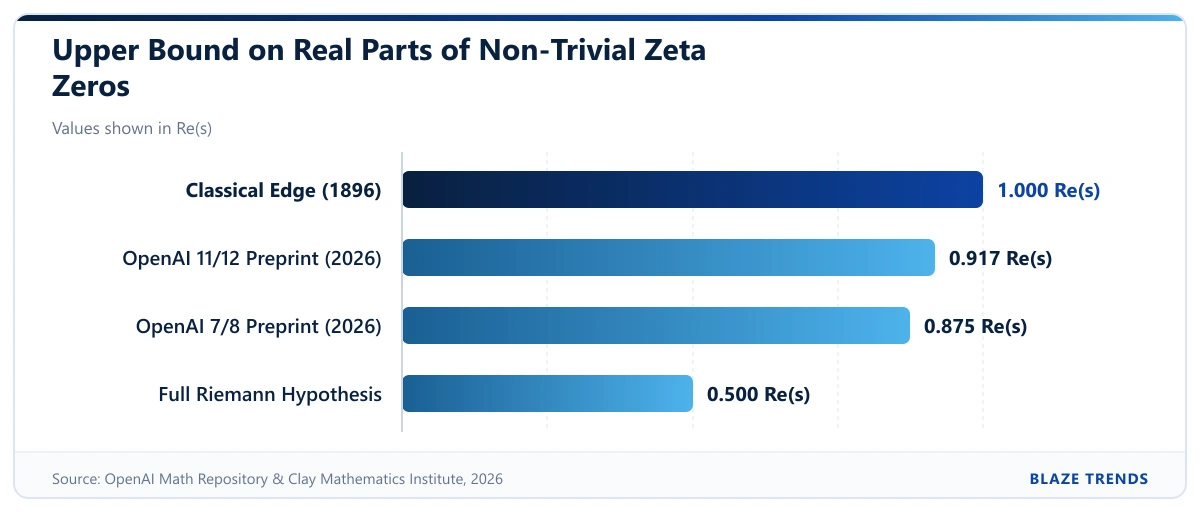
The quasi-Riemann hypothesis sets a wider target. As defined by Wolfram MathWorld, it states only that the zeta function has a fixed zero-free half-plane where the real part exceeds some constant strictly smaller than 1, such as 11/12 or 7/8.
Symmetry does double duty once you build that wall. Riemann’s functional equation mirrors non-trivial zeros across the 1/2 line, so proving no zero sits above 7/8 automatically rules out any zero below 1/8 and confines every non-trivial zero to the vertical band between 1/8 and 7/8.
| Milestone | Zero-free boundary | Allowed strip for non-trivial zeros | Status as of November 2026 |
|---|---|---|---|
| Prime Number Theorem (1896) and Korobov-Vinogradov (1958) | Curves closer to 1 as height grows | Entire open strip between 0 and 1 | Established theorems |
| Quasi-Riemann hypothesis (7/8 bound) | Fixed vertical wall at Re(s) greater than 7/8 | Strip from 1/8 to 7/8 | Claimed in October 2026 AI preprints; awaiting full human review |
| Full Riemann hypothesis (1859) | Fixed vertical wall at Re(s) greater than 1/2 | Single vertical line at Re(s) = 1/2 | Open Millennium Problem; November 2026 Lean claim unverified |
Why could mathematicians not draw a straight line below 1?
For more than a century, number theorists could clear out zeros near the edge at 1, yet they could never lock in a straight vertical border. In 1896, Jacques Hadamard and Charles Jean de la Vallée Poussin independently proved that the zeta function has no zeros directly on the line where the real part equals 1, a breakthrough that established the Prime Number Theorem.
Over the next six decades, mathematicians carved slightly wider zero-free regions just inside that border, including the stronger 1958 bounds proved independently by Korobov and I. M. Vinogradov. Both of those classical regions share the same catch: as you climb higher up the vertical imaginary axis, the zero-free edge bends asymptotically back toward 1.
Because those regions keep shrinking toward 1 at huge heights, classical methods leave room for a stray zero to sneak arbitrarily close to the right edge of the strip. Proving a fixed wall at 7/8, or even 0.9999, breaks that barrier completely by holding firm all the way to infinity.
What did OpenAI’s October 2026 preprints claim to prove?
On October 6, 2026, OpenAI released a large batch of mathematics manuscripts generated by an unreleased internal model—counted by Wikipedia as 722 manuscripts across 372 topics and described by Quanta Magazine as 377 results. Two preprints in the OpenAI math repository targeted the quasi-Riemann hypothesis directly: an October 5 paper claiming a boundary at 11/12 (about 0.917) and a September 30 paper titled “The Quasi-Riemann Hypothesis: A Zero-Free Half-Plane Re(s)>7/8” (0.875).
Rather than attacking the Riemann zeta function alone, the September 30 preprint works on finite-order Hecke L-functions over the Eisenstein integers and transfers the 7/8 boundary to Dirichlet L-functions, a family that includes the classic zeta function. The argument builds on cubic-theta methods pioneered by Alexander Dunn and Maksym Radziwiłł, and University of Waterloo mathematician Michael Rubinstein explained how taking a single probe average over a family of L-functions yields a contradiction if any zero lies past 7/8.
Human mathematicians began testing and tuning the argument within days. On October 8, 2026, with a revision on October 12, Baiying Liu posted an arXiv preprint that adjusted the proof’s length and moment parameters to push the boundary slightly past 0.875 down to roughly 0.874957, while formalizing the deduction in the Lean 4 proof assistant.
What does a 7/8 bound change for prime numbers and math?
Prime numbers look erratic up close, yet the Prime Number Theorem predicts their average density across large ranges. According to the Clay Mathematics Institute, the real parts of the zeta zeros dictate how far actual prime counts can swing away from that smooth average.
A fixed vertical wall below 1 turns shrinking error estimates into a permanent power-saving bound. In an October 2026 arXiv preprint, Matt Visser of Victoria University of Wellington worked out a concrete example assuming OpenAI’s 7/8 bound holds: for every positive integer n, at least one prime is guaranteed to exist between consecutive 8th powers—such as between 256 and 6,561—and even in the shorter gap between n to the 8th power and n to the 8th power plus n to the 7th power. Without a fixed vertical wall, the best unconditional guarantee for all positive integers only promises a prime between consecutive 86th powers.
What remains unsettled is verification. Quanta Magazine reported that one mathematician called the implications “staggering”, while Princeton number theorist Peter Sarnak said he would not call the result a “theorem” until human mathematicians verify and understand it. MIT’s Andrew Sutherland similarly warned that single-agent proof claims stay unverified while OpenAI keeps the underlying model unreleased.
That scrutiny now runs alongside a broader test for AI-assisted mathematics. On November 20, 2026, Anthropic mathematician Levent Alpöge announced a separate full Riemann hypothesis claim produced with Claude in Lean, spanning more than 250,000 pages and also awaiting independent review by the math community.
Frequently asked questions
Does the quasi-Riemann hypothesis win the $1 million Millennium Prize?
No. The Clay Mathematics Institute’s $1 million prize requires proving that every non-trivial zero has real part strictly equal to 1/2. A fixed vertical bound such as 7/8 narrows the strip without placing all zeros on that center line.
Why does checking 10 trillion zeros not settle the problem?
Computers have verified that the first 10 trillion non-trivial zeros sit on the 1/2 line, as documented by the Clay Mathematics Institute. Finite calculations cannot rule out a single exception appearing higher up the critical strip, closer to 1.
How do zero-density theorems differ from the quasi-Riemann hypothesis?
Zero-density theorems cap how many zeros can stray into a region of the critical strip, as described in the Clay Mathematics Institute’s 2004 annual report. The quasi-Riemann hypothesis sets a stricter geometric barrier by forbidding even one zero past a fixed vertical line.