

To get the most out of early Black Friday deals, verify prices across stores, check full model numbers on electronics, and buy early only when stock is tight or the retailer offers price adjustments and extended returns. Discounts usually deepen into Cyber Week, so early shopping works best for scarce sizes and high-demand gifts.
ContentsToggle
When early Black Friday deals beat waiting
Most U.S. shoppers now start well before Thanksgiving. According to a 2025 National Retail Federation survey, 84% of holiday shoppers had already begun buying by Thanksgiving weekend, yet 53% of their shopping still remained. Retailers respond by launching sales in late October and early November, with Best Buy opening its 2026 holiday calendar on October 30.
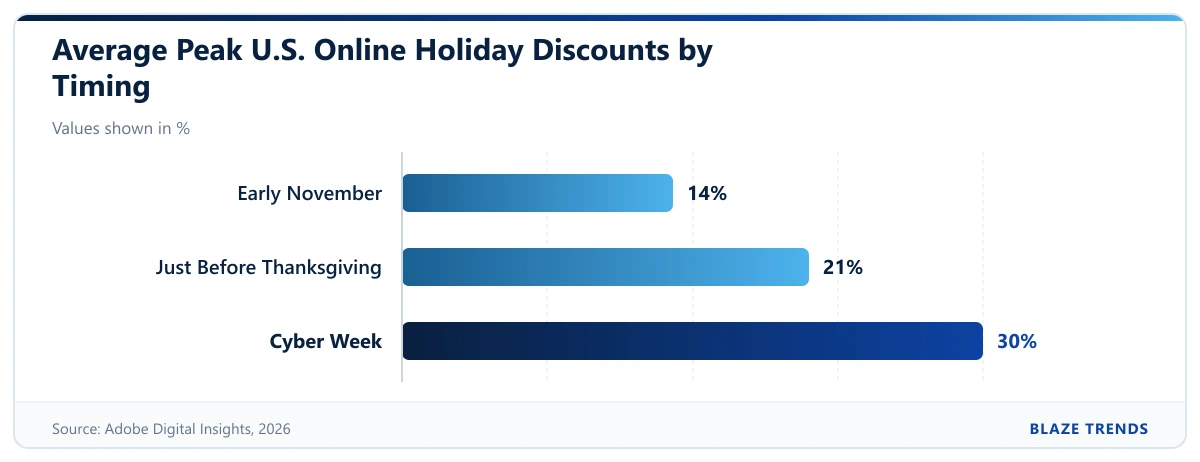
The catch is that early-month markdowns are rarely the steepest of the season. Adobe Digital Insights’ 2026 report projects average peak U.S. online discounts rising from 14% off in early November to 21% just before Thanksgiving and 30% during Cyber Week.
Put those percentages into plain dollars on a $500 appliance or gift list. Buying at a 14% early-November discount costs $430 ($70 off), waiting for a 21% pre-Thanksgiving cut lowers it to $395 ($105 off), and hitting a 30% Cyber Week discount drops the price to $350 ($150 off). That is an $80 gap between early November and Thanksgiving week, before sales tax or shipping.
Even so, buying early makes financial sense in two cases. First, popular toy lines, apparel sizes, and specific colors often sell out before peak markdowns arrive. Second, if a store guarantees holiday price adjustments or extended returns, you can lock in inventory early and recover the difference if the price falls later.
Step-by-step plan to shop early sales
- Set a hard budget before browsing any store banner. Write down a total spending cap and a per-recipient dollar limit, and include non-sticker costs like sales tax, shipping fees, batteries, cables, and gift wrap so an advertised markdown does not blow past your target.
- Record the exact product specifications and full model numbers ahead of time. Place your target items into your online cart or wish list before promotions start so you do not accidentally grab a lower-spec lookalike during a flash sale.
- Compare the identical model number across multiple retailers instead of trusting one store’s crossed-out price. Sign up for free retailer loyalty programs for member-only offers, and pair legitimate markdowns with cash-back browser extensions or rewards credit cards when you plan to pay the balance off in full.
- Check whether the seller is the retailer itself or a third-party marketplace partner before clicking buy. Marketplace listings frequently carry separate return rules and are often excluded from holiday price-adjustment programs.
- File every order confirmation and digital receipt in one dedicated email folder. If the same retailer cuts its price during the holiday window, contact customer support while the lower listing is still live—for example, through Guest Services in-store or online Chat at Target using the active Target.com or Target App listing rather than a screenshot.
Compare holiday return and price-adjustment rules
Major U.S. chains have scaled back competitor price matching in recent years, including Target’s decision to end its 12-year Amazon and Walmart competitor price-match policy after July 28, 2025. That shift makes own-store price adjustments and extended holiday return windows your main protection when you buy early.
Policy dates change every season, so confirm current-year terms on each retailer’s support page before checking out. As of 2026, here is how three major U.S. chains structure their holiday safety nets:
| Retailer (U.S., as of 2026) | Holiday purchase window | Extended return deadline | Key exclusions and price-adjustment notes |
|---|---|---|---|
| Amazon | Nov. 1 to Dec. 31, 2026 | Jan. 31, 2027 | Applies to most qualifying orders under Amazon’s 2026 Extended Holiday Returns policy. |
| Best Buy | Oct. 30 to Dec. 31, 2026 | Jan. 15, 2027 (Jan. 31 for Plus and Total members) | Best Buy’s 2026 holiday rules match its own lower holiday price, but exclude Marketplace items; activatable devices get 14 days (30 for Verizon), and AppleCare+ and holiday decor are excluded. |
| Target | Nov. 1 to Dec. 24, 2026 | Clock starts Dec. 26: Jan. 24, 2027 for most electronics; Jan. 8, 2027 for Apple, Beats, and mobile phones | Target’s Price Match Guarantee requires an identical model number verified live on Target.com or the Target App; screenshots, expired prices, and promotional Target GiftCard offers do not qualify. |
Fixes for common early Black Friday mistakes
Do not treat a steep crossed-out “was” price as proof of an annual low. A 2025 pricing investigation by UK consumer group Which? tracked products across the four-week 2024 Black Friday period and found that 83% sold for the same price or less at other times of the year, while none hit their lowest price exclusively on Black Friday itself.
Pricing disclosure laws also vary by country. In the U.S., the FTC deceptive pricing guidelines (16 CFR Part 233) state that a former price must be an actual price openly offered for a reasonably substantial period rather than a temporary inflated figure, without setting a single federal look-back day count. In the European Union, Article 6a of Directive 98/6/EC requires merchants announcing a price cut to show the lowest price applied over at least the prior 30 days, including across back-to-back promotions like Singles’ Day, Black Friday, and Cyber Monday.
Another trap hits big-ticket doorbusters. Manufacturers sometimes build “derivative models” specifically for holiday promotions or warehouse clubs—TVs, laptops, and appliances that look nearly identical to well-reviewed models in ads but omit ports, features, or internal components.
Always match the complete alphanumeric model number on the product page or box label against the standard version you researched. If a retailer’s holiday version has extra letters or swapped digits, open its specification sheet side by side with the standard model before assuming the lower price is a bargain.
Finally, match your timing to the product category. In Adobe’s finalized 2025 U.S. online data ($257.8 billion in total November and December spending), peak holiday discounts ran deepest in electronics (30.9% off listed prices), toys (29.6%), apparel (25.1%), TVs (24.3%), and computers (23.4%), while appliances hit 20.2% and furniture 18.8%. Countertop small appliances also see heavy Black Friday markdowns, sometimes 50% off or more, alongside gaming console bundles.
Other categories regularly drop further outside November. Holiday decor often hits up to 80% off right after Christmas, bedding and towels drop during January white sales, fitness gear and activewear see cuts up to 40% in early January, and winter coats and boots are typically cheaper late in the season.
Frequently asked questions
Are non-physical purchases worth checking during Black Friday?
Yes. Beyond physical goods, Black Friday and Cyber Monday regularly bring annual discounts on streaming subscriptions, local attraction passes like zoos and aquariums, gym memberships, event tickets, and early travel promotions ahead of Travel Tuesday.
Why do Apple products rarely get direct discounts from Apple itself?
According to Consumer Reports, Apple seldom discounts hardware directly on its own storefront compared with authorized third-party retailers. Shoppers looking for price cuts on Apple devices usually find better cash discounts or bundle promotions at major chains like Best Buy or Target, though return windows on Apple and Beats hardware are often shorter.
Can I use a screenshot to claim a holiday price adjustment later?
Often no. Major retailers such as Target explicitly reject screenshots and expired past prices, requiring customer service to verify the lower price live on their website or app while the promotion is active.