

Loeys-Dietz syndrome is a rare genetic connective tissue disorder that weakens the walls of the aorta and other arteries. It causes blood vessel bulges called aneurysms and sudden tears called dissections at younger ages and smaller diameters than usual. Early genetic diagnosis lets doctors monitor the full arterial tree and schedule preventive open-heart surgery before a rupture occurs.
ContentsToggle
Why Loeys-Dietz syndrome puts the aorta at risk
Connective tissue gives strength and elasticity to your blood vessels, bones, ligaments, skin, and internal organs. In Loeys-Dietz syndrome, a genetic variant disrupts the TGF-beta signaling pathway and alters how the body builds its surrounding tissue framework, according to MedlinePlus Genetics.
Dr. Bart Loeys and Dr. Hal Dietz first identified the disorder at Johns Hopkins University School of Medicine in 2005. Because weakened vessel walls stretch more easily under normal blood pressure, more than 95% of diagnosed patients develop enlargement at the aortic root, the section of the main artery leaving the heart, based on NIH GeneReviews guidance.
What makes the condition especially unpredictable is how early an artery can tear. In a case reported by Northwestern Medicine in 2026, Glen Ellyn resident Annette Wagner suffered an emergency aortic dissection at a vessel diameter of 4.2 cm, despite taking blood-pressure medications and keeping up with routine scans.
Wagner had helped uncover her family’s condition years earlier by collecting relatives’ blood and skin samples for a research study after her brother suffered an aortic dissection at age 38 in 1992. Genetic testing confirmed in 2011 that she and three of her children, Charles, Gavin, and Kirstin, carried a Loeys-Dietz gene.
After Annette’s dissection, imaging showed her three affected children had aortic measurements just 1 to 2 millimeters smaller than hers. Because family history strongly signals dissection risk, cardiac surgeon Dr. Christopher Mehta recommended preventive repair, leading to open-heart surgeries for Gavin on December 3, 2025, Kirstin on February 23, 2026 in Paris, and Charles on March 9, 2026.
What are the signs and symptoms beyond the heart?
Loeys-Dietz syndrome can affect almost any organ system, though outward signs vary widely from person to person. Some patients have clear physical clues from childhood, while others carry serious arterial disease with almost no visible traits on the outside.
Doctors look closely for four hallmark features described by the Cleveland Clinic in 2025: arterial aneurysms, twisted or spiraled blood vessels called arterial tortuosity, widely spaced eyes called orbital hypertelorism, and a split or broad uvula or cleft palate. Beyond those four traits, the condition can affect the skeleton, skin, and immune system.
- Skeletal changes such as scoliosis, a sunken or protruding chest wall, clubfoot or flat feet, overly flexible joints, early osteoarthritis, and instability in the upper neck spine
- Skin traits including translucent, velvety skin that bruises easily and forms wide scars
- Allergic and digestive conditions such as food allergies, asthma, eczema, eosinophilic gastrointestinal disease, and inflammatory bowel disease
- Rare structural risks, including congenital heart defects like a bicuspid aortic valve and potential rupture of hollow organs such as the bowel, spleen, or uterus
Because Loeys-Dietz syndrome shares tall, flexible skeletal traits and aortic aneurysms with Marfan syndrome, the two disorders are frequently confused. Telling them apart matters because Loeys-Dietz syndrome requires broader imaging and earlier surgery.
| Feature | Loeys-Dietz syndrome | Marfan syndrome |
|---|---|---|
| Genetic cause | TGF-beta pathway genes (TGFBR1, TGFBR2, SMAD2, SMAD3, TGFB2, TGFB3, IPO8) | Fibrillin-1 gene (FBN1) |
| Eye lens dislocation | Not typical | Common clinical feature |
| Arterial pattern | Aortic root plus twisted arteries and aneurysms from head to pelvis | Primarily centered on the aortic root |
| Adult preventive surgery cutoff | Often 4.5 cm, or 4.0 cm with high-risk features or before pregnancy | Typically 5.0 cm, or 4.5 cm with high-risk features |
How doctors diagnose and monitor the condition
A definitive diagnosis requires molecular genetic testing alongside a physical and cardiovascular exam. Specialists typically consider testing when someone develops aortic root enlargement or dissection without the eye lens dislocation seen in Marfan syndrome.
Classic medical classifications group the syndrome into five main types tied to specific genes: Type I (TGFBR1), Type II (TGFBR2), Type III (SMAD3), Type IV (TGFB2), and Type V (TGFB3). Updated 2024 diagnostic criteria from GeneReviews also recognize variants in SMAD2 and biallelic variants in IPO8, with Types I and II appearing most common even though exact global prevalence remains unknown.
The disorder follows an autosomal dominant inheritance pattern, meaning each child of an affected parent has a 50% chance of inheriting the gene variant. Still, having no family history does not rule it out, as MedlinePlus Genetics reports that about 75% of cases stem from a new spontaneous mutation.
Once a diagnosis is confirmed, relying on a heart ultrasound alone leaves major blind spots. Roughly 50% of studied patients have an aneurysm distant from the aortic root that an echocardiogram will miss, so care teams pair regular echocardiograms with head-to-pelvis CT angiography (CTA) or MR angiography (MRA) scans.
Doctors also advise genetic testing for at-risk blood relatives after one family member tests positive. Catching an affected parent, sibling, or child early allows monitoring to start before blood vessels stretch to dangerous sizes.
How Loeys-Dietz syndrome is treated and managed
There is no cure for Loeys-Dietz syndrome, so treatment focuses on lowering mechanical stress on fragile vessel walls and replacing enlarging segments before they tear. Cardiologists commonly prescribe blood-pressure and heart-rate medications such as beta-blockers or angiotensin receptor blockers (ARBs), though ARBs are stopped during pregnancy.
Preventive surgery cutoffs are stricter than for the general public and vary by gene, country guideline, and personal risk factors. Both the 2022 American College of Cardiology and American Heart Association guidelines in the US and the 2024 European EACTS/STS and ESC guidelines set 5.5 cm for asymptomatic sporadic thoracic aneurysms and 5.0 cm for Marfan syndrome.
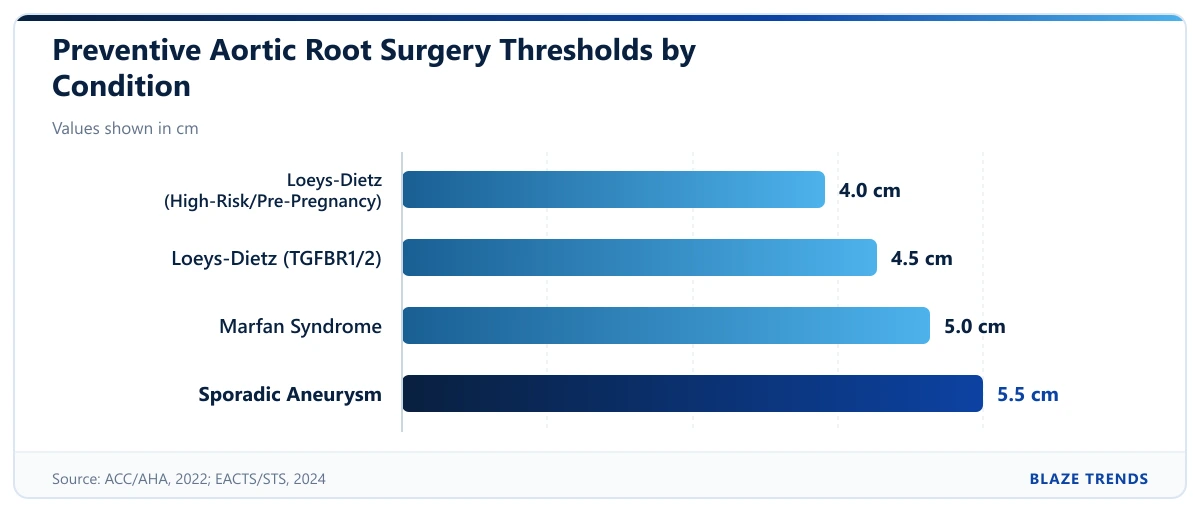
For Loeys-Dietz syndrome, European EACTS/STS 2024 criteria set a Class I surgical threshold of at least 4.5 cm for both TGFBR1 and TGFBR2 variants. US ACC/AHA 2022 recommendations also list 4.5 cm for TGFBR1 and allow earlier repair down to 4.0 cm for TGFBR1, TGFBR2, or SMAD3 when high-risk features, rapid growth, family history of dissection, or pregnancy planning apply.
Age and biological sex influence surveillance as well. In children, doctors evaluate aortic growth using body-size Z-scores rather than adult centimeter cutoffs, with Johns Hopkins Medicine noting valve thresholds of 1.8 to 2.0 cm when enlargement is progressive alongside prominent craniofacial signs. A 2026 Erasmus University Rotterdam review also found higher aortic event risk in males than females across most Loeys-Dietz genes, and highlighted mitral valve prolapse monitoring especially for SMAD3 variants.
Because the syndrome was only described in 2005 and affects a small population, clinical guidelines draw heavily from specialist registries and expert consensus rather than large randomized trials. Even with those evidence limits, specialist teams consistently advise avoiding heavy isometric weightlifting, straining maneuvers, and collision sports, while working with a cardiologist to choose safe mild-to-moderate aerobic exercise.
Warning signs and when to see a doctor
An acute aortic dissection is a medical emergency that develops suddenly. Call emergency services immediately if you or someone with a known or suspected connective tissue disorder experiences sudden, severe ripping or tearing pain in the chest or between the shoulder blades, or suddenly faints.
For non-emergency care, schedule a visit with a primary care doctor, cardiologist, or genetic counselor if a close relative has had an aortic aneurysm, an unexplained dissection at a young age, or a confirmed connective tissue disorder. Mentioning unusual skeletal traits, a split uvula, or unexplained vascular findings helps your doctor decide whether genetic testing and baseline head-to-pelvis imaging make sense for you.
Frequently asked questions
What is the life expectancy with Loeys-Dietz syndrome?
Early medical papers published shortly after the condition’s 2005 discovery reported an average life expectancy of 37 years, a figure heavily skewed toward severe, undiagnosed cases. Cleveland Clinic noted in 2025 that researchers are still studying modern life expectancy, and early diagnosis, routine imaging, and timely preventive surgery have changed care significantly.
Can people with Loeys-Dietz syndrome have a safe pregnancy?
Pregnancy increases blood volume and strain on the aorta and carries a rare risk of uterine rupture, so planning ahead with a cardiologist and high-risk obstetric team is important. Under 2022 US ACC/AHA guidelines, doctors consider preventive aortic surgery before pregnancy at 4.0 cm for TGFBR1, TGFBR2, and SMAD3 variants, or 4.5 cm for TGFB2 and TGFB3, and switch patients off ARB medications.
Why do doctors avoid standard stent grafts in Loeys-Dietz syndrome?
For descending thoracic aneurysms, 2022 ACC/AHA guidelines favor open surgical repair over catheter-based endovascular stent grafts (TEVAR) in Loeys-Dietz patients. Johns Hopkins Medicine also notes that patients with the disorder generally tolerate vascular surgery well because their arterial tissue is not unusually fragile during open repair.