
The UEFA Champions League league phase format puts 36 clubs into one table instead of eight groups. Each club plays eight different opponents, four home and four away, with 3 points per win and 1 per draw. The top eight reach the round of 16, 9th to 24th enter play-offs, and 25th to 36th are eliminated.
UEFA introduced this structure for the 2024/25 season, expanding the main draw from 32 clubs and raising pre-knockout fixtures from 96 to 144 matches across eight matchdays. Those 18-match rounds run from September through January, including one exclusive matchweek across Tuesday, Wednesday, and Thursday, before all 18 Matchday 8 games kick off simultaneously.
ContentsToggle
How does the Champions League league phase draw work?
Under UEFA’s 2026/27 draw regulations, all 36 qualifiers are sorted into four pots of nine based on their UEFA club coefficient at the start of the season. The reigning Champions League titleholder automatically takes the top seed in Pot 1.
Every club draws two opponents from each of the four pots, playing one from each pot at home and the other away. That catches many fans off guard because sitting in Pot 1 does not give a club an easier schedule than a Pot 4 side. Every team in the competition faces two Pot 1 clubs, two from Pot 2, two from Pot 3, and two from Pot 4.
During the draw ceremony, officials pull physical club balls from four bowls while automated software reviewed by an external auditor assigns the eight opponents and home-or-away venues. In principle, clubs cannot face opponents from their own national association during the league phase, and no team can play more than two clubs from any other single association unless UEFA adjusts a condition under Paragraph 16.03 to prevent a draw deadlock.
Scheduling safeguards keep fixture runs balanced across the autumn and winter calendar. In principle, no club plays more than two consecutive home or away matches, and each team plays one home game and one away game across both the first two matchdays and the final two matchdays. Starting in the 2026/27 season, UEFA also prohibited the exact same fixture between two clubs from repeating with the same home team for three consecutive seasons.
How many points do teams need to qualify?
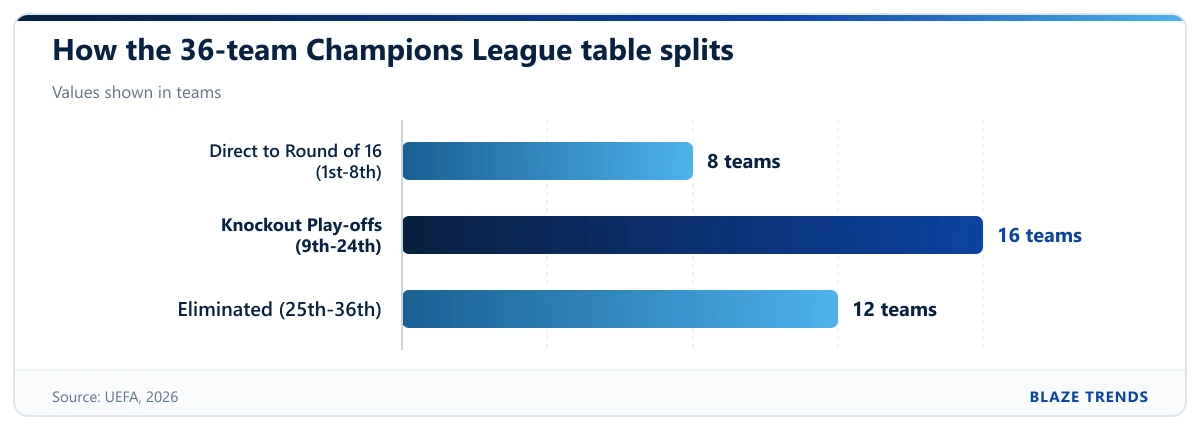
With eight matches and 3 points for a win, every club competes for up to 24 points in a single 36-team table. Your final ranking splits the field into three tiers with no safety net for the bottom third.
- 1st through 8th place qualify directly for the round of 16 as seeded clubs, skipping the knockout play-off round.
- 9th through 24th place advance to a two-legged knockout phase play-off, with 9th through 16th seeded and 17th through 24th unseeded.
- 25th through 36th place are eliminated from all UEFA club competitions for the rest of the season, with no transfer into the UEFA Europa League.
Cutting out the Europa League drop-down raised the stakes near the bottom of the standings compared with the old group stage, where third-place teams moved into Europe’s second-tier tournament. Under the league phase, slipping from 24th to 25th ends your European campaign immediately.
Results from the first two completed seasons show how slim the margins are around both cutoffs. According to NBC Sports’ 2026 figures, 8th place finished on 16 points in both 2024/25 (+7 goal difference) and 2025/26 (+6 goal difference), while 9th place missed the automatic bye on 15 points both years. The 24th-place play-off cutoff landed at 11 points (-4 goal difference) in 2024/25 and dropped to 9 points (-2 goal difference) in 2025/26, with 25th place eliminated on goal difference in both seasons.
How do league phase tiebreakers work?
Because clubs do not play identical schedules or face every rival head-to-head, head-to-head results are not used in the league phase. When two or more teams finish level on points after Matchday 8, Article 18 of UEFA’s regulations separates them in a strict 10-step order.
- Superior overall goal difference in the league phase
- Higher number of goals scored
- Higher number of away goals scored
- Higher number of wins
- Higher number of away wins
- Higher collective number of points earned by the club’s eight league-phase opponents
- Superior collective goal difference of those eight opponents
- Higher collective number of goals scored by those eight opponents
- Lower disciplinary points total (3 points for a red card or two-yellow expulsion and 1 point for a yellow card, covering players and team officials)
- Higher UEFA club coefficient
Those opponent-strength criteria in steps six through eight only apply once Matchday 8 is complete. While the league phase is still in progress, provisional standings use only criteria one through five to separate teams level on points.
How do final standings set the knockout bracket?
Every spot in the league phase carries weight into the spring because rankings feed into a fixed tennis-style knockout bracket. Under UEFA’s 2026/27 knockout regulations, clubs are paired in twos so higher finishers stay on opposite halves of the draw, meaning 1st and 2nd place cannot meet before the final.
In the knockout phase play-offs, 9th and 10th are drawn against 23rd and 24th, 11th and 12th face 21st and 22nd, 13th and 14th face 19th and 20th, and 15th and 16th meet 17th and 18th. Seeded clubs ranked 9th through 16th host the second leg.
Top-eight finishers enter the round of 16 paired as 1st/2nd, 3rd/4th, 5th/6th, and 7th/8th, each drawn against designated play-off winners and hosting the second leg. Under rules added for 2025/26 and retained in the 2026/27 edition, teams finishing 1st through 4th also guarantee hosting the quarter-final second leg, and teams finishing 1st or 2nd guarantee hosting the semi-final second leg.
UEFA does not re-seed the bracket after an upset. If a lower-ranked team eliminates a seeded club in any knockout round, the winner inherits that defeated seed’s bracket position and home second-leg advantage for subsequent rounds. All ties before the single-match final are decided on aggregate goals across two legs, with no away-goals rule.
How does the format differ across other UEFA competitions?
UEFA applied the single-table model across its other European club tournaments, though match totals and pot counts vary by competition. The men’s UEFA Europa League mirrors the Champions League in full, while the UEFA Conference League uses six pots of six and trims each club’s league phase to six matches.
Starting in 2025/26, the UEFA Women’s Champions League format shifted to an 18-team single table where clubs play six matches across three pots and the top four move straight to the quarter-finals.
| Competition | Teams | Seeding pots | Matches per club | Direct knockout spots | Play-off spots | Eliminated |
|---|---|---|---|---|---|---|
| Men’s Champions League | 36 | 4 pots of 9 | 8 (4 home, 4 away) | 1st–8th (Round of 16) | 9th–24th | 25th–36th |
| Men’s Europa League | 36 | 4 pots of 9 | 8 (4 home, 4 away) | 1st–8th (Round of 16) | 9th–24th | 25th–36th |
| Men’s Conference League | 36 | 6 pots of 6 | 6 (3 home, 3 away) | 1st–8th (Round of 16) | 9th–24th | 25th–36th |
| Women’s Champions League | 18 | 3 pots of 6 | 6 (3 home, 3 away) | 1st–4th (Quarter-finals) | 5th–12th | 13th–18th |
UEFA updates competition regulations before each new season, so check UEFA’s official documents portal ahead of each campaign for any draw or seeding changes beyond the 2026/27 rulebook.