
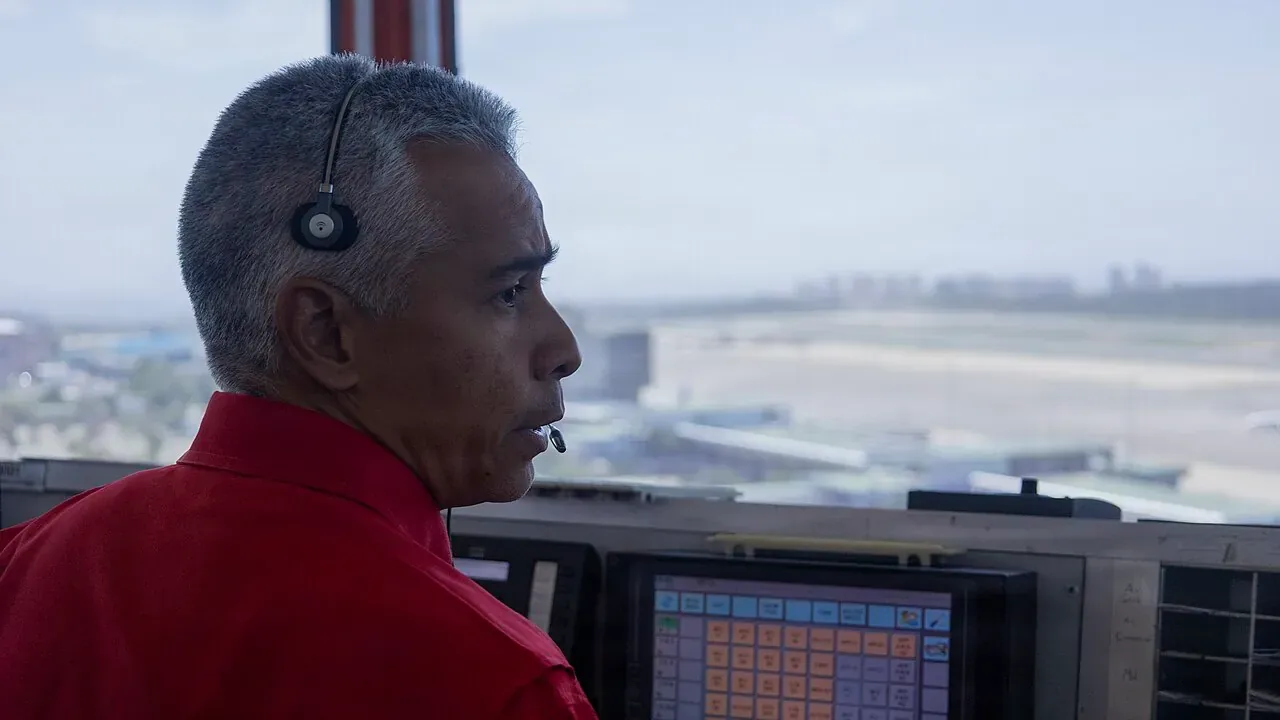
Line up and wait directs a pilot to pull onto an active runway and hold until cleared for takeoff, trimming seconds between departures. The procedure is risky because a stationary jet sits in the path of landing traffic. Effective November 24, 2026, an FAA supervisor rule requires a dedicated tower overseer during the maneuver.
ContentsToggle
How does line up and wait work at busy airports?
When you feel a jet roll onto the runway centerline and stop with its engines idling, the crew has usually received a line up and wait instruction. Under the FAA Aeronautical Information Manual, that phrase authorizes a pilot to taxi onto the runway, align for departure, and wait for further instructions, never to begin the takeoff roll.
Airports rely on the maneuver to protect runway capacity during busy departure pushes. According to FAA Order JO 7110.65, controllers use line up and wait to stage an aircraft for an imminent departure when landing or departing traffic prevents an immediate takeoff clearance.
The rulebook advises controllers not to leave an aircraft holding on the runway for more than 90 seconds without issuing additional instructions. If you have heard older aviation recordings call the same move “position and hold,” the Federal Aviation Administration retired that phrase on September 30, 2010, adopting the international line up and wait wording after National Transportation Safety Board Safety Recommendation A-00-71 sought to cut radio confusion.
Why does putting a plane on the runway cause close calls?
Keeping an aircraft on an active strip turns small human errors into immediate collision hazards. Safety depends on two separate teams getting every step right at the same time: the tower controller tracking the parked plane alongside inbound traffic, and the flight crew waiting for an explicit takeoff clearance.
On the flight deck, expectation bias is a documented trap. FAA safety reviews cited in the Aeronautical Information Manual found that a significant number of pilots read back a line up and wait instruction accurately and still started rolling for takeoff without clearance, sometimes after confusing a similar call sign on the frequency.
In the tower cab, workload and distraction create the mirror-image risk: clearing another plane to land on the same strip while a jet is still parked there. On February 1, 1991, at Los Angeles International Airport, USAir Flight 1493 landed on Runway 24L and struck SkyWest Flight 5569, which had been told to hold in takeoff position at Intersection 45. The NTSB accident report recorded 34 fatal injuries under the agency’s reporting rule then in force, with a 35th victim dying 31 days later from burns.
The communications math from that night shows how fast controller bandwidth disappears. Investigators documented more than 60 air traffic control transmissions during the final 3 minutes and 43 seconds before impact, which works out to 223 seconds, or more than one radio call every 3.7 seconds. The NTSB concluded that LAX tower management’s failure to establish redundant procedures was the probable cause.
More than three decades later, a high-profile close call exposed the same vulnerability. On August 11, 2023, at San Diego International Airport, a Southwest Airlines Boeing 737 was waiting on Runway 27 under a line up and wait instruction when a landing Cessna Citation 560X overflew the airliner by about 100 feet. In Senate testimony later that year, NTSB Chair Jennifer Homendy noted that the incident put at least 117 lives at risk, and reporting later confirmed that a jammed flight-strip printer in the tower had pulled supervisory attention away during the sequence.
Federal oversight data shows that runway conflicts remain stubborn even when the worst near-misses decline. A March 2025 DOT Inspector General audit counted 1,758 total U.S. runway incursions in fiscal year 2024, up nearly 12% from fiscal year 2021. Serious Category A and B close calls dropped 59% from 22 in fiscal year 2023 to 9 in fiscal year 2024, a reduction of 13 incidents, yet as of October 2024 the FAA had completed only 5 of the 24 recommendations issued by its independent Safety Review Team in November 2023, leaving 19 unfinished.
What does the FAA supervisor rule actually change?
Signed on October 8, 2026, and effective November 24, 2026, FAA Notice JO 7210.979 permanently amends FAA Order JO 7210.3 to remove staffing ambiguity in airport towers. Previously, agency guidance said towers “should” staff watch supervision during line up and wait; the updated policy changes that wording to “must.”
Under the rule, any tower using line up and wait is required to staff a stand-alone Operations Supervisor or Controller-in-Charge who is not combined with any other operational desk. The notice also bars towers from combining the local runway controller with non-local positions such as ground control, clearance delivery, flight data, cab coordinator, or watch supervision during the maneuver, though combining local control with a local assist or local monitor role remains allowed.
Look at the staffing math on a slow or understaffed shift. Running line up and wait now requires at least two uncombined people dedicated strictly to the runway and its oversight before a tower even covers ground control or clearance delivery. When staffing is too thin to keep a supervisor completely separate, controllers cannot issue line up and wait and must hold departing planes behind the runway boundary line until full takeoff clearance is available.
The FAA stated that the November 2026 change will not disrupt airport operations. Controllers have cautioned pilots that facilities unable to staff a dedicated supervisor could see slightly slower departure queues during busy pushes, since planes spend extra seconds crossing the hold-short line after takeoff clearance is finally granted. Because line up and wait rules also vary sharply by weather, time of day, and country, pilots flying internationally deal with different boundaries as well.
| Rule area | U.S. rule (FAA, as of Nov. 2026) | International or operational variation |
|---|---|---|
| Tower watch supervision | Stand-alone OS or CIC required, never combined with another desk | Without dedicated oversight, U.S. towers must hold aircraft short of the runway |
| Conditional line-up phrases | Prohibited under FAA Order JO 7110.65 | Permitted under ICAO Doc 4444 abroad when the condition is explicitly stated |
| Landing traffic on same runway | Barred without full-core-alert safety logic, or whenever ceiling is below 800 feet or visibility is under 2 miles | Allowed at towers with full-core-alert safety logic above those weather minimums |
| Intersection departures | Banned anytime the intersection is not visible from the tower | Between sunset and sunrise in the U.S., requires Service Area Director approval, a departure-only runway, and one lined-up aircraft max |
| Time waiting on runway | Guidance advises no more than 90 seconds without further instructions | Controllers must issue updates or cancel the hold if departure is delayed |
Why runway alert technology still cannot replace human eyes
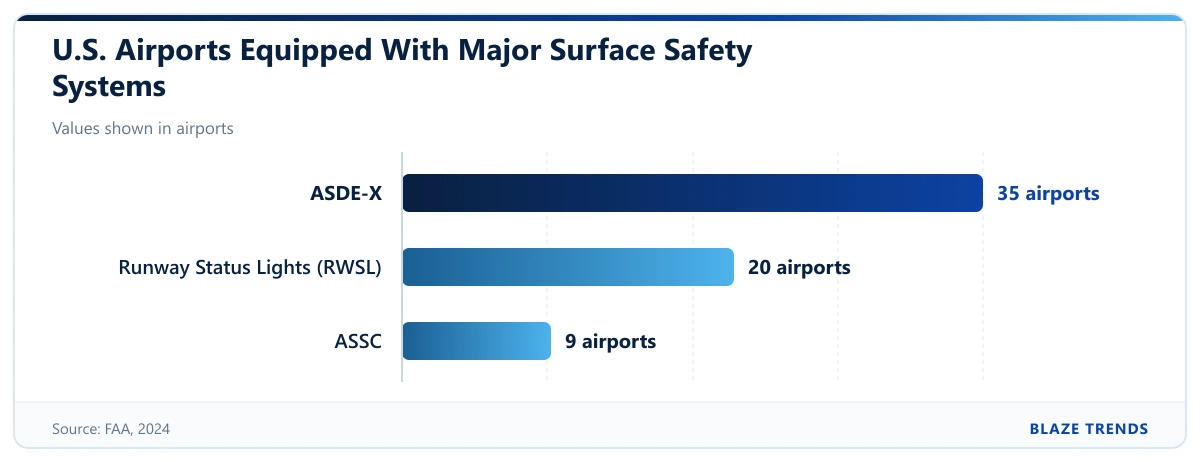
Automated ground surveillance and lighting systems can catch an occupied-runway conflict in seconds, yet those tools cover only a small share of U.S. towered airports. According to 2024 FAA Human Factors committee minutes and 2026 FAA deployment data, Airport Surface Detection Equipment Model X (ASDE-X) operates at 35 U.S. airports, Airport Surface Surveillance Capability (ASSC) operates at 9 airports, and automated Runway Status Lights are commissioned at 20 major airports.
At those 20 equipped hubs, Runway Status Lights embed red LEDs directly into the pavement as Runway Entrance Lights and Takeoff Hold Lights. When radar tracks high-speed traffic approaching or departing, the red lights switch on automatically to tell pilots it is unsafe to cross or roll, though the FAA stresses that dark lights never replace a verbal takeoff clearance from the tower.
Newer backup tools are rolling out across additional facilities. By December 2024, U.S. Department of Transportation figures showed Approach Runway Verification running in 73 towers, the Surface Awareness Initiative live at 9 airports, and Runway Incursion Devices under evaluation at 5 sites. Until automated ground alerts reach the rest of the national network, an uncombined supervisor watching the runway from the tower window remains the primary backstop.
Frequently asked questions
Does line up and wait mean your flight is about to take off?
Usually yes, because FAA rules reserve the instruction for an imminent departure and advise towers not to leave a jet waiting on the runway for more than 90 seconds without further instructions. Even so, the pilots cannot advance the throttles for takeoff until the tower issues a separate verbal takeoff clearance.
Why did U.S. towers stop saying position and hold?
The FAA replaced “position and hold” with “line up and wait” on September 30, 2010, acting on NTSB Safety Recommendation A-00-71. The change aligned U.S. radio phraseology with the International Civil Aviation Organization standard to cut misunderstandings between domestic and foreign crews.
Could the FAA supervisor rule ban line up and wait at smaller airports?
No, Notice JO 7210.979 allows any tower to use line up and wait whenever it staffs a stand-alone Operations Supervisor or Controller-in-Charge and keeps local control uncombined with non-local desks. At a short-staffed facility that cannot separate those positions on a given shift, planes simply hold short on the taxiway until cleared directly for takeoff.