
Five-dimensional Black Saturn spacetime is an exact mathematical solution to Albert Einstein’s vacuum equations of general relativity in a universe with four spatial dimensions and one time dimension. It describes a central spherical black hole encircled by a spinning, doughnut-shaped black ring. Each object keeps its own event horizon, while centrifugal force stops the ring from collapsing.
ContentsToggle
Why does five-dimensional spacetime allow a Black Saturn?
In our familiar four-dimensional spacetime, which has three spatial dimensions and one time dimension, black holes follow strict geometric rules. Uniqueness theorems limit stationary, asymptotically flat vacuum black holes to the two-parameter Kerr family, and Hawking’s topology theorem requires their event horizons to be spherical, as detailed in a 2025 paper in Classical and Quantum Gravity.
Add a fourth spatial dimension, and those restrictions fall apart. In a 2008 review in Living Reviews in Relativity, physicists Roberto Emparan and Harvey Reall showed that higher-dimensional vacuum gravity breaks both black hole uniqueness and spherical-only horizons. Their earlier 2002 rotating black ring study in Physical Review Letters proved that five-dimensional spacetime allows a doughnut-shaped black ring with S1 x S2 horizon topology that can hold arbitrarily large angular momentum for a fixed mass.
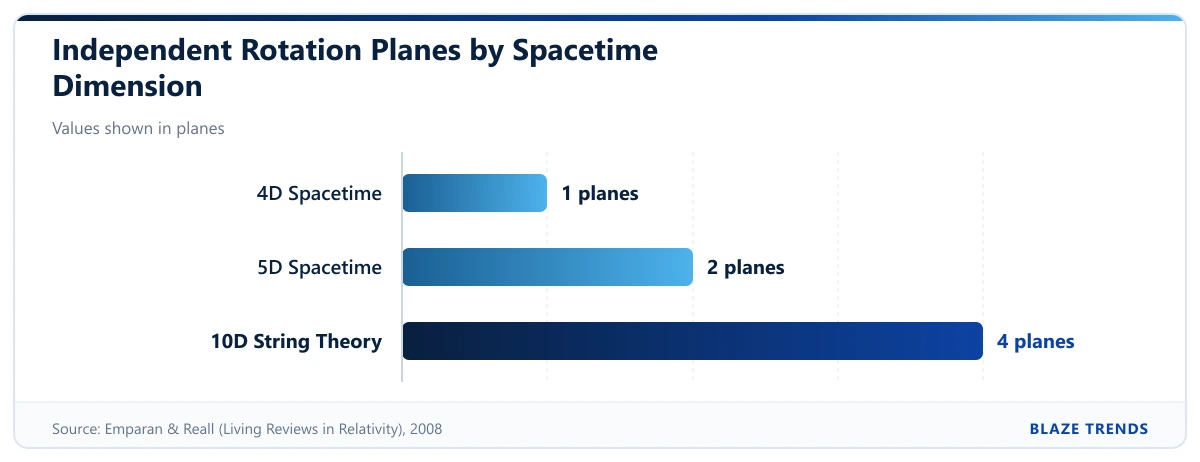
Extra spatial dimensions also change how objects spin. Every independent plane of rotation requires two perpendicular spatial directions of its own, so the maximum number of independent spin planes equals half the spatial dimensions rounded down. Four-dimensional spacetime fits just one spin plane, five-dimensional spacetime fits two, and ten-dimensional string theory spacetime fits four.
Building on the black ring, MIT physicist Henriette Elvang and University of Barcelona physicist Pau Figueras derived the original Black Saturn in their 2007 Black Saturn paper in the Journal of High Energy Physics. Using the inverse scattering method, they placed a central spherical S3 black hole inside a concentric rotating black ring. Spin gives the ring outward centrifugal force to balance its own gravity, and the math works whether the two black holes spin in the same direction or opposite directions.
What did Jay Armas’s 2026 doubly spinning solution add?
Elvang and Figueras’s 2007 Black Saturn had one major limit: both black holes could rotate in only a single plane. In a November 2026 arXiv preprint, University of Amsterdam theoretical physicist Jay Armas removed that restriction. Using an inverse-scattering construction, Armas derived a six-parameter family of stationary, asymptotically flat solutions in five-dimensional vacuum Einstein gravity where both the central sphere and the surrounding black ring spin independently in both rotation planes.
Separating established results from newer work matters here. The 2002 black ring, 2006 doubly rotating ring, and 2007 Black Saturn models all went through journal peer review, whereas Armas posted his 30-page doubly spinning solution on November 16, 2026, as an arXiv preprint that had not undergone peer review as of November 2026.
Even as a preprint, the solution passes strict mathematical checks by recovering three established five-dimensional black holes as special cases. Strip away the ring, and the equations reduce to the doubly spinning spherical black hole derived by R. C. Myers and M. J. Perry in 1986. Strip away the central black hole, and you get the doubly rotating black ring constructed by A. A. Pomeransky and R. A. Sen’kov in 2006. Turn off the second spin plane, and you return to the 2007 singly spinning Black Saturn. Armas’s exact results also agree with earlier blackfold approximation predictions for the system’s phase diagram.
| Black Hole Solution | Spacetime Dimensions | Horizon Shapes | Independent Spin Planes | Origin |
|---|---|---|---|---|
| Kerr black hole | 4D (3 space, 1 time) | Single sphere | 1 | Established 4D vacuum uniqueness family |
| Singly spinning Black Saturn | 5D (4 space, 1 time) | Central S3 sphere and S1 x S2 ring | 1 | Elvang and Figueras, JHEP (2007) |
| Doubly spinning Black Saturn | 5D (4 space, 1 time) | Central S3 sphere and S1 x S2 ring | 2 | Jay Armas, arXiv preprint (November 2026) |
How frame dragging and double extremality behave in a Black Saturn
A spinning black hole twists the spacetime around it, an effect called frame dragging. Inside a Black Saturn, the rotating black ring drags spacetime hard enough to make the central black hole’s event horizon spin even in a plane where that central object has zero intrinsic angular momentum. You can also tune the parameters the other way around, forcing the central horizon to have zero local angular velocity even though the black hole still carries intrinsic spin.
Two-plane rotation also opens the door to double extremality. An extremal black hole spins at the maximum rate allowed for its mass, which drops its Hawking temperature to absolute zero and shuts off Hawking radiation. In five dimensions, keeping a regular event horizon at that limit requires rotation in both planes.
Armas’s 2026 family contains a finite doubly extremal boundary, making it the first known exact five-dimensional vacuum solution where two separate black holes hit extremality at the same time while keeping distinct event horizons. Non-extremal Black Saturns can settle into full thermodynamic equilibrium, where both horizons share the same temperature and angular velocities. Armas proved that a doubly extremal Black Saturn cannot reach full equilibrium: even though both horizons sit at absolute zero, matching their angular velocities in both planes breaks the Black Saturn geometry.
Why physicists study five-dimensional black holes
No telescope has ever detected a Black Saturn, and as of November 2026 there is no experimental evidence that our universe contains an extra large spatial dimension. Five-dimensional Black Saturn spacetime is an exact mathematical solution inside general relativity rather than a physical object spotted in space.
Physicists still put serious work into these solutions because higher-dimensional black holes appear across string theory and quantum gravity research. Testing Einstein’s equations in five dimensions acts as a theoretical test bench, showing which black hole rules are universal laws of gravity and which ones happen only because our observable universe has three spatial dimensions. As Armas wrote in his November 2026 paper, “The space of black holes in higher-dimensional vacuum gravity is richer than its four-dimensional counterpart.”
Frequently asked questions
Does the black ring sit inside the central black hole’s event horizon?
No. The black ring surrounds the spherical black hole across empty space, and both objects maintain completely separate, disconnected event horizons. Unlike Saturn’s rings of ice and dust, Black Saturn’s ring is a vacuum black hole itself.
Why can one total mass produce multiple Black Saturn shapes?
Four-dimensional uniqueness theorems force a vacuum black hole’s shape to depend strictly on its mass and spin. Five dimensions lift that restriction, so the same total mass and angular momentum can divide differently between the central sphere and the ring across a continuous family of valid solutions, as Elvang and Figueras demonstrated in 2007.
Are all five-dimensional Black Saturn models pure vacuum solutions?
The 2007 Elvang-Figueras model and Armas’s 2026 doubly spinning generalization solve pure vacuum Einstein gravity with no matter or electromagnetic charge. Physicists also study separate charged and dipole-charged black ring models in five-dimensional supergravity and Kaluza-Klein theory, which follow different balance and supersymmetry conditions.