
ARTEX is an open-source, Go-based penetration testing framework that uses external large language models to automate cyberattacks at machine speed. In a November 13, 2026 warning, the FBI reported that threat actors deploying the ARTEX AI framework can move from initial targeting to privileged system access in under three hours, outpacing manual incident response.
ContentsToggle
How did an open-source pentesting tool end up in FBI alerts?
A China-based developer originally released ARTEX on GitHub in July 2026 as an authorized security testing platform under the AGPL open-source license, according to 1Password and the Cloud Security Alliance. Under the hood, the tool pairs a Go backend with a Next.js web console and a PostgreSQL database so operators can manage multiple engagements from one interface.
That legitimate design gave defenders and red teams a serious engineering tool, and malicious actors quickly adopted it for the same reasons. By August 2026, roughly a month after release, both nation-state operators and cybercriminals were running ARTEX against live corporate and government targets worldwide.
Following public reports linking ARTEX to breaches at South Korean financial institutions, the original developer removed the GitHub repository on October 8, 2026. Because the project shipped under an open-source license and had already been widely mirrored, the takedown stopped upstream updates while leaving the software in wide circulation. Community forks and localized rebrands, including ScopeWeaver, ARTEX MX, and AntiFox (which reached version 2.0 while other forks passed version 0.3.29), remain active alongside archived copies and a commercial edition called ARTEX PRO.
How does the ARTEX AI framework run an attack?
Traditional offensive tools force an operator to run scanners, parse output, write exploits, and chain credentials by hand. With the ARTEX AI framework, an operator enters a high-level tactical objective in plain natural language, and specialized AI sub-agents translate that goal into live commands with minimal human intervention, according to the FBI FLASH advisory (FLASH-20261113-001).
Those cooperating agents handle reconnaissance, vulnerability scanning, credential testing, privilege escalation, lateral movement, and data exfiltration across multiple targets at the same time, around the clock. Because the agents automate the technical work between steps, actors with limited technical skill can run complex multi-target intrusions that once required an experienced team.
ARTEX ships without a built-in AI model. Instead, it connects to external large language model APIs, including DeepSeek, OpenAI GPT, Anthropic Claude, Grok, Zhipu GLM, and Kimi. FBI analysis of attacker-controlled deployments found Chinese models, led by the DeepSeek Flash family, were the most common choice due to their combination of low API cost and strong coding capability.
Automated speed creates a strange paradox for defenders. ARTEX generates loud forensic trails, including compressed bursts of traffic, rapid waves of failed attempts, duplicate requests, and sub-agents overwriting one another’s work. Those spikes routinely trigger security alerts, yet the intrusion often reaches privileged access before human responders can triage the queue and isolate affected accounts.
Which major cyberattacks have used ARTEX?
The highest-profile ARTEX intrusion disclosed in 2026 targeted ConnectWise Cloud Backup, formerly known as SkyKick. In an October 21, 2026 report, Microsoft Threat Intelligence attributed the supply-chain compromise to China-nexus actor Storm-0940, which abused stolen multi-tenant OAuth credentials to run ARTEX agents nonstop across customer environments.
According to Cybersecurity Dive and FBI reporting, Storm-0940 attempted sign-ins across more than 2,250 downstream Microsoft 365 tenants at up to 2,900 attempts per minute before ConnectWise suspended access after detecting suspicious activity on October 14, 2026. In multiple environments, ARTEX agents enumerated cloud resources, read secrets from Azure Key Vault, and reached privileged cloud access in under three hours. Microsoft cautioned that an attempted or successful sign-in does not automatically confirm that data was accessed or stolen.
Adoption spread rapidly beyond one group across finance, government, technology, defense, semiconductors, energy, health care, manufacturing, and telecommunications:
- Financially motivated ARTEX breaches against South Korean financial institutions exposed personal data belonging to roughly 67,000 people, according to the FBI’s November 2026 advisory.
- Microsoft documented a Cambodia-based financial cluster, Storm-3358, using ARTEX agents with netcat and curl to download WISP, vshell, and AdaptixC2 remote access trojans onto compromised hosts in November 2026.
- The Cloud Security Alliance noted that a campaign tracked as VAPOR PANDA targeted more than 200 organizations across 14 countries and probed exposed AI infrastructure such as LiteLLM, Dify, Langflow, RAGFlow, Open WebUI, and Ollama.
- Between October 3 and November 5, 2026, Amazon Threat Intelligence used MadPot decoy sensors posing as LLM inference APIs to capture live ARTEX requests carrying the agents’ own campaign operating memory.
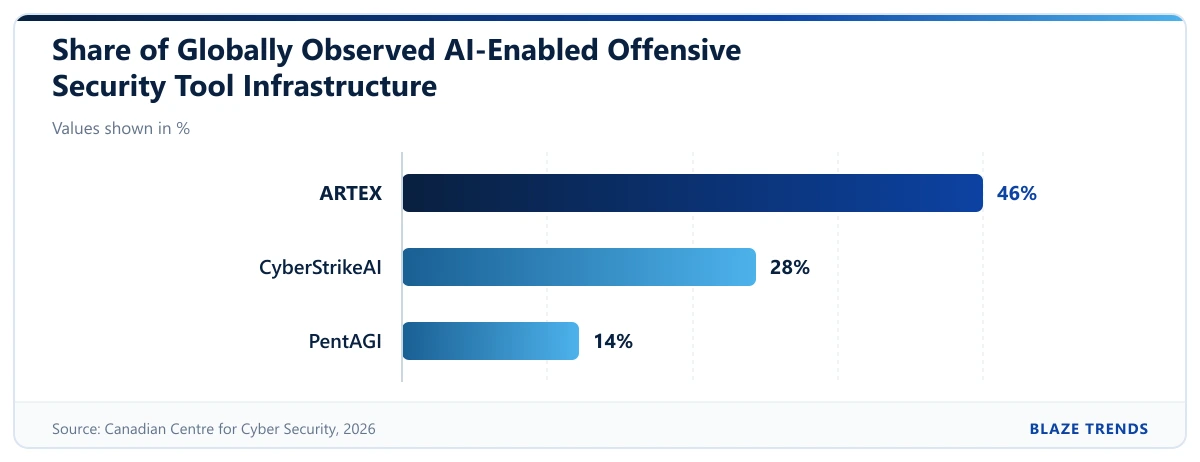
That surge put ARTEX well ahead of rival agentic offensive tools. In a November 21, 2026 update, the Canadian Centre for Cyber Security reported that roughly 46% of globally observed AI-enabled offensive security tool infrastructure was tied to ARTEX, compared with 28% for CyberStrikeAI and 14% for PentAGI.
Public scanning data reflects the same rapid spread. Early November 2026 research cited by Industrial Cyber counted more than 1,600 publicly exposed ARTEX consoles, while a later November 2026 Check Point report cited by The Hacker News identified more than 1,800 exposed instances, with neither count capturing private deployments sitting behind firewalls.
How do security teams defend against ARTEX?
Government guidance varies slightly by jurisdiction, though the technical priorities match. In the United States, the FBI’s November 13, 2026 advisory asks affected organizations to report intrusions to IC3 (ic3.gov) or a local FBI field office, while the New York State Department of Financial Services issued a November 21, 2026 cybersecurity alert for DFS-regulated financial institutions. In Canada, the Canadian Centre for Cyber Security published technical advisories on October 26 and November 21, 2026.
Across those advisories, defenders focus on cutting the attack surface and starving automated agents of credentials and error feedback before an intrusion begins:
- Inventory every internet-facing system, including partner and supplier portals, mobile backends, legacy services, and third-party cloud integrations where forgotten vulnerabilities often sit.
- Sweep source code, configuration files, CI/CD pipelines, and front-end bundles for embedded secrets, and rotate signing and authentication keys.
- Require phishing-resistant passkeys or FIDO2 multi-factor authentication, replace long-lived secrets with short-lived credentials, and lock multi-tenant OAuth application permissions down to least privilege.
- Suppress verbose error messages and stack traces on production servers, because detailed errors let AI agents rewrite and fix failed payloads within seconds, and enforce strict API rate limits and recipient caps.
Static file-hash blocking falls apart against ARTEX because open-source forks constantly change binary signatures and external LLM endpoints. Security teams get much stronger coverage by alerting on machine-speed behavior inside cloud and network logs.
| Environment | Logs and services to monitor | ARTEX behavioral indicators |
|---|---|---|
| Microsoft 365 and Azure | Microsoft Graph, Microsoft Entra audit logs, Azure Key Vault, Azure ARM | Compressed sign-in bursts, unexpected credential additions, Key Vault secret reads, and ARM deployment validation dry-runs |
| Amazon Web Services | AWS IAM logs and cloud storage telemetry | Rapid IAM permission enumeration, privilege changes, and sub-second test blob writes and deletes |
| Public portals and APIs | Web application firewall, API gateway, and outbound network logs | Sequential portal lookups, high-volume iterative failed payload retries, duplicate agent requests, and unexpected outbound traffic to external LLM APIs |
Frequently asked questions
Does ARTEX invent new zero-day exploits?
No. According to an October 26, 2026 Canadian Centre for Cyber Security bulletin, ARTEX chains familiar attack techniques together at industrial scale rather than discovering novel zero-day exploits. Its main advantage is testing exposed portals, stale credentials, broad OAuth grants, and unpatched apps far faster than a human operator.
Are ARTEX cyberattacks fully autonomous without human operators?
Not yet. The Canadian Centre for Cyber Security noted in November 2026 that human operators still choose targets, define tactical objectives, and oversee campaigns, while ARTEX sub-agents automate the rapid scanning, credential testing, and lateral movement steps in between.
Can ARTEX hack everyday consumer devices directly?
Observed ARTEX campaigns target organizations, including banks, cloud software vendors, corporate portals, and government agencies, rather than personal home computers or phones. Everyday users still face indirect exposure when a breached organization leaks customer records, as happened to roughly 67,000 individuals in the 2026 South Korean financial breaches.