
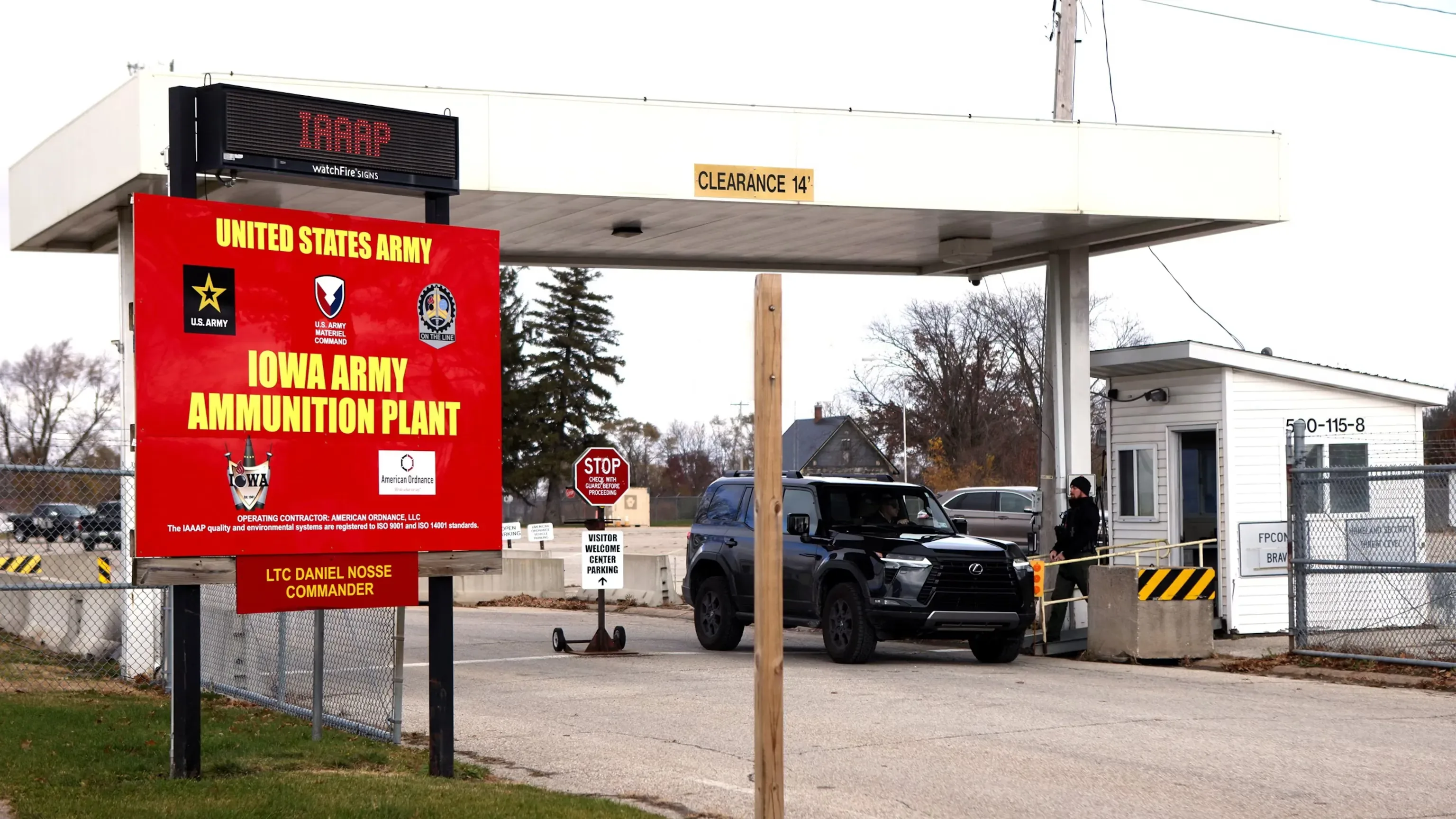
The U.S. Army plans to blow up roughly 68 barrels of unstable lead azide at the Iowa Army Ammunition Plant in Middletown on Wednesday morning, Nov. 25, the day before Thanksgiving. The controlled blast, set for approximately 9 a.m. CST (10 a.m. EST), follows a federal appeals court ruling and a Tuesday disaster emergency declaration covering three southeastern Iowa counties.
Lead azide is a volatile initiating explosive used to trigger munitions, and the barrels in Middletown hold the entire U.S. stockpile after their transfer from an Army facility in Texas in 2009, according to the Associated Press. A Tuesday U.S. Army announcement put the total at more than 9,700 pounds net explosive weight across earth-covered storage magazines, though news outlets including the Associated Press and The Guardian have described it as five tons and PBS NewsHour earlier cited 9,500 pounds.
Military officials said the stockpile has degraded rapidly over the past eight months. Col. Aaron Teller of the 71st Explosive Ordnance Disposal Group said crystallized lead azide has built up on the exterior of the barrels and lids, preventing crews from safely moving the drums or opening them for chemical neutralization. Army and Justice Department lawyers also argued in court that below-freezing temperatures raise the risk of an uncontrolled chain-reaction explosion.
Maj. Gen. Eric Shirley, the commander of the operation, said at a Tuesday press conference in Middletown, “Inaction is no longer an option.” He added, “It would be irresponsible for us to not take the determined, consensus-based course of action moving forward.” To capture lead dust, crews placed blast barriers around the bunkers and plan to apply ballistic gels, foams, and thousands of gallons of water.
Acting Army Secretary Adam Telle sought to calm local concern on Tuesday, saying, “We don’t believe that the public should be in a panic.” Telle told reporters, “Our goal is to keep as much of it as we can here on our Iowa Army Ammunition plant to prevent it from traveling.” He said officials had evaluated other options before deciding on the blast, adding, “In every instance, the answer is controlled detonation is safest.”
Evacuations and health warnings for southeastern Iowa
Updated Army plume maps released Tuesday project the dust cloud moving southwest across southeastern Iowa into northern Missouri, away from Burlington, a city of just under 25,000 people. National Weather Service forecasts called for southwest winds of 5 to 10 mph on Wednesday morning. Earlier projections had pointed north, a shift that fueled resident complaints about conflicting information.
Iowa Gov. Kim Reynolds issued a disaster emergency proclamation on Tuesday for Des Moines, Lee, and Van Buren counties and deployed up to 100 Iowa National Guard soldiers to support public safety and outreach to roughly 150 households. Federal officials said temporary lodging through Nov. 27, transportation, and meals are available through FEMA at 1-800-621-3362, and evacuated residents will be notified by phone when they may return home.
| Area | Official guidance | Support and outlook |
|---|---|---|
| Within 5 miles southwest of plant | Prepare for temporary evacuation after Tuesday cellphone alert | National Guard outreach to roughly 150 households; federal lodging through Nov. 27 |
| Up to 20 miles from plant | Stay indoors with windows and exterior doors closed; set HVAC to recirculation; avoid unnecessary travel | Clean indoor and outdoor surfaces children may touch; indoor guidance ranges from 24 to 48 hours |
| Northern Missouri and Illinois | Monitor updated plume deposition maps ahead of the blast | Projected plume extends into northern Missouri; Illinois is not expected to be affected |
Public health guidance on how long to remain inside varies slightly between state agencies. Illinois EPA guidance recommends keeping windows and exterior doors closed for 24 hours after the detonation unless updated advisories state otherwise, while Iowa health officials previously advised staying indoors for 24 to 48 hours, according to PBS NewsHour.
Court ruling and political disputes before the blast
Inspectors first identified the degraded stockpile during a March safety review, and the plant held an open house in Middletown on Oct. 15 before the U.S. Environmental Protection Agency granted an emergency permit on Nov. 13, according to PBS NewsHour. The Army originally scheduled two detonations for Nov. 20, though its Tuesday advisory refers to a controlled, in-place detonation after three schedule changes prompted by public concern and a lawsuit.
Environmental groups represented by Earthjustice sued to challenge the validity of the EPA permit rather than emergency military action, according to managing attorney Rachel Rintelmann. On Monday, Nov. 23, a three-judge panel of the U.S. Court of Appeals for the Eighth Circuit lifted a halt on the blast, finding that the EPA permit “adequately incorporated safeguards to minimize the dispersal of lead dust into the environment and mitigate the risks associated with potential exposure,” according to Task & Purpose.
Before the court ruled, President Donald Trump paused the operation on Monday in a social media post and said he wanted Democratic Gov.-elect Rob Sand to approve the detonation. Sand, who takes office in January, responded that the decision belongs fully to the Trump administration and that earlier actions had left no good options.
Reynolds announced her support for the detonation on Tuesday after speaking with Defense Secretary Pete Hegseth and Telle, saying, “I take the Army’s warning seriously that the choice is between a planned detonation or an uncontrolled explosion.” Her office noted in a separate release, “The U.S. Army is solely responsible for planning and conducting the detonation.”
Lawmakers still faulted federal agencies over how information reached residents before the holiday. Democratic U.S. Sen.-elect Josh Turek pledged to press for answers when he joins the Senate in January, saying in a statement, “There is no excuse for such a failure of transparency and communication, especially when the health and safety of the public is involved.” Iowa’s sitting U.S. senators, Joni Ernst and Chuck Grassley, also urged the Army to give residents clearer details.
Monitoring and next steps on Wednesday
The Army said it will post updated plume deposition maps six hours before the detonation and hourly after that, with the final blast time dependent on Wednesday morning weather checks. The EPA has deployed personnel to Middletown to test air, water, and soil before, during, and after the explosion and plans to post results on a public data dashboard. Following the blast, officials plan to release an updated estimate of the affected area and contact evacuated residents by phone once it is safe to return.