
A PLF movie screen, short for Premium Large Format, is any auditorium upgraded with a bigger screen, stronger projection, and louder sound for a surcharge. IMAX is the largest licensed brand inside that category, adding custom room geometry and expanded aspect ratios. House PLFs like Cinemark XD and Regal RPX play the standard movie file on upgraded hardware.
ContentsToggle
How a PLF movie screen differs from IMAX
Movie ticket apps often list IMAX right next to a chain’s own premium label, which makes them look like competing categories. In reality, PLF is the umbrella term for upgraded large-format auditoriums, and IMAX is one third-party licensed brand inside it. Dolby Laboratories even classifies Dolby Cinema rooms as PLF auditoriums in its fiscal 2025 Form 10-K.
Theater chains split their premium rooms into two business models: licensed formats and in-house brands. Licensed formats include IMAX, Dolby Cinema, ScreenX, and 4DX. In-house PLFs are owned directly by the exhibitor, including Cinemark XD, Regal RPX, PRIME at AMC, Harkins CINÉ XL in the United States, Cineplex UltraAVX in Canada, and Vue’s Barco-powered Epic rooms in Europe.
Chains build house PLFs for control and margin. Licensing IMAX involves hardware or lease agreements, revenue sharing, and scheduling commitments covered by premium large format theater contracts. With an in-house auditorium, the theater keeps all of the extra ticket surcharge after standard studio film rental and decides which movie plays in its biggest room every Friday.
That cost difference reaches your wallet too. AMC noted in its 2025 Form 10-K that its in-house PLF carries a lower surcharge than licensed IMAX or Dolby Cinema rooms, letting chains offer an upgraded screen in more price-sensitive markets.
What makes IMAX and Dolby Cinema technically different?
Most house PLFs project the exact same Digital Cinema Package (DCP) sent to standard auditoriums. That standard file is usually framed in 2.39:1 widescreen or 1.85:1 flat, meaning a house PLF gives you a larger image and bigger speakers without changing the frame itself. For example, Cinemark XD specifications pair wall-to-wall screens with 4K projection and 50,000 watts of multi-layered surround sound across nearly 300 auditoriums in the United States and Latin America.
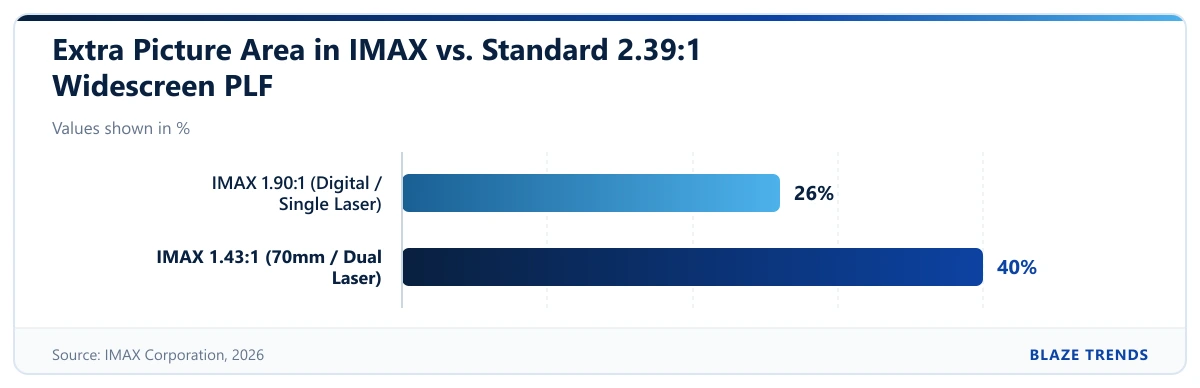
IMAX changes what is on screen. Through the IMAX Filmed For IMAX program and its Digital Media Remastering (DMR) pipeline, IMAX works with directors from camera choice through post-production to open up the vertical frame. Movies formatted for IMAX expand to a 1.90:1 aspect ratio on digital and single-laser screens, revealing up to 26% more picture than standard 2.39:1 scope.
Select IMAX 70mm film and Dual-Laser locations go even taller to a 1.43:1 aspect ratio, delivering up to 40% more image. Only a small roster of flagship theaters supports that full 1.43:1 height, such as AMC Lincoln Square 13 in New York, AMC Metreon 16 in San Francisco, and Scotiabank Toronto. IMAX has also developed next-generation 70mm film cameras and slated at least 12 Filmed For IMAX titles for 2027.
The Dolby Cinema format takes a different technical route, focusing on contrast and spatial audio rather than extra frame height. Films get a separate Dolby Vision high dynamic range (HDR) master projected through Dual 4K lasers for deeper blacks and sharper highlights. In the United States, AMC pairs that projection with power recliners built with seat transducers that rumble during bass-heavy scenes.
Audio engineering splits along similar lines. IMAX mixes custom soundtracks tuned for raw bass impact, high dynamic headroom, and clear dialogue at loud volumes. According to Dolby Atmos cinema specifications, Dolby’s object-based system supports up to 128 simultaneous lossless audio streams routed across up to 64 discrete speaker feeds, including overhead speakers, inside a single DCP that adapts to the room.
| Format | Ownership | Projection and Picture | Audio and Seating |
|---|---|---|---|
| IMAX | Licensed third-party | 1.90:1 (up to 26% more image) or 1.43:1 (up to 40% more) via laser, xenon, or 70mm film | Custom IMAX surround mix; seating varies by theater chain |
| Dolby Cinema | Licensed third-party | Dual 4K laser Dolby Vision HDR in standard aspect ratios | Dolby Atmos with overhead speakers; power recliners at AMC |
| House PLFs (XD, RPX, PRIME, UltraAVX) | Exhibitor-owned | 4K digital or laser on wall-to-wall screens; standard theater DCP | Upgraded multi-channel surround or Atmos; usually recliners |
| 4DX and ScreenX | Licensed third-party | Standard screen (4DX) or 270-degree side-wall projection on select scenes (ScreenX) | Motion seats with 21+ physical effects like wind, water, snow, and scent (4DX) |
Why screen size and projection vary inside the same format
No industry standard sets a minimum screen width for a PLF auditorium. AMC puts its entry-level XL tier at 40 feet wide with 4K laser projection and reserves its PLF label for larger rooms above that, while Harkins runs an 83-foot curved screen in its CINÉ XL auditorium in Goodyear, Arizona. Ceiling height inside a given mall or multiplex often decides how big a screen fits, which means a newly built house PLF can physically outweigh an older retrofitted IMAX room.
Hardware gaps exist inside IMAX itself. According to a 2026 IMAX SEC filing, the company had 1,864 systems worldwide at the end of 2025, rising to 1,876 by June 30, 2026. Yet IMAX’s annual disclosures show that 1,089 of those systems at the end of 2025 still used older xenon digital lamps rather than the 757 newer laser installations.
You can spot that projection gap immediately on screen. IMAX with Laser uses 4K laser projection rated at 22 foot-lamberts of brightness in 2D and 14 foot-lamberts in 3D. Legacy Digital Xenon IMAX runs dual 2K projectors with 5.1 sound and drops to roughly 4.5 foot-lamberts in 3D, producing a noticeably dimmer picture.
Studios have also started auditing house PLFs so moviegoers know which rooms meet modern brightness and sound targets. In 2026, Disney introduced Infinity Vision, a quality certification badge awarded to existing chain-owned PLFs that pass its technical benchmarks. Unlike IMAX or Dolby Cinema, a certification badge does not install proprietary projectors or expand the movie’s aspect ratio.
Which premium format is worth your ticket?
Premium formats pull far more money per screen than standard rooms because moviegoers treat big releases as events. IMAX captured a record 5.2% of the United States box office in 2025 from roughly 1% of domestic screens, and 3.8% of the global box office ($1.28 billion) from under 1% of screens worldwide. Cinemark reported in August 2026 that its Cinemark XD screens generated 12% of the chain’s global box office in 2024 from just 5% of its screens.
Industry estimates for total PLF market share vary depending on which premium tiers and territories get counted. Comscore tracked more than 950 North American PLF cinemas in 2024, up 33.7% over five years, accounting for 9.1% of the domestic box office (about $600 million). On a February 2026 earnings call, Cinemark CEO Sean Gamble placed overall premium formats closer to 15% of total box office, a broader figure that reflects international markets and newer upgraded rooms.
Before paying a premium surcharge, run through three quick checks on the showtime page:
- Check whether the movie carries the Filmed For IMAX label or has expanded 1.90:1 or 1.43:1 sequences. If it does, IMAX with Laser or IMAX 70mm gives you visual information no other room can show.
- Read the exact projection tag on your local listing. Look for IMAX with Laser or IMAX 70mm instead of an unlabeled IMAX room that may still run legacy 2K xenon bulbs.
- Match the format to the film’s style and your comfort preference. If a movie stays in standard 2.39:1 widescreen and leans heavily on dark visuals or overhead sound design, Dolby Cinema is the stronger pick; if you want a massive screen and recliners for a lower surcharge, a modern house PLF like XD, RPX, or PRIME delivers the upgrade without paying for an expanded frame the movie does not use.
Frequently asked questions
Is standard 70mm film the same as IMAX 70mm?
No. Standard 70mm film feeds vertically through a projector to produce a 2.20:1 widescreen image, whereas IMAX 70mm runs horizontally at 15 perforations per frame. That horizontal layout creates a much larger film frame that fills a tall 1.43:1 IMAX screen.
Why do box-office reports list IMAX and PLF separately?
Trade outlets and studios break out IMAX separately because it operates as its own publicly traded brand with dedicated release windows and remastered prints. Grouping Cinemark XD, Regal RPX, Dolby Cinema, and other upgraded rooms under “PLF” keeps box-office accounting clean, even though IMAX is technically a PLF too.
Can you visit Dolby Cinema outside AMC in the United States?
As of August 2026, AMC Theatres operates all 177 Dolby Cinema locations in the United States under an exclusive domestic arrangement. Outside the United States, Dolby Cinema operates across multiple international theater chains, bringing its global footprint past 300 auditoriums.