
What airlines owe passengers during major flight delays and system outages depends on where your flight operates and what caused the disruption. In the US, you get an automatic cash refund only if you skip the trip, with no mandatory delay cash. In the EU, UK, and Canada, controllable delays trigger fixed cash payouts alongside meals and hotels.
ContentsToggle
What US federal law guarantees during major flight delays
Under the U.S. Department of Transportation’s 2024 DOT automatic refund rules, airlines owe you a full refund if your flight is canceled or significantly changed and you decide not to fly. That refund covers your base fare, taxes, airline fees, and any paid extras you did not receive, such as seat selection or onboard Wi-Fi.
Federal rules define a significant delay as a domestic flight departing at least 3 hours early or arriving at least 3 hours late, or an international flight shifted by 6 hours or more. Refunds also apply if the airline switches your departure or arrival airport, adds a connection, downgrades your cabin, or assigns a less-accessible aircraft or connection to a traveler with a disability.
You never have to accept a travel voucher in place of money. If you decline or do not respond to an airline’s rebooking offer, the carrier must send an automatic refund to your original payment method within 7 business days for credit card purchases or 20 calendar days for other payment types.
What US law does not give you is extra cash for waiting. The DOT formally dropped a Biden-era proposal for mandatory delay cash payouts in September 2025, leaving involuntary denied boarding (bumping) as the only US disruption with required federal cash compensation. Bumped passengers can receive 200% of a one-way fare up to $1,075, or 400% up to $2,150 for longer arrival delays.
If your plane is stuck on the tarmac in the US, separate federal rules protect basic comfort. Airlines must provide food and water within 2 hours, keep lavatories working, and let you off the plane after 3 hours on domestic flights or 4 hours on international flights, unless safety or security rules prevent it.
What airlines owe passengers during system outages
Meals, hotel rooms, and rebooking on partner carriers in the US are not set by a single federal mandate. Instead, the DOT enforces the voluntary customer service plans each airline posts on the DOT cancellation and delay dashboard, which apply only when the disruption falls inside the airline’s control. As of 2026, major US carriers on that dashboard commit to free rebooking on their own flights and a meal or meal voucher for controllable waits of 3 hours or more, most commit to overnight hotels, and zero commit to cash payouts.
Whether an IT meltdown counts as controllable makes a major difference to your wallet. When an internal scheduling failure at Southwest Airlines caused 16,900 cancellations and stranded 2 million travelers in December 2022, the DOT assessed a $140 million civil penalty in December 2023 and oversaw more than $600 million in passenger refunds and reimbursements. The DOT also ordered Southwest to provide transferable vouchers starting April 30, 2024, for controllable arrival delays of 3 hours or more.
Third-party software crashes sit in a tighter gray zone. When a faulty CrowdStrike security update crashed roughly 8.5 million Windows computers and canceled 5,078 flights worldwide on July 19, 2024, the DOT initially confirmed those delays were controllable under airline service plans. In June 2026, however, federal regulators closed their investigation of Delta Air Lines’ multi-day outage without imposing financial penalties, citing Delta’s customer care and the industry-wide scope of the crash.
US rules for external system failures are also narrowing. Under a DOT final rule implementing Section 511(b) of the FAA Reauthorization Act of 2024, published in September 2026 and delayed on October 15, 2026, to take effect on February 1, 2027, 10 specific disruption causes move outside the carrier-controllable category. Those carve-outs include cybersecurity attacks against airlines that follow federal cybersecurity rules, unexpected government system shutdowns or failures affecting safe flight operations, and outages of third-party baggage systems not controlled by the carrier or its contractor. Once effective, airlines will no longer owe dashboard hotel or meal commitments during those outages, though automatic ticket refund rights remain unchanged.
How flight delay compensation works in the EU, UK, Canada, and abroad
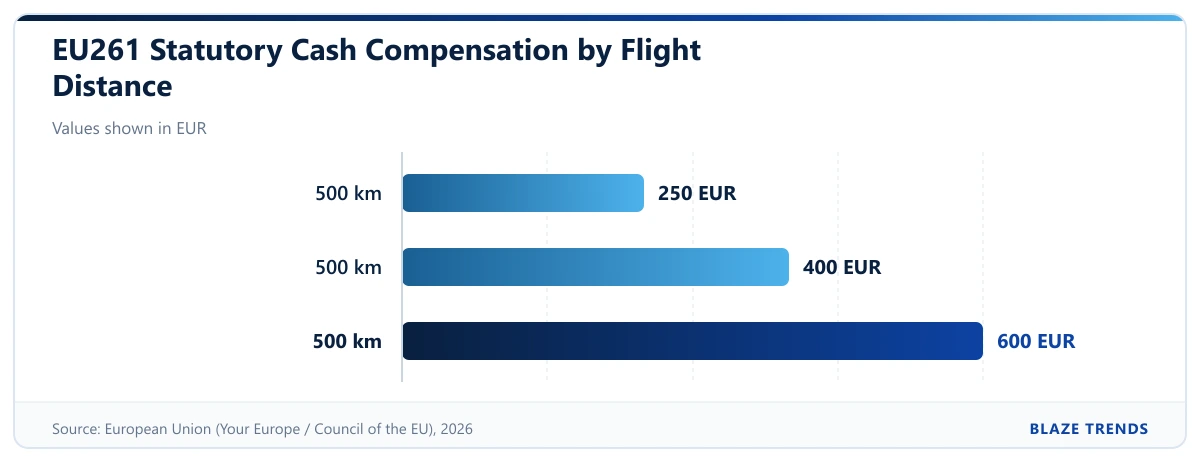
Flights touching Europe, the UK, or Canada carry far stronger statutory rights than US domestic trips. European Union Regulation 261/2004 (EU261) covers every flight departing an EU or EEA airport on any airline, plus flights arriving in the EU from abroad on an EU-licensed carrier. For controllable arrival delays of 3 hours or more, or cancellations with less than 14 days’ notice, EU261 sets fixed cash payouts of €250 for flights up to 1,500 km, €400 for intra-EU flights over 1,500 km and other flights between 1,500 km and 3,500 km, and €600 for flights over 3,500 km.
In June and July 2026, EU lawmakers reached a 2026 EU passenger rights agreement keeping that 3-hour threshold and the €250, €400, and €600 tiers intact while tightening enforcement. The agreement specifies refreshments every 2 hours, meals after 3 hours, up to 3 hotel nights during extraordinary circumstances, a 30-day claim response deadline, and the right to self-reroute up to 400% of your ticket price if an airline fails to offer rerouting within 3 hours. Airlines still carry the burden of proving extraordinary circumstances, and European courts separate internal airline IT failures (generally compensable) from external breakdowns, such as a 13-hour airport terminal IT blackout caused by a telecom strike that Germany’s Federal Court of Justice ruled outside an airline’s control.
Post-Brexit rules published by the UK Civil Aviation Authority (UK261) apply to all UK departures and to arrivals into the UK on UK or EU airlines. Both EU261 and UK261 require airlines to provide meals, communications, and overnight hotels after 2, 3, or 4 hours depending on flight distance, even during weather or external outages, and both grant a full refund option after a 5-hour delay. UK261 controllable cash payouts are £220 for flights under 1,500 km, £350 for flights between 1,500 km and 3,500 km, and £520 for flights over 3,500 km arriving 4 hours or more late (or £260 for long-haul delays arriving 3 to 4 hours late).
Canada’s Air Passenger Protection Regulations (APPR), detailed in the Canadian Transportation Agency guide, scale cash payouts by airline size for controllable delays not required for safety. Large airlines owe CAD $400 for delays of 3 to 6 hours, $700 for 6 to 9 hours, and $1,000 for 9 hours or more, while small airlines owe $125, $250, or $500; passengers who choose a refund instead of rebooking still get $400 from a large carrier or $125 from a small one. Safety-related controllable delays require care and rebooking without cash, and outside-control disruptions carry no cash or statutory care, though rebooking or a refund kicks in after 3 hours.
| Region or Treaty | Cash Payout for Controllable Delay | Meals and Hotel Duty | Refund Trigger If You Cancel |
|---|---|---|---|
| United States (DOT) | None mandated | Voluntary carrier commitments for controllable delays (narrowed Feb. 1, 2027) | 3+ hours domestic, 6+ hours international |
| European Union (EU261) | €250, €400, or €600 at 3+ hours late | Mandatory after 2 to 4 hours, regardless of cause | 5+ hours delay or cancellation |
| United Kingdom (UK261) | £220, £350, £260, or £520 at 3+ hours late | Mandatory after 2 to 4 hours, regardless of cause | 5+ hours delay or cancellation |
| Canada (APPR) | CAD $400–$1,000 (large) or $125–$500 (small) for non-safety delays | Controllable delays only; none for outside-control events | 3+ hours delay or cancellation |
| International (Montreal Convention) | Proven delay losses up to 6,303 SDRs (about US$8,400) | Reimbursement for documented reasonable costs unless airline proves reasonable measures | Governed by ticket fare rules and local law |
For international flights between participating nations, the Montreal Convention (MC99) offers another path when a delay causes documented financial losses like prepaid hotels or missed connections. Effective December 28, 2024, the International Civil Aviation Organization raised liability caps to 6,303 Special Drawing Rights (about US$8,400) for passenger flight delays and 1,519 SDRs (about US$2,000) for delayed, damaged, or lost baggage. An airline can avoid Montreal Convention delay payouts only by proving it took all reasonable measures to prevent the damage.
How to protect your refund and claim rights at the airport
When departure boards turn red, small decisions in an airline app can quietly waive hundreds of dollars in protections. Follow these steps in order before tapping any rebooking banner:
- Ask the gate agent or airline chat representative for the official reason for the delay or cancellation in writing, and screenshot flight status alerts showing scheduled and actual arrival times.
- Decide whether you still want to travel before clicking anything, because accepting a rebooked flight or travel credit in the US forfeits your right to an automatic cash refund.
- Check your carrier’s active US commitments on FlightRights.gov, or check EU261, UK261, or APPR coverage based on your departure airport and operating airline before buying meals or a hotel room.
- Save itemized receipts for every reasonable meal, hotel stay, and airport transfer if the airline fails to hand out vouchers during a covered delay.
- File a mishandled baggage report at the airport before leaving the terminal if your checked bag is delayed so you preserve bag-fee refund and expense claims.
- Submit a written claim directly to the operating airline, and keep your confirmation number along with dates for statutory deadlines (7 business days for US credit card refunds, and 30 days for claim replies in Canada and under the 2026 EU agreement).
Watch out for two budget traps that catch frequent flyers off guard. First, a refund only returns what you paid for an unused ticket; it is not extra compensation, and taking a rebooked flight means you no longer get your ticket refunded. Second, booking two separate “self-transfer” tickets instead of one linked itinerary usually strips away statutory protection if the first flight delays you into missing the second.
If an airline ignores your claim or denies a payout you believe the law requires, you do not have to pay a third-party claim agency right away. Escalate directly to the U.S. DOT Office of Aviation Consumer Protection, the UK’s Alternative Dispute Resolution (ADR) scheme or CAA Passenger Advice and Complaints Team, the Canadian Transportation Agency (within 1 year of the disruption), or the relevant EU national enforcement body. You can also check whether the credit card used to book your ticket includes trip-delay insurance, or consult a licensed consumer or aviation attorney if you are pursuing large documented financial damages under the Montreal Convention.
Frequently asked questions
Do I get my checked bag fee back if an outage delays my luggage?
Under US DOT rules, airlines must refund your checked bag fee if your bag is significantly delayed on an international flight: more than 15 hours for flights lasting 12 hours or less, or more than 30 hours for flights over 12 hours. For international itineraries under the Montreal Convention, you can also claim documented essential purchases up to 1,519 SDRs (about US$2,000), as of December 28, 2024.
Does my passport or citizenship decide whether EU261 or UK261 applies?
No. Coverage follows your departure airport and operating airline, not your nationality. A US airline flying from New York to Paris is not covered by EU261, while the exact same US airline flying from Paris back to New York is covered.
Can I dispute the charge with my credit card company if an airline refuses a refund?
In the US, the DOT notes that credit card billing-dispute rights can help if an airline fails to deliver a service or ceases operations. File a written refund request with the airline first, wait past the 7-business-day credit card window, and attach your cancellation proof if you open a dispute with your card issuer.