
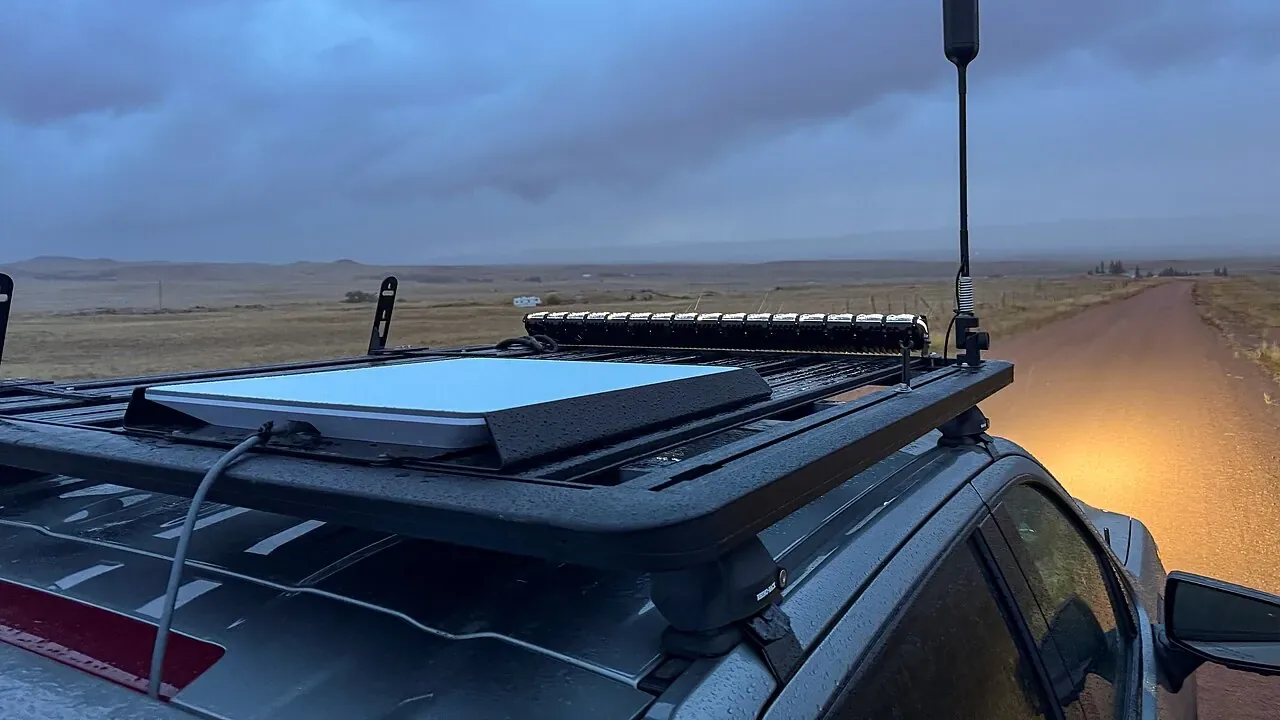
Low Earth orbit (LEO) satellite internet delivers broadband by relaying data between a flat-panel antenna at your location, a dense network of satellites orbiting 480 to 1,200 kilometers above Earth, and ground gateway stations wired into fiber-optic backbones. Because these spacecraft orbit roughly 60 times closer than traditional geostationary (GEO) satellites at 35,786 kilometers, radio signals travel a fraction of the distance and cut real-world latency from over 500 milliseconds down to 25 to 60 milliseconds. To keep your connection steady while individual satellites streak across the sky, the terminal electronically steers its radio beam and hands off traffic to a rising satellite every 15 to 90 seconds.
Why does orbit altitude control satellite internet latency?
Radio waves travel at the speed of light—299,792.458 kilometers per second—so physical distance sets an unavoidable floor on how fast a packet can make a round trip. In a traditional GEO setup, a single satellite sits fixed above the equator at 35,786 kilometers, forcing every packet to travel up and down at least 71,572 kilometers before reaching a ground station. According to Satcom Index latency benchmarks citing IETF RFC 2488, that geometry creates a minimum space-only round-trip time of 477.5 milliseconds, stretching to 480 to 560 milliseconds at typical slant angles before terrestrial routing even begins.
Lowering the orbit changes the math dramatically. Commercial LEO constellations operate between 480 and 1,200 kilometers up (Starlink places shells between 480 and 570 kilometers, while OneWeb orbits at roughly 1,200 kilometers). At 550 kilometers, the pure space round-trip floor drops to between 3.7 and 7.3 milliseconds, which translates into 25 to 60 milliseconds of real-world service latency on land.
Lower latency also improves usable download speed through a metric called the Bandwidth-Delay Product (BDP). BDP measures how much unacknowledged data must stay in flight to fill a network pipe; shorter round-trip times allow standard TCP connections to ramp up throughput without stalling while waiting for delivery confirmations.
What hardware connects your terminal to the internet?
Every packet you send travels across four distinct network segments before reaching a public web server, as outlined in the arXiv LEO architecture study and industry network documentation:
- The user terminal at your home, vehicle, or ship, which transmits and receives high-frequency radio signals in the Ku-band (12 to 18 GHz) or Ka-band (26.5 to 40 GHz).
- The space segment, consisting of hundreds or thousands of small satellites arranged in inclined and polar orbital shells so at least one spacecraft stays inside your terminal’s field of view.
- Feeder links and gateways, where large ground stations fitted with protective radomes pull traffic down from overhead satellites and inject it into terrestrial fiber-optic cables.
- The core telecom network, which handles subscriber authentication, assigns IP addresses, and routes packets onto the wider internet.
Because LEO satellites orbit so close to the surface, each spacecraft illuminates only a small footprint on the ground, with individual spot beams covering cells roughly 15 to 25 kilometers wide. Covering continents continuously requires thousands of satellites working together rather than three or four high-altitude GEO spacecraft.
How do flat-panel dishes track moving satellites without motors?
A GEO satellite appears motionless from the ground, letting a standard dish lock onto one spot in the sky forever. A LEO satellite moves at orbital velocity and crosses from horizon to horizon in a few minutes, which would wear out mechanical motors in short order.
To solve this, modern LEO user terminals use electronically steered phased-array antennas described in the Safeguard.sh satellite architecture guide. Inside the flat housing sits a grid of hundreds or thousands of tiny antenna elements, each equipped with its own phase control circuit. By shifting the timing of the radio wave emitted by each element by fractions of a wavelength, the array shapes and points a focused radio beam electronically with zero moving parts, updating tracking calculations up to 50 times per second (50 Hz).
Before a tracked satellite dips below the horizon, the terminal and ground network coordinate an automated handoff to an incoming satellite every 15 to 90 seconds, according to Orbital Radar technical documentation. Under ITU-T quality of service findings (2026), these scheduled handovers are predictable events that produce brief micro-spikes in packet delay variation, visible mainly in the 99.9th percentile of jitter measurements rather than everyday browsing.
What happens when no ground gateway is nearby?
Early LEO satellites used a “bent-pipe” design, acting like simple mirrors in the sky. When a bent-pipe satellite receives your uplink signal, it shifts the radio frequency and immediately broadcasts it back down to Earth. That approach works only when both your terminal and a fiber-connected ground gateway sit inside the same satellite’s footprint at the exact same moment.
Newer constellations add regenerative payloads and optical inter-satellite links (ISLs) to route traffic across space. Instead of dropping data straight back to the ground, an overhead satellite demodulates your packets on board and fires infrared lasers to neighboring satellites in orbit. The signal hops from spacecraft to spacecraft until it reaches a satellite passing over a coastal gateway station.
Optical laser links solve coverage gaps over open oceans, polar latitudes, and remote regions without local ground infrastructure. They also offer a raw physics advantage over long distances: light travels through the vacuum of space at 299,792 kilometers per second, roughly 47 percent faster than light moves through the glass core of an undersea fiber-optic cable.
What factors still slow down LEO satellite connections?
Even with low orbital altitude, real-world performance varies based on geography, weather, and local network load. A 550-kilometer orbit sets a 7.3-millisecond physical round-trip floor, yet terrestrial connections typically measure 25 to 60 milliseconds—and remote ocean or polar links routed across multiple laser hops can exceed 100 milliseconds.
Weather and obstructions also matter more than they do on wired broadband. High-frequency Ku-band and Ka-band radio signals suffer from rain fade, where dense storm clouds absorb and scatter signal energy, temporarily lowering throughput. Trees, buildings, or terrain blocking the terminal’s wide sky view will likewise interrupt handoffs between passing satellites. Local spectrum licensing rules also shape performance by country, since national telecom regulators govern which frequency bands and power limits operators can use within their borders.
Frequently asked questions
Can LEO satellite internet beat undersea fiber-optic cables on latency?
Over long intercontinental routes, yes. Because laser light moves through a vacuum roughly 47 percent faster than through glass fiber, a multi-hop space path between continents can deliver lower point-to-point latency than a submarine cable following a longer coastal route.
Why do you need an unobstructed view of the entire sky?
Unlike a traditional television dish aimed at one fixed point, a LEO terminal switches between moving satellites every 15 to 90 seconds across different angles of the sky. A tree branch or roofline blocking even one edge of that field of view can cause brief packet drops during handoffs.
Why does counting only the satellite’s altitude underestimate GEO latency?
Signals have to make a full round trip—up to the satellite, down to a gateway, back up to the satellite, and down to your terminal. For a GEO satellite at 35,786 kilometers, one way up and down already covers 71,572 kilometers (238.7 milliseconds), making the minimum round trip 477.5 milliseconds before any terrestrial routing occurs.