
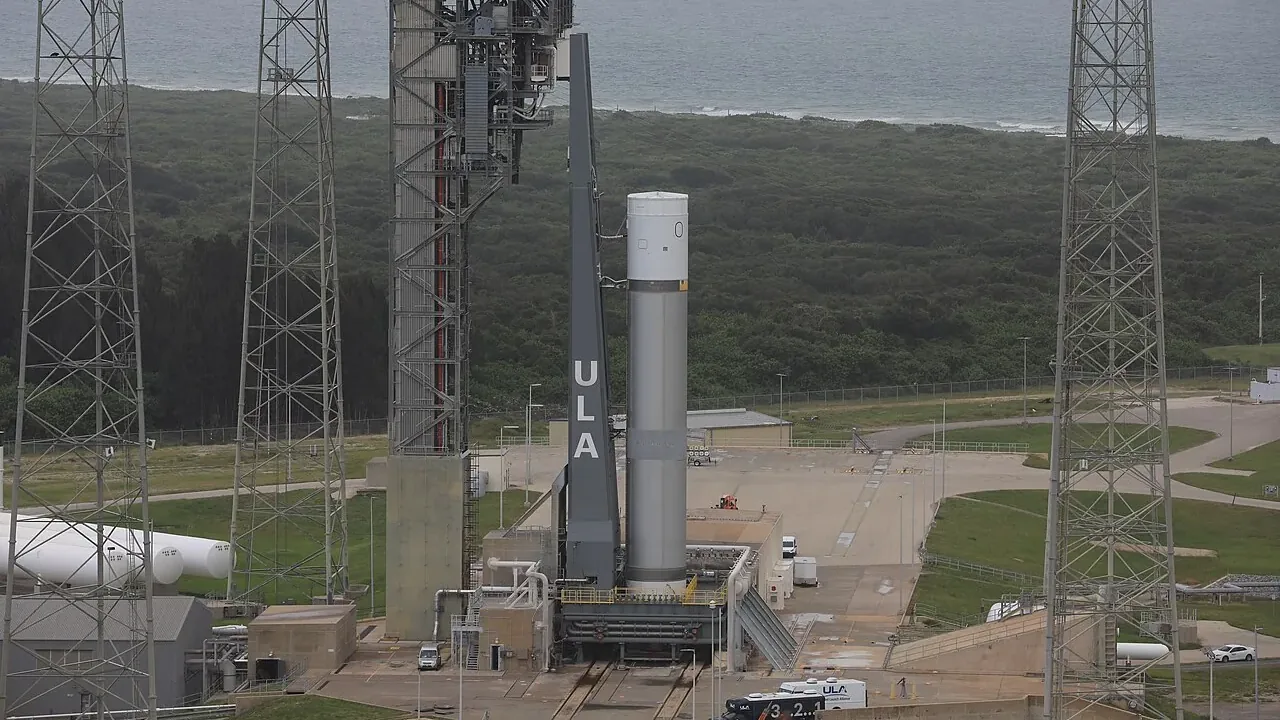
A United Launch Alliance (ULA) Vulcan Centaur rocket failed roughly 10 minutes after liftoff from Florida on Sunday, Nov. 15, destroying all 40 spacecraft aboard for Amazon’s Leo broadband internet network. The mishap is the first total mission failure in the 20-year history of ULA, the 50-50 joint venture formed by Boeing and Lockheed Martin in 2006, Reuters reported.
For prospective customers waiting on Amazon Leo, formerly known as Project Kuiper and built to compete with SpaceX’s Starlink internet service, the launch failure destroys a full batch of low-Earth orbit hardware and grounds ULA’s flagship rocket pending a formal investigation.
Outfitted with six strap-on solid rocket boosters, the Vulcan vehicle lifted off from Space Launch Complex 41 at Cape Canaveral Space Force Station during a window that opened at 12:11 p.m. EST on Sunday.
“Based on data received by our Launch Director, we confirm that the Vulcan vehicle launched from Space Launch Complex 41 suffered an anomaly 10 minutes into the flight and failed to deliver the Amazon mission to orbit,” ULA said in a statement on Sunday.
ULA added that because the anomaly had just happened, its engineers did not yet have specific data to explain what went wrong during the ascent. The company said it will work alongside Amazon and federal authorities to review flight telemetry, determine the root cause, and put corrective actions in place before returning Vulcan to flight.
What Happened During the Launch
Designated Amazon Leo LV-01, Sunday’s mission was the fifth flight overall for the Vulcan Centaur since the heavy-lift launcher debuted in January 2024. The flight had already been delayed twice over the weekend, with ULA scrubbing a Friday, Nov. 13 attempt and calling off a Saturday, Nov. 14 countdown because of a ground communication issue at the Cape Canaveral launch pad.
According to CBS News, the rocket’s six solid rocket boosters appeared to work normally during the initial climb on Sunday. However, ULA ended its live launch broadcast without commentators mentioning any in-flight problems or confirming whether the rocket’s Centaur upper stage completed its first planned engine firing. ULA did not immediately state which stage malfunctioned at the 10-minute mark.
How the Loss Affects Amazon Leo
Sunday’s flight was the first of 38 Vulcan launches that Amazon contracted with ULA to deploy its broadband constellation, according to Spaceflight Now. Had the mission reached orbit, the 40 lost spacecraft would have brought Amazon’s total launched satellites to 436 out of the more than 3,300 satellites planned for the full network. Instead, the constellation remains at 396 satellites launched to date.
In addition to its 38 booked Vulcan flights, Amazon holds launch contracts for 24 flights on Blue Origin’s New Glenn rocket, 24 on Europe’s Ariane 6, and 13 on SpaceX’s Falcon 9. Amazon Leo officials said in a statement on Sunday that they believe ULA will learn from the mission failure and deliver on its long-term launch plans.
Booster Fixes and Grounded Military Flights
Sunday’s mission marked Vulcan’s return to flight after a nine-month grounding. While Vulcan delivered its previous payloads to orbit, solid rocket booster nozzle anomalies occurred on both its second launch in October 2024 and its fourth launch, the USSF-87 national security mission on Feb. 12, 2026.
Ahead of Sunday’s countdown, ULA CEO Mark Peller told Aviation Week & Space Technology that engineers had addressed the booster problems. “We’ve identified three credible causes (of the nozzle issue), and we have taken positive steps to mitigate all of those,” Peller said.
Peller also noted that Blue Origin, which builds the Vulcan first stage’s BE-4 main engines, had installed a valve design retrofit on the engines used for Sunday’s flight. “They were down at our facilities probably a couple months ago and implemented that retrofit kit on the engines on this upcoming mission,” Peller said, adding, “And they’re working with us to work through our inventory of engines.”
Following the February 2026 booster issue, the U.S. Space Force placed an indefinite pause on national security launches aboard Vulcan and reassigned several GPS satellite missions to SpaceX’s Falcon 9. NASA also moved its SunRISE space weather mission from Vulcan to a SpaceX Falcon Heavy in July 2026.
Even with those schedule changes, NASA Administrator Jared Isaacman posted on X on Sunday that the agency stood ready to help ULA investigate the failure as the company phases out its older Atlas V rocket.
“Appreciate you quickly keeping the public and your partners informed,” Isaacman wrote to ULA. “The team at @NASA is available to assist in all matters related to the investigation and remediation effort. Artemis, Moon Base, and the nation need ULA. We are in your corner and here to help.”
ULA has not announced a timeline for completing the investigation or scheduling the next Vulcan launch.