
Air yards per attempt measures the average vertical distance, in yards, that a quarterback’s passes travel downfield from the line of scrimmage to the target, excluding yards gained after the catch. In NFL box scores, it usually refers to Intended Air Yards per Pass Attempt (IAY/PA), covering both completions and incompletions to show how aggressively an offense throws downfield.
ContentsToggle
How is air yards per attempt calculated?
Traditional passing yards blend two different skills into one total. In 2007, analyst Brian Burke coined the term “air yards” on Advanced Football Analytics with a simple equation: Pass Yards = Air Yards + Yards After Catch (YAC).
To find air yards on any play, count only the vertical yardage from the line of scrimmage to the yard line where the ball reaches the receiver. Using an example from Brad Congelio’s textbook reference NFL Analytics with R, imagine a quarterback throwing from his own 20-yard line to a receiver at the 50-yard line, who then runs to the opponent’s 30-yard line. The box score records 50 passing yards, split into 30 air yards and 20 yards after the catch.
Once you add up the air yards across a game or season, divide by pass attempts to get the per-attempt average. Intended Air Yards per Pass Attempt (IAY/PA) divides total intended air yards across every pass attempt, complete or incomplete, by total pass attempts. Completed Air Yards per Pass Attempt (CAY/PA) counts only air yards on caught passes in the numerator while still dividing by all pass attempts.
Air yards can also drop below zero. If a quarterback dumps a screen or swing pass to a running back standing 3 yards behind the line of scrimmage, that throw logs -3 air yards, even if the runner sprints 15 yards downfield afterward.
One frequent mix-up on TV broadcasts is confusing air yards with air distance. Air yards measure straight-line vertical progress from the line of scrimmage, whereas air distance measures the actual flight path of the football from the quarterback’s hand to the catch point. If a quarterback drops back 7 yards behind the line and whips a diagonal throw across the field to the far sideline 10 yards downfield, the air distance is much longer than the 10 air yards credited on the stat sheet.
How do intended and completed air yards differ?
Because box scores and analytics sites track throw depth in several ways, the abbreviations can blur together quickly. The biggest split comes down to whether incomplete passes count toward the distance total and what sits in the denominator.
| Metric | What it includes | Denominator | What it shows you |
|---|---|---|---|
| Intended Air Yards per Attempt (IAY/PA) | Air yards on all pass attempts, complete or incomplete | All pass attempts | How far downfield a quarterback and play-caller try to throw |
| Completed Air Yards per Attempt (CAY/PA) | Air yards on completed passes only | All pass attempts | Downfield air yardage actually gained per pass attempt |
| Completed Air Yards per Completion (CAY/Cmp) | Air yards on completed passes only | Completed passes | Average depth of the throws a quarterback actually completes |
| Average Depth of Target (aDOT) | Air yards on passes with an identified receiver | Targeted throws (excludes spikes and throwaways) | True target depth without non-targeted plays dragging the average down |
| Air Yards Differential (AYD) | Completed air yards minus intended air yards | Compared averages | Whether a passer completes shorter throws than he attempts on average |
| Air Yards to the Sticks (AYTS) | Air yards relative to the first-down marker | All pass attempts | Whether throws travel past or short of the yardage needed for a first down |
According to the nflverse Next Gen Stats dictionary, NFL Next Gen Stats labels its main per-attempt figure Average Intended Air Yards and its completion-depth figure Average Completed Air Yards. Checking whether a table divides completed air yards by completions or by all pass attempts prevents comparing two different scales by mistake.
How does the NFL measure air yards?
The league captures official tracking data directly inside every stadium rather than eyeballing yard lines from TV angles. According to NFL Football Operations, every NFL stadium houses 20 to 30 ultra-wideband receivers that read 2 to 3 RFID tags inside players’ shoulder pads, plus RFID tags embedded inside the football, officials, pylons, sticks, and chains.
That hardware generates more than 200 data points per play, which Next Gen Stats processes through machine-learning models on AWS. It pinpoints the football’s exact yard line at the moment a receiver catches it or fails to haul it in.
Independent football databases gather air yards differently, so the same quarterback’s stat line often varies by a few tenths of a yard depending on where you look. As noted in the Pro-Football-Reference advanced stats notes, its IAY and CAY tables come from Sportradar game charting, updated by 6 p.m. ET each Tuesday after a week’s games.
The denominator also creates small gaps between sites. While IAY/PA divides by official pass attempts, aDOT calculated from nflverse play-by-play data excludes spikes and passes without a listed target, which made up 4.3% of NFL pass attempts during the 2025 regular season according to NFL Analytics (2026).
What counts as high or low air yards per attempt?
Across the 2025 NFL regular season, the league-wide average depth of target sat at 7.86 yards, with high-volume quarterbacks (250 or more targets) ranging from 6.2 to 9.3 yards, per NFL Analytics (2026). Nearly half of all 2025 pass targets (49.4%) went between 0 and 9 yards past the line of scrimmage, while 17.5% went behind the line, 21.5% traveled 10 to 19 yards, and 11.7% went 20 yards or deeper.
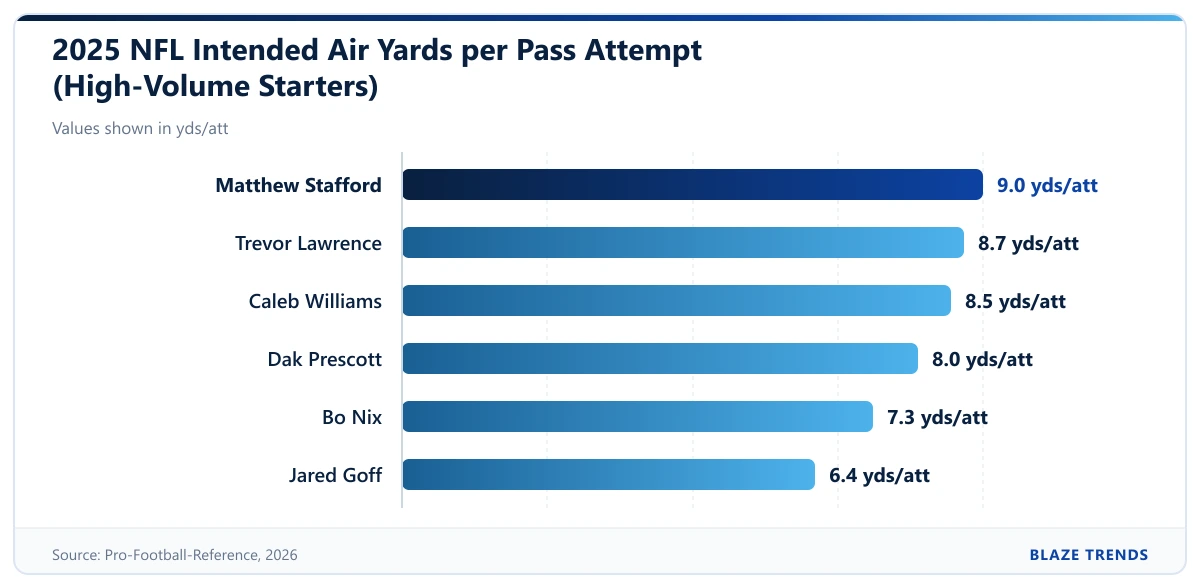
Team averages in 2025 spanned a similar band on Pro-Football-Reference, running from 5.9 IAY/PA for the Pittsburgh Steelers and 6.1 for the Las Vegas Raiders up to 9.0 for the Los Angeles Rams and Philadelphia Eagles and 9.2 for the New England Patriots. Because play-calling trends shift from season to season, check current league leaders on NFL Next Gen Stats or Pro-Football-Reference when comparing newer years.
A higher number does not automatically equal better quarterback play. Deeper throws carry lower completion rates and keep quarterbacks holding the ball longer against the pass rush, which is why analysts fold air yards into models like Completion Percentage Above Expectation (CPOE) instead of grading passers on throw depth alone.
The 2025 NFL advanced passing data from Pro-Football-Reference gives a clear side-by-side example of two elite offenses winning in opposite ways:
- Matthew Stafford (Los Angeles Rams) threw 597 passes for 5,358 intended air yards (9.0 IAY/PA), 2,857 completed air yards (4.8 CAY/PA and 7.4 CAY/Cmp), and 1,850 YAC (4.8 YAC per completion), finishing with 4,707 passing yards.
- Jared Goff (Detroit Lions) threw 578 passes for 3,684 intended air yards (6.4 IAY/PA), 2,140 completed air yards (3.7 CAY/PA and 5.4 CAY/Cmp), and 2,424 YAC (6.2 YAC per completion), finishing with 4,564 passing yards.
Both quarterbacks cleared 4,500 passing yards on nearly identical attempt totals. Stafford pushed the ball 2.6 yards deeper per pass, while Detroit’s receivers generated 574 more yards after the catch.
Tracking one quarterback’s air yards per attempt over several seasons often says more about defensive adjustments and coaching than arm strength. According to Next Gen Stats figures compiled by 4for4 (2025), Patrick Mahomes’ Average Intended Air Yards dropped from 9.2 in 2018 to 8.6 in 2019, 8.5 in 2020, 7.3 in 2021, 7.5 in 2022, and 6.3 in 2024 as defenses took away deep shots and Kansas City leaned harder on quick throws and YAC.
From 2002 through 2006, Brian Burke found that NFL teams averaged 3,533 passing yards per season, split into 2,008 air yards (57%) and 1,533 yards after catch (43%), with air yards carrying about three times the weight of YAC in explaining yards per completion.
At the aggressive end of the spectrum, NFL.com (2021) pointed out that Jameis Winston posted 10.5 intended air yards and 8.2 completed air yards per attempt in 2019, compared with Teddy Bridgewater’s 6.2 intended and 4.6 completed. Reading air yards alongside completion rate and YAC tells you whether a passer is hunting big plays downfield or letting playmakers run in space.
Frequently asked questions
What is the difference between air yards per attempt and yards per attempt (YPA)?
Yards per attempt divides total passing yards, which combine completed air yards and yards after catch, by pass attempts. Intended air yards per attempt ignores yards after catch completely and includes the downfield depth of incomplete throws.
Do incomplete passes count in air yards per attempt?
Yes in Intended Air Yards per Attempt (IAY/PA), where an incomplete 35-yard deep shot still adds 35 yards to the total because it measures where the quarterback tried to throw. In Completed Air Yards per Attempt (CAY/PA), that incompletion stays in the denominator as zero air yards.
How is air yards per attempt different from aDOT?
Both stats measure a quarterback’s average downfield throw depth past the line of scrimmage. The difference sits in the denominator: IAY/PA divides by official pass attempts, while aDOT divides by targeted passes and drops spikes and throwaways without an intended receiver.