
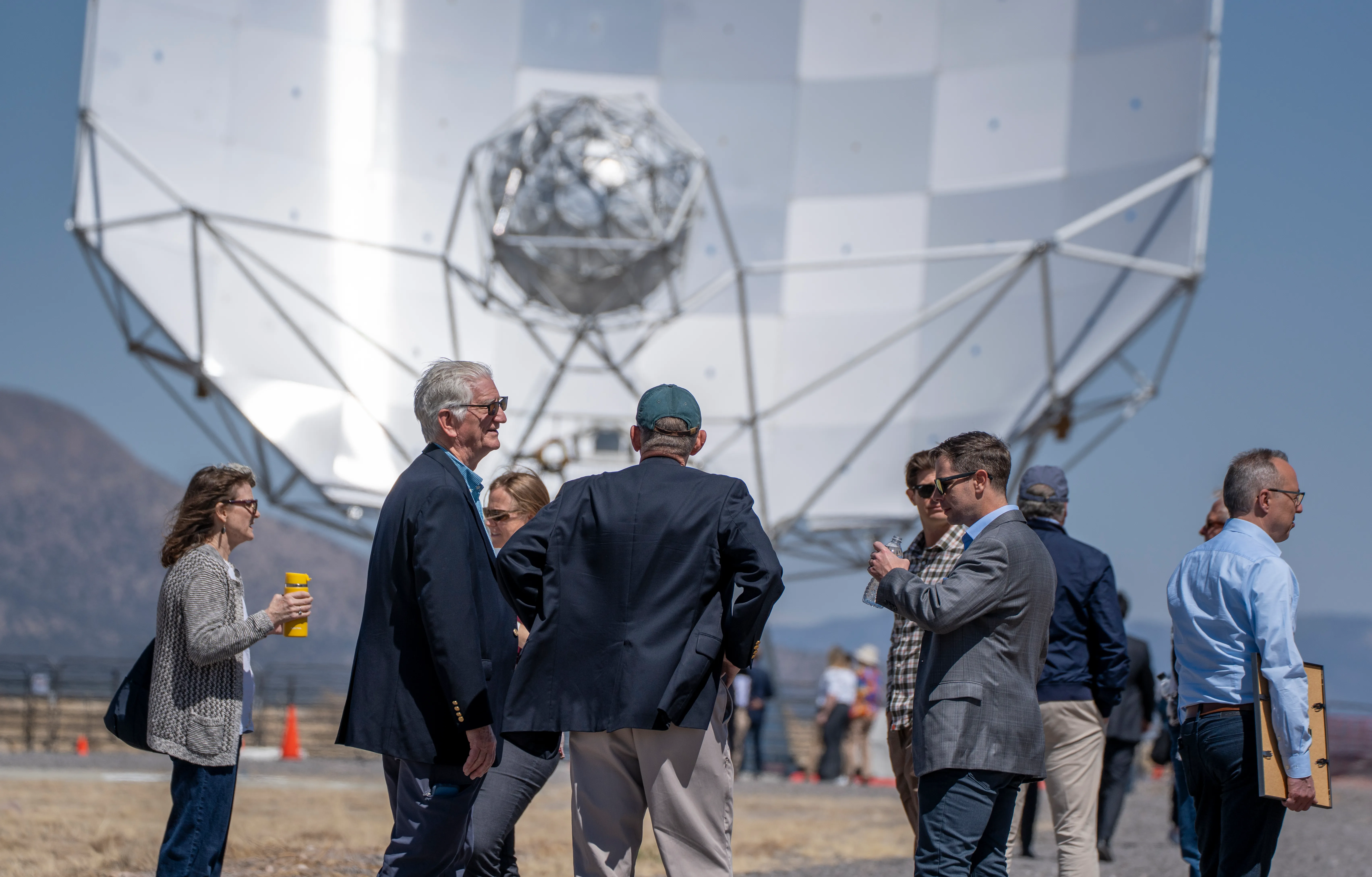
The search for answers about supermassive black holes and the origins of galaxies just took a significant step forward. We are rapidly hitting the limits of what older observatories can see, driving a push for hardware that spans entire continents. The Next Generation Very Large Array (ngVLA) project has officially activated its prototype antenna.
Astronomers confirmed the dish successfully achieved operational status, according to a detailed project timeline verifying the prototype antenna achieved first light and interferometric fringes on April 29 and April 30. This marks a critical milestone for the observatory before full-scale construction begins.
Mapping the Cosmos with 263 Antennas
When completed, the ngVLA will feature a distributed network of 263 individual radio antennas spread across the United States and extending deep into Mexico. Scientists will use this interconnected web of dishes to map gas and molecular lines on kiloparsec scales. Researchers are essentially building a continent-sized camera to study galaxy kinematics and observe the high-resolution structure of particle jets blasting out from supermassive black holes.
To pull this off, the hardware had to undergo a serious technical upgrade. The new facility boasts 10 times the collecting area and 10 times longer baselines—stretching up to 300 kilometers—making it significantly more powerful than the currently operational Jansky Very Large Array (VLA) and the Atacama Large Millimeter/submillimeter Array (ALMA).
The project is also hardwiring education directly into the infrastructure. Specific sites, like the planned Florida LONG station, are partnering with local universities to act as hands-on STEM hubs for both K-12 students and college undergraduates looking to enter the astrophysics field.
Why 300-Kilometer Baselines Change Black Hole Observation
The jump from the legacy Jansky VLA to this new network alters how researchers process radio signals. By expanding the physical distance between the individual antennas to 300 kilometers, astronomers artificially create a synthetic lens as wide as a state. This specific structural change allows researchers to resolve the exact physical mechanisms behind black hole particle jets, a phenomenon older telescopes could only capture as blurry thermal hotspots.
The successful first light test last month proves the underlying interferometry software can actually synchronize these distant signals in real time. Hitting those interferometric fringes means the prototype dish successfully communicated and locked onto a cosmic radio source in tandem with existing hardware, validating the core technology required to link all 263 future antennas.