
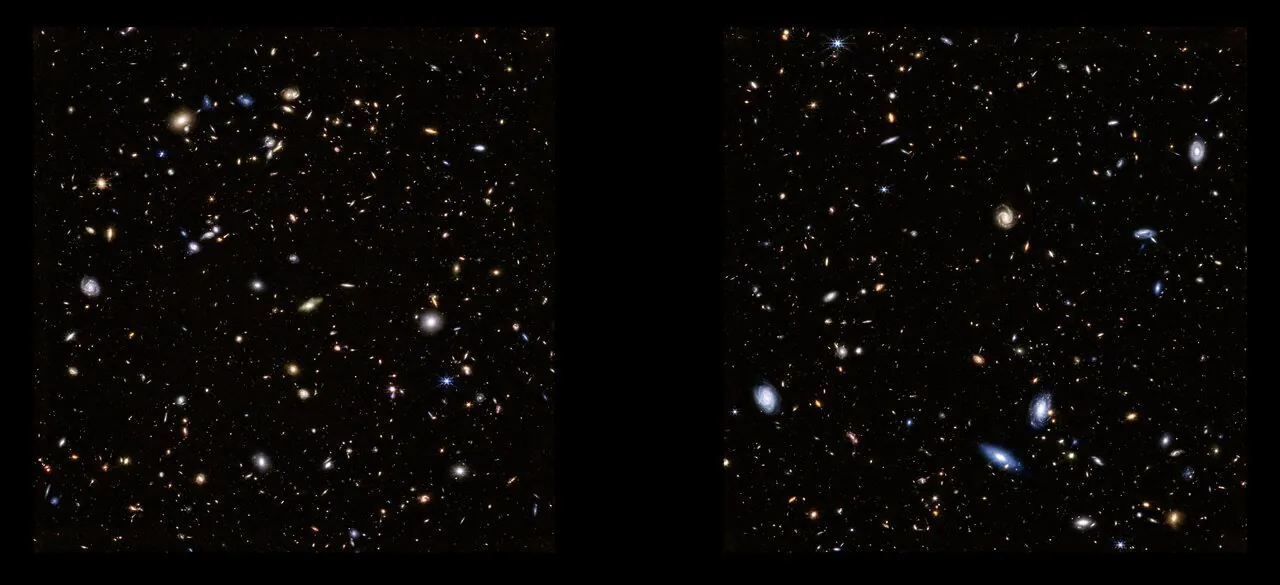
No single object holds an uncontested claim as the largest structure in the universe. The Hercules-Corona Borealis Great Wall reaches roughly 10 billion light-years, yet remains unconfirmed as a connected mass. Among mapped nearby galaxy superstructures, Quipu and the Sloan Great Wall span 1.3 to 1.37 billion light-years, putting the 1.3-billion-light-year Big Ring right alongside them.
ContentsToggle
Why astronomers disagree on the largest structure in the universe
When you picture a cosmic structure, you might imagine a solid object held together like a planet or a star cluster. At scales above a few hundred million light-years, astronomers instead map statistical networks of galaxies, galaxy clusters, quasars, and gamma-ray bursts strung along the cosmic web.
That difference explains why the record depends on how you look. Under the standard Lambda-CDM model of cosmology, the Cosmological Principle assumes matter smooths out uniformly in every direction once you zoom out far enough. Cosmologists commonly cite a theoretical ceiling of about 1.2 billion light-years, or roughly 370 megaparsecs, above which coherent structures should not have had time to assemble since the Big Bang.
Direct galaxy surveys in the nearby universe give researchers sharp three-dimensional maps, because telescopes can track the positions and velocities of thousands of galaxies. Deeper in space, surveys rely on far sparser markers like bright quasars or fleeting gamma-ray bursts, leaving plenty of debate over whether a giant pattern is physically connected or a chance alignment.
How the Big Ring compares with other cosmic megastructures
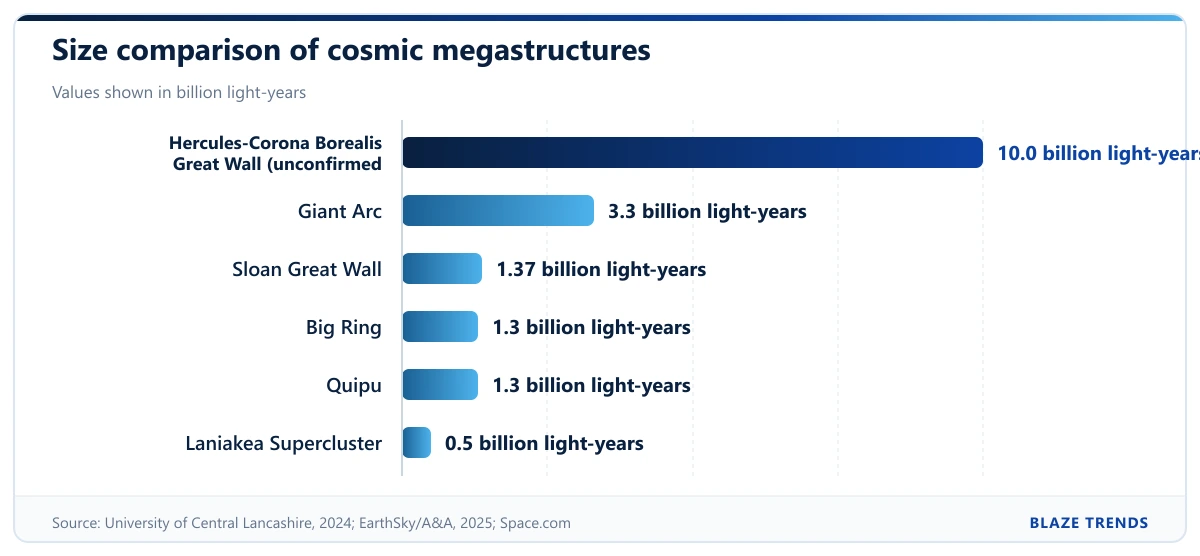
Put the major contenders side by side, and the Big Ring lands near the middle of the size chart rather than at the top. Several claimed entities stretch much farther across space, though the largest ones attract the heaviest skepticism from astronomers.
| Structure | Approximate span | Detection method | Confirmation status |
|---|---|---|---|
| Hercules-Corona Borealis Great Wall | Up to 10 billion light-years | Gamma-ray burst clustering | Unconfirmed |
| Huge-LQG | About 4 billion light-years | 73 luminous quasars | Disputed |
| Giant Arc | 3.3 billion light-years | Mg II quasar absorption lines | Debated |
| South Pole Wall | 1.4 billion light-years | Nearby galaxy redshift and velocity map | Mapped nearby |
| Sloan Great Wall | 1.37 billion light-years | Direct galaxy survey | Mapped nearby |
| Big Ring | 1.3 billion light-years across | Mg II quasar absorption lines | Debated |
| Quipu | 1.3 billion light-years | Nearby galaxy cluster survey | Confirmed nearby |
| Laniakea Supercluster | 500 million light-years | Galaxy velocity flow map | Confirmed home supercluster |
The Hercules-Corona Borealis Great Wall sits at the top of the raw size list at roughly 10 billion light-years across. Astronomers first inferred it in 2014 from a clustering of gamma-ray bursts at redshift 1.6 to 2.1, and a 2020 follow-up study of 487 bursts argued the statistical excess remained. Even so, Max Planck Institute astronomer Hans Böhringer noted in a 2025 EarthSky interview that the wall has “never been confirmed as a connected concentration of matter.”
The Huge-LQG, a grouping of 73 quasars spanning more than 1 gigaparsec (about 4 billion light-years) reported in 2013, drew a quick methodological challenge. In a 2013 MNRAS analysis, cosmologist Seshadri Nadathur showed that the friends-of-friends linking algorithm routinely builds gigaparsec-scale groups inside purely random point clouds, and found the Sloan Digital Sky Survey quasar catalog stayed homogeneous above roughly 130 megaparsecs (adjusted for cosmic expansion).
Closer to home, direct galaxy and cluster surveys sit on firmer ground. The Sloan Great Wall measures 1.37 billion light-years long, about 80 percent longer than the 1989 CfA2 Great Wall, according to Gott and colleagues in 2005. In 2020, researchers from the Institut de Physique des 2 Infinis de Lyon and the University of Hawaiʻi mapped the 1.4-billion-light-year South Pole Wall hiding behind the Milky Way’s dust plane at roughly half the Sloan Great Wall’s distance.
In 2025, Böhringer’s Max Planck Institute team reported Quipu in Astronomy & Astrophysics as the largest confirmed superstructure in the nearby universe. Sitting 425 to 800 million light-years from Earth, Quipu stretches roughly 1.3 billion light-years (more than 400 megaparsecs) and holds the mass of about 200 quadrillion stars. Together with four other nearby superstructures mapped in the same study, it accounts for roughly 45 percent of the galaxy clusters, 30 percent of the galaxies, and 25 percent of the matter in that surveyed volume.
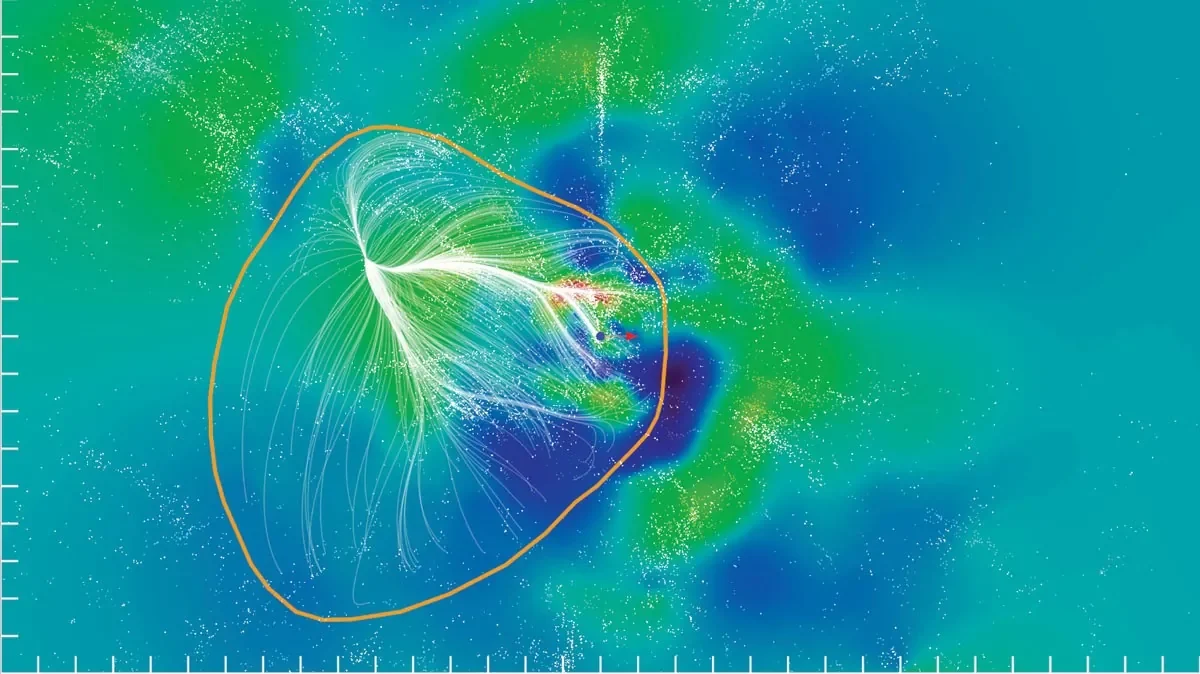
To put those figures in perspective, our own cosmic neighborhood looks modest beside them. The Laniakea Supercluster, mapped by University of Hawaiʻi astronomer Brent Tully’s team in 2014, bundles the Milky Way with roughly 100,000 galaxies across 500 million light-years, less than half the diameter of the Big Ring.
What makes the Big Ring unusual
PhD researcher Alexia Lopez announced the Big Ring in January 2024 at the 243rd American Astronomical Society meeting, followed by a 2024 JCAP paper titled “A Big Ring on the Sky” with Roger Clowes and Gerard Williger. According to the University of Central Lancashire, the structure measures 1.3 billion light-years in diameter and roughly 4 billion light-years in circumference at a distance of 9.2 billion light-years. If you could see it with the naked eye, it would cover the width of 15 full Moons across the sky.
Its diameter already nudges past the 1.2-billion-light-year theoretical limit, and its geometry makes it stranger still. In three dimensions, the galaxies trace a corkscrew coil oriented almost face-on to Earth, creating the look of a giant ring across the sky.
Even more striking is its neighbor. The Big Ring sits at the same cosmic epoch (redshift around 0.802) just 12 degrees north of the 3.3-billion-light-year Giant Arc, which the same team published in Monthly Notices of the Royal Astronomical Society in 2022 as “A Giant Arc on the Sky.”
“Neither of these two ultra-large structures is easy to explain in our current understanding of the universe.” — Alexia Lopez, University of Central Lancashire (2024)
Researchers first tested whether the Big Ring could be a leftover imprint of Baryon Acoustic Oscillations, sound waves from the early universe that froze into galaxy shells. Lopez’s team ruled out that standard explanation because acoustic shells form spheres around a 150-megaparsec radius, whereas the Big Ring is much wider and corkscrew-shaped.
With the acoustic shell explanation ruled out, the authors and university release noted two speculative possibilities. One involves cosmic strings, hypothetical filamentary defects left over from phase transitions in the early universe, while the other cites Sir Roger Penrose’s Conformal Cyclic Cosmology, an alternative model outside mainstream consensus that predicts ring patterns from prior cosmic eras.
Is the Big Ring real or a statistical illusion?
Lopez’s team mapped the Big Ring indirectly using spectroscopy instead of taking a direct telescope image. They combed Sloan Digital Sky Survey (SDSS DR16Q) spectra for singly ionized magnesium (Mg II) absorption lines, where gas clouds around intervening galaxies absorb specific wavelengths from brighter quasars farther behind them.
Using a spatial test called the Convex Hull of Member Spheres algorithm, the discovery team reported statistical departures from uniformity up to 5.2 sigma. In physics, five sigma marks a steep bar against simple random noise, which is why the paper drew immediate attention from cosmologists.
Independent researchers remain unconvinced that these Mg II patterns break the standard cosmological model. In a 2025 FLAMINGO-10K study published in Monthly Notices of the Royal Astronomical Society, Till Sawala and colleagues ran the Giant Arc’s detection algorithm on a massive standard-model simulation and random point sets. They concluded that gigaparsec-scale patterns show up routinely as algorithmic artifacts without reflecting true excess matter underneath.
That critique sparked a formal back-and-forth across arXiv in 2025. Lopez and Clowes posted an April 2025 rebuttal arguing Sawala’s simulation analysis contained methodological errors and failed to replicate comparable gigaparsec structures, and Sawala’s group issued an October 2025 counter-response standing by its findings. As of 2026, cosmologists treat the Big Ring and Giant Arc as unresolved anomalies waiting for denser galaxy redshift surveys to test whether real matter overdensities sit behind the absorption lines.
Frequently asked questions
Are billion-light-year structures held together by gravity?
No. While gravity binds individual galaxies and galaxy clusters, structures stretching past a billion light-years are too vast to resist the expansion of space. Astronomers classify them as statistical overdensities and loosely linked filament networks rather than gravitationally bound objects.
Why do reports list two different distances for the Big Ring?
Reports cite roughly 6.9 billion years of light-travel time alongside a distance of 9.2 billion light-years because space expands while light is in transit. The same effect separates the Hercules-Corona Borealis Great Wall’s roughly 10-billion-light-year light-travel distance from its present-day comoving distance of 15 to 17.7 billion light-years.
Can you photograph the Big Ring with a telescope?
You cannot capture it as a glowing ring in a standard optical photograph. Its member galaxies are too faint and spread out at that distance, so astronomers detect it indirectly by spotting dark magnesium absorption dips in the light of background quasars.