
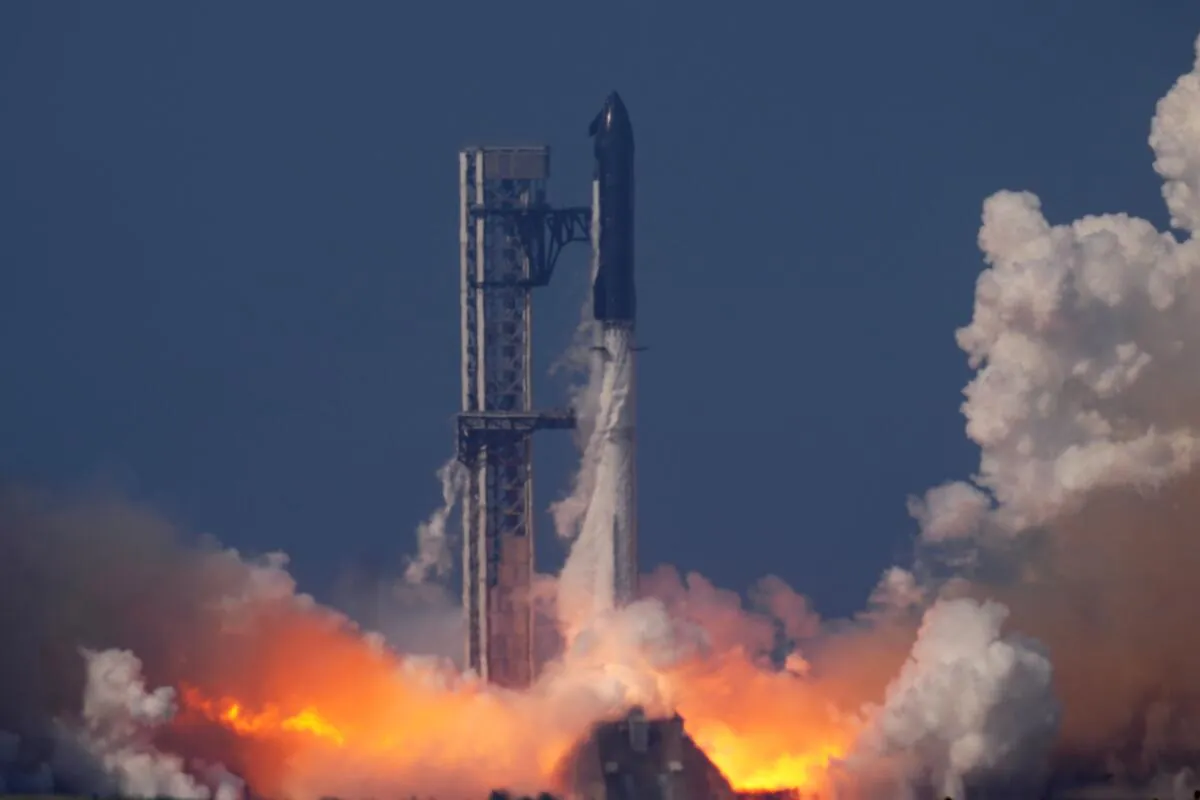
The third-generation Starship rocket successfully navigated its 12th test flight on Friday evening, completing a critical suborbital journey before splashing down in the Indian Ocean. The 407-foot redesigned V3 spacecraft managed to orient itself vertically for the ocean landing before erupting in flames, while its Super Heavy booster executed a controlled splashdown in the Gulf of Mexico.
The successful test arrives right as SpaceX faces an intense financial and political crucible. Just days after the company filed a prospectus for a record-breaking $1.75 trillion IPO, the pressure to prove Starship’s operational viability is at an all-time high. The mission also keeps SpaceX competitive against Jeff Bezos’ Blue Origin as both companies race to fulfill NASA’s upcoming Artemis moon landing objectives.
The launch finally took off after a 24-hour delay caused by a stuck hydraulic pin on the launch tower. Once airborne, the V3 rocket completed its primary in-flight objective by deploying 20 mock and camera-equipped Starlink test satellites into orbit, according to a report by the Associated Press detailing the mission’s Artemis implications.
NASA Administrator Jared Isaacman watched the launch unfold from a highly unusual vantage point. Isaacman actively piloted an F-5 Tiger II jet over the Starbase facility during the liftoff. He later noted the flight pushes Starship closer to the strict timeline required for NASA’s lunar ambitions.
Getting this V3 iteration off the ground is about more than just lunar exploration. The company recently filed regulatory paperwork for a highly anticipated public offering, relying heavily on Starship’s operational deployment to justify a $1.75 trillion valuation.
Why the V3 Redesign is Crucial for the IPO Pitch
The V3 Starship is not just a taller rocket; it is the financial engine for SpaceX’s next decade. Previous iterations proved the rocket could fly, but the V3 was overhauled specifically to achieve full reusability. If SpaceX cannot routinely land and reuse these heavy-lift boosters, the profit margins promised to IPO investors will collapse.
The successful deployment of the 20 mock Starlink satellites during Friday’s test proves the cargo mechanism works in a suborbital environment. But the fiery end to the Indian Ocean splashdown shows the heat shielding and landing mechanics still require refinement before the company can start turning around rockets like commercial airplanes.