
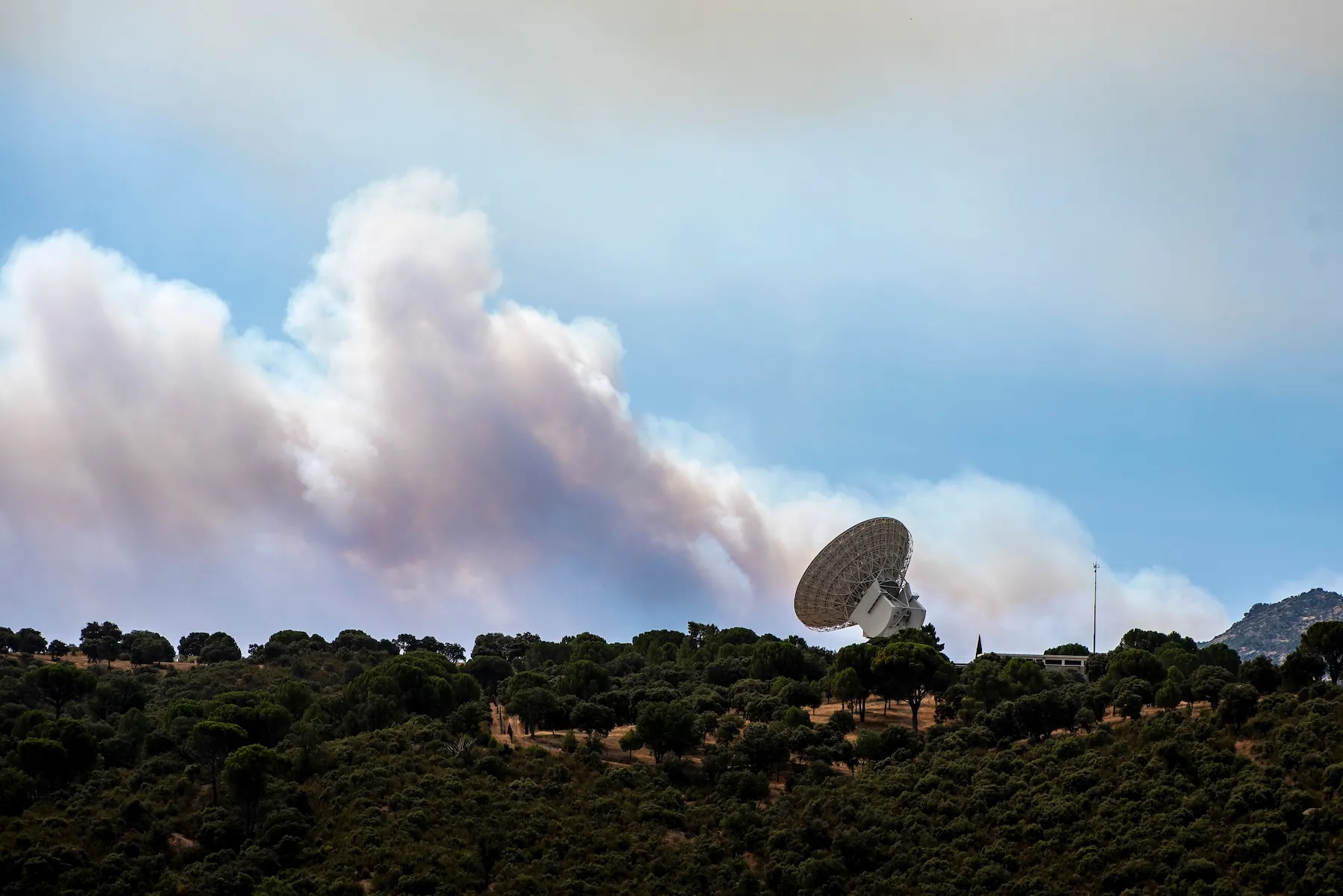
Extreme heat and high winds triggered a wildfire disaster across Europe this week. The Spanish government declared a state of emergency as the blaze forced over 60,000 residents to evacuate the Madrid region on Friday.
During the chaos, flames physically passed through the grounds of NASA’s Madrid Deep Space Communications Complex in Robledo de Chavela. According to reports documenting the crisis, the fire swept directly across the MDSCC site. Aerospace infrastructure appears to have avoided destruction.
The European Space Agency’s Cebreros tracking station in Ávila was also evacuated as a precaution. That facility appears intact pending a safety inspection. All 90 workers at the Madrid site got out safely before the fire arrived.
To prevent mission blackouts, NASA triggered a backup plan. Flight controllers transitioned deep space communications to the agency’s Canberra and Goldstone network centers. That shift to California exposes a mechanical vulnerability in the system.
Goldstone is currently operating with reduced capacity.
Following a $4.1 to $4.6 million over-rotation mishap in September 2025, the site’s 70-meter DSS-14 antenna remains offline. The dish sustained damage while tracking the Juno spacecraft.
Goldstone Capacity Squeeze Tests DSN Redundancy
With the Madrid array temporarily offline, the Deep Space Network must rely entirely on its remaining two global nodes. This bottleneck forces mission planners to prioritize bandwidth for active probes over routine data downloads. Formal material damage assessments at the Spanish sites are still pending. Once local authorities grant safe access to the hills west of Madrid, engineers will evaluate the physical hardware.