
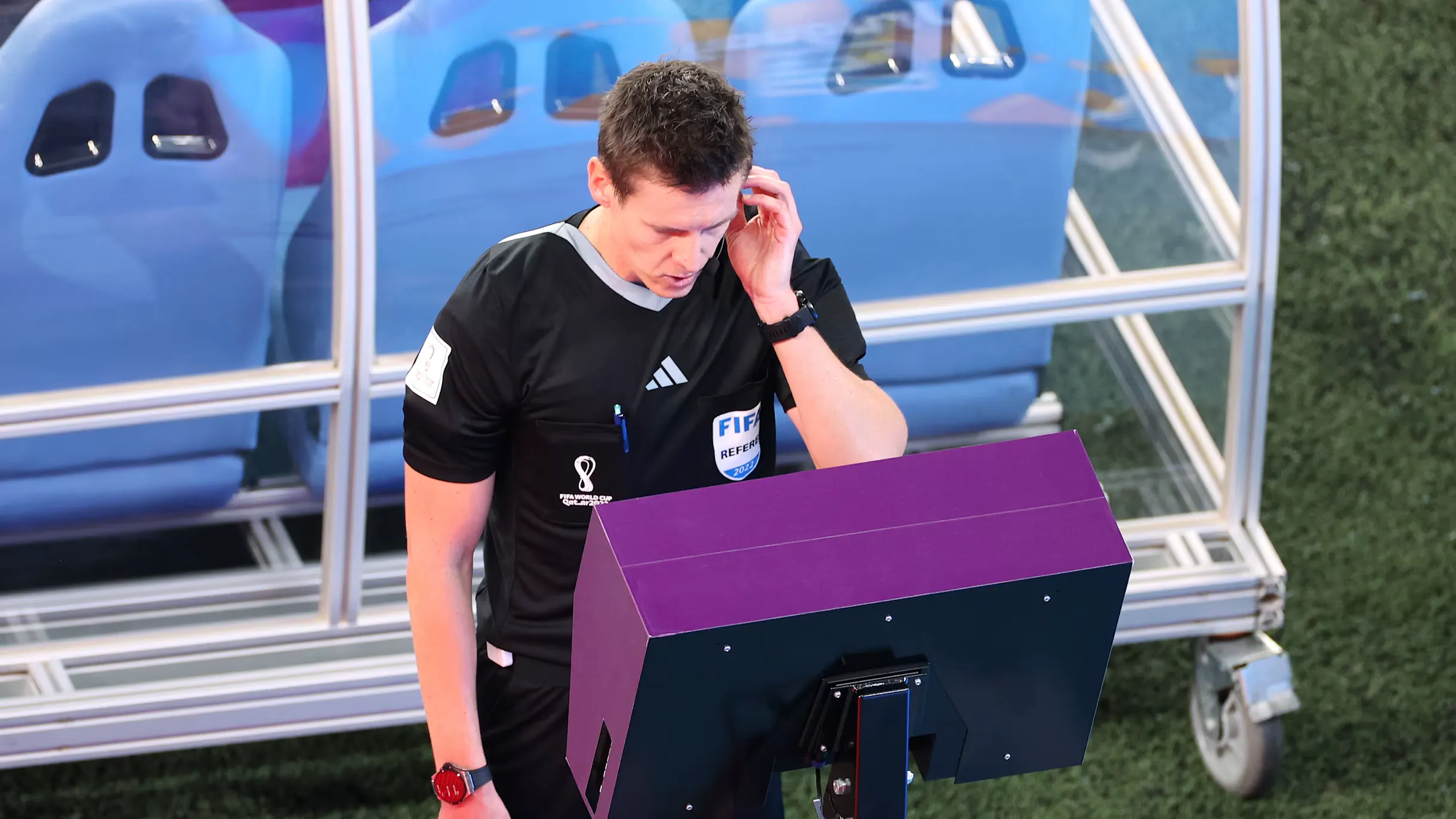
In soccer, a VAR offside check triggers automatically after every goal and penalty call by freezing play at the exact moment a teammate touches the ball. Video officials compare the attacker’s furthest legal scoring body part to the second-last defender using optical cameras, virtual lines, or broadcast replays before confirming the decision to the referee.
ContentsToggle
When does VAR check offside, and why does the flag stay down?
The Video Assistant Referee does not stop play for every tight run down the wing. Under IFAB’s VAR protocol, video officials review offside only when it occurs in the attacking build-up to a goal or a penalty kick, which follows the broader rules on when VAR can intervene in a match.
That narrow scope explains the delayed flag you see on TV. On tight runs during an immediate goalscoring attack, assistant referees keep the flag down so play finishes naturally. If the whistle blows early and replays later prove the striker was onside, a legal goal is lost forever.
Once a goal is scored or a penalty, free kick, corner, or throw-in is awarded, the assistant finally raises the flag and the VAR room runs an automatic check. For the 2026/27 Laws of the Game, IFAB also updated Law 5 to formally permit competitions to use offside technology, including semi-automated tracking, while banning unofficial tech.
Long delayed-flag chases have drawn criticism because sprinting into a late challenge raises collision risks. To fix that, FIFA tested Advanced Semi-Automated Offside Technology (SAOT) at the 2025 FIFA Club World Cup and FIFA Intercontinental Cup before rolling it out at the 2026 World Cup, sending real-time alerts directly to on-field officials on clear offsides so play stops sooner.
How does semi-automated offside technology track players?
Before any camera tracks a run, the software has to follow Law 11 offside rules set by IFAB. An attacker is in an offside position if any part of the head, body, or feet is in the opponent’s half, excluding the halfway line, and nearer the goal line than both the ball and the second-last opponent.
Hands and arms do not count for any player, with the upper boundary of the arm set in line with the bottom of the armpit, often called the T-shirt line. Being level with the second-last opponent counts as onside.
When a competition uses FIFA’s semi-automated offside technology, every tight call moves through five quick stages:
- Dedicated stadium cameras track the ball and player limbs continuously throughout the match.
- Optical camera feeds and, in FIFA and UEFA tournaments, an internal motion sensor inside the connected match ball pinpoint the exact kick-point frame when the pass leaves a teammate’s boot.
- Tracking software places the offside plane on the second-last defender and alerts the Video Operation Room automatically if an attacker in an offside position receives the ball.
- Human video match officials verify the kick point and the generated offside line before confirming the call to the on-field referee—the system is semi-automated because people still make the final decision.
- Once confirmed, the software builds a 3D animation from those exact positional coordinates and sends it to stadium big screens and TV broadcasters.
At the 2026 FIFA World Cup, each stadium used 16 optical tracking cameras capturing 29 body points per player at 50 frames per second, generating over 150 million tracking data points per match. Ahead of SAOT’s World Cup debut in 2022, FIFA projected the tech would cut offside reviews from an average of 70 seconds under manual VAR down to 20 to 25 seconds, as reported by the Associated Press.
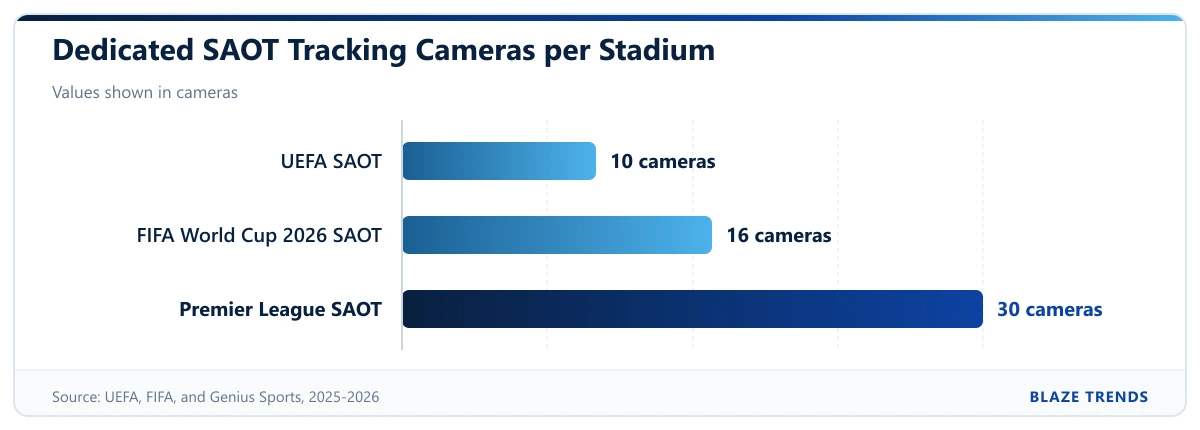
Not every league uses the same hardware to build that 3D model. When the English Premier League launched SAOT in Matchweek 32 in April 2025, it partnered with Genius Sports to install 30 high-resolution iPhone cameras per stadium powered by GeniusIQ, tracking up to 10,000 surface mesh points per player per second.
Under Premier League SAOT rules, the league expected the automated mesh to shave roughly 30 seconds off close offside checks compared with manual line drawing. The walkthrough below shows how Premier League officials turn that player mesh into a final broadcast render.
How VAR offside lines work without semi-automated tech
In competitions without SAOT—and in the Premier League whenever SAOT is temporarily unavailable—the VAR room falls back on calibrated Hawk-Eye virtual offside lines. Technicians calibrate each stadium before the season to map the pitch’s 3D camber, ensuring the software accounts for the subtle crown built into grass fields for drainage.
Operators freeze synchronized 50 frames-per-second broadcast cameras on the exact kick-point frame. For clear calls, they drop a single 2D Gridline across the pitch; for tight calls, they switch to a two-line Crosshair system, placing yellow and black reference lines on the furthest legal scoring body parts of the defender and attacker before locking in final red, blue, or green lines.
Whether a match uses SAOT or manual lines, purely positional offside calls count as factual decisions under IFAB and UEFA rules. That means the VAR runs a VAR-only review and tells the referee the answer through the headset, so the referee never walks to the pitchside monitor.
You see a monitor visit only when offside turns subjective. If an offside attacker might have blocked the goalkeeper’s line of sight, challenged a defender for the ball, or gained an advantage after a defender touched the pass, the VAR recommends an on-field review.
Under Law 11, a defender’s touch resets offside only when it qualifies as a controlled deliberate play—meaning the defender had time and coordinated movement to pass, control, or clear the ball. An instinctive stretch, a deflection, or a deliberate save does not play an attacker onside.
Why VAR offside rules look different across leagues
Every major competition plays under IFAB’s Law 11, yet the hardware and tolerance margins vary noticeably once you switch channels. The biggest split comes down to camera setups and whether a league gives attackers a tiny cushion on razor-thin calls.
| Competition | Offside system (as of 2026) | Tracking setup | Attacker margin |
|---|---|---|---|
| FIFA World Cup 2026 | Advanced SAOT | 16 optical cameras (29 points, 50 fps) plus connected ball sensor | Strict line geometry |
| UEFA Champions League and EUROs | SAOT (Champions League since 2022) | 10 specialized cameras (29 points); connected ball at EURO 2024 and Women’s EURO 2025 | Strict line geometry |
| English Premier League | Genius Sports SAOT (since April 2025) | 30 iPhone cameras per stadium (up to 10,000 mesh points per player per second) | 5cm thicker-line tolerance |
| Major League Soccer (MLS) | Manual VAR without virtual lines | Broadcast replay angles and visual pitch markers | Clear-error visual standard |
Even after upgrading to SAOT, the Premier League kept the thicker offside lines it introduced for the 2021/22 season. As reported by The Guardian in 2025 and Sky Sports in 2026, that thicker line gives attackers a 5cm margin of tolerance, whereas FIFA and UEFA tournaments enforce strict geometry without a buffer.
Major League Soccer takes a different path altogether. Back in 2021, then-Professional Referee Organization (PRO) general manager Howard Webb explained on MLSSoccer.com that MLS avoided millimeter virtual lines so officials would focus on clear errors rather than disallowing goals for “minutiae.”
That approach remained in place as of late 2026. In a November 2026 Professional Referee Organization review of MLS Matchday 34 between New England and Inter Miami, video officials needed 1 minute 46 seconds to disallow a goal by lining up broadcast angles against “the mow lines in the turf,” rather than computer-drawn lines.
Frequently asked questions
Why do vertical VAR offside lines sometimes look crooked on TV?
Broadcast cameras mounted in stadium stands are rarely perfectly level. Because of camera roll, a mathematically vertical drop-line from an attacker’s shoulder to the grass can appear to lean slightly on screen even when the pitch calibration is accurate.
Do hair or a goalkeeper’s outstretched arms count for offside?
No. Under IFAB Law 11, the hands and arms of every player, including goalkeepers, are excluded from offside measurements. FIFA’s SAOT guidelines also confirm that hair does not count as part of the body unless a significant mass, such as a top knot, actually alters the ball’s movement or trajectory.
Can VAR call offside directly from a throw-in, corner, or goal kick?
No. Law 11 states that a player cannot commit an offside offense if they receive the ball directly from a goal kick, a throw-in, or a corner kick, so VAR will not disallow a goal for offside position on that first pass.
What happens if VAR or semi-automated offside fails during a match?
Under IFAB protocol, a technology malfunction never invalidates a match. In competitions like the Premier League, officials switch to manual Hawk-Eye virtual offside lines if SAOT goes down, and if the entire VAR system fails, the on-field referees officiate offside manually.