
Dog show judging does not use numerical scorecards or 100-point rubrics to pick Best in Show. Conformation shows run as a three-round elimination tournament where judges compare each dog against its breed’s written standard for structure, movement, and temperament. Points apply only to championship titles and annual rankings, based on how many dogs an entrant defeats.
ContentsToggle
What happens inside the ring during dog show judging?
The official name for a breed dog show is conformation, because judges evaluate how closely each dog conforms to the written ideal for its breed. Each breed’s national parent club writes, maintains, and owns that official standard, and in the United States the American Kennel Club approves it.
Breed standards describe the physical traits and temperament a dog needs to perform its original job, such as herding livestock, flushing birds, or tracking game. Rather than pitting a terrier’s looks against a hound’s, judges measure every dog individually against its own blueprint.
“you’re not judging the dogs against each other… You’re judging the dogs against a picture of perfection you have in your mind of the standard” — Elliott B. Weiss, AKC judge
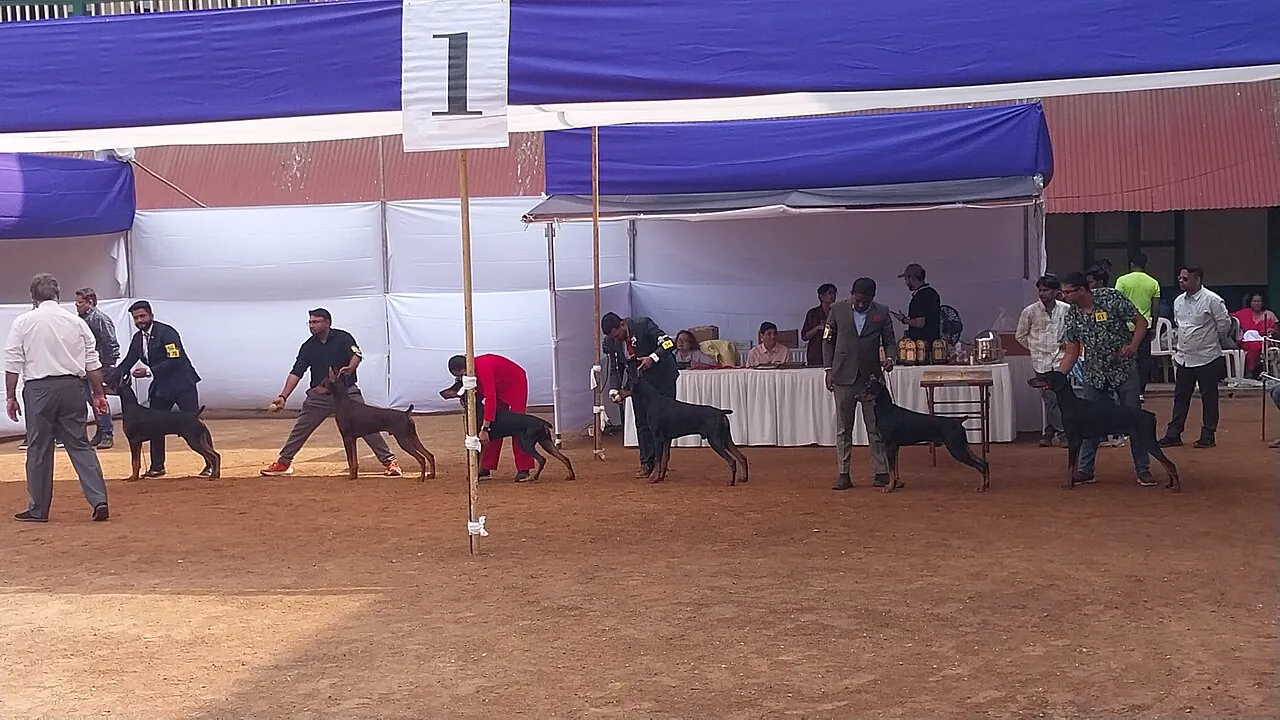
In a busy ring, judges often have about two minutes per dog to make a decision. Handlers begin by posing the dog in its natural stance, called stacking, so the judge can read its overall silhouette, proportions, and balance.
Next comes a hands-on examination on the ground, a ramp, or a table, depending on the breed. The judge checks skeletal structure, muscle tone, bite, and coat texture, and uses a measuring wicket or scale whenever a breed standard specifies height or weight limits.
Finally, the handler trots the dog across the ring so the judge can assess its gait, or stride, for smooth and efficient movement. Standard AKC ring patterns include circling the ring (“Around”), running straight away and back (“Down and back”), moving in a triangle, and occasionally following an L or T pattern.
How does a dog advance from Breed to Best in Show?
At a standard American Kennel Club all-breed show, which can draw over 3,000 entries, every dog follows the same three-stage elimination ladder. Losing at any stage ends that dog’s run for the day.
- Breed competition starts with non-champions divided by sex into seven regular classes, including Puppy, 12-to-18 Month, Bred-by-Exhibitor, American-bred, and Open (the only regular class champions may enter). First-place class winners compete for Winners Dog (males) and Winners Bitch (females), who then join existing Champions to compete for Best of Breed (or Best of Variety), Best of Winners, Best of Opposite Sex, and optional Select awards.
- Group judging brings every Best of Breed winner into one of seven AKC groups organized by historical function: Sporting, Hound, Working, Terrier, Toy, Non-Sporting, and Herding (which split out from the Working Group in 1983). Judges award first through fourth place in each group, and only the Group 1st winner advances.
- Best in Show puts the seven group winners in the final ring together. The judge typically announces Reserve Best in Show first (a runner-up honor the AKC introduced in 2012) and then awards Best in Show, traditionally marked with a red, white, and blue ribbon, to the lone undefeated dog of the event.
Not every event runs all three stages. Single-breed specialty shows stop after Best of Breed, while Champions-only invitationals like the Westminster Kennel Club Dog Show skip the regular non-champion classes, begin directly at Best of Breed, and let judges hand out optional Awards of Merit to standout runners-up.
How do AKC championship points and rankings work?
Because television broadcasts often mention point totals, it is easy to assume judges add up points to pick Best in Show. Under AKC rules, points track two separate long-term goals: earning official championship titles and climbing the annual national rankings.
Championship title points are awarded only to Winners Dog, Winners Bitch, or non-champions that take Best of Winners, Best of Opposite Sex, Best of Breed, or a Group placement. The number of points depends on regional, breed-and-sex-specific Point Schedules based on how many present, non-disqualified dogs were defeated, with a hard cap of 5 points per show.
A common trap in counting points is assuming Best of Winners combines the male and female totals. According to the official AKC point-counting guide, if a Winners Dog defeats 3 regular-class males for 2 points and a Winners Bitch defeats 4 regular-class females for 3 points, beating her for Best of Winners gives the male 3 points—the higher of the two counts, never 5 combined. If that same male then wins Best of Breed over 3 regular-class males plus 3 Champions (6 dogs total), he reaches the single-show maximum of 5 points.
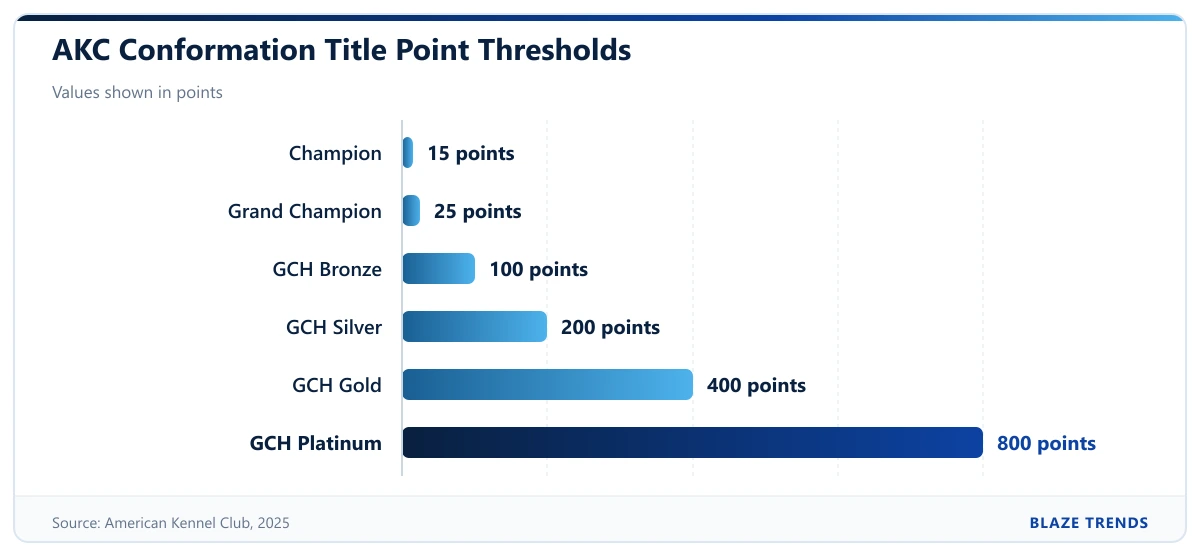
To earn the AKC Champion (CH) title as of 2025, a dog needs at least 15 championship points, including two “major” wins of 3, 4, or 5 points under two different judges, plus at least 1 point under a third judge. Current regional schedules are posted on the AKC’s conformation pages since breed entry numbers change over time.
Champions can then compete in Best of Breed classes toward the Grand Champion (GCH) title, which requires 25 GCH points, three majors under three different judges, at least 1 point under a fourth judge, and defeating at least one other Champion at three separate shows. Cumulative GCH points unlock higher levels at Bronze (100 points), Silver (200 points), Gold (400 points), and Platinum (800 points, increasing every 800 points thereafter).
National ranking “breed points” work on a completely different scale. According to the National Dog Show’s judging overview, AKC rankings credit 1 point for every dog defeated at a show, allowing top-campaigning show dogs to pass 50,000 points in a single year.
How do dog show rules differ in the US, the UK, and Europe?
If you watch Crufts in the United Kingdom or an international show in Europe, the ring procedure will look familiar, while the breed groups and title rules change significantly. Each major governing body sets its own path to a championship.
| Governing body | Breed groups | Judging format | Main championship path |
|---|---|---|---|
| AKC (United States) | 7 groups (Sporting, Hound, Working, Terrier, Toy, Non-Sporting, Herding) | Elimination against breed standard; no written quality grades | 15 points including 2 majors under at least 3 different judges |
| The Royal Kennel Club (United Kingdom) | 7 groups (Gundog, Hound, Pastoral, Terrier, Toy, Utility, Working) | Elimination against breed standard; Crufts entry via qualifying wins or Stud Book number | 3 Challenge Certificates (CCs) under 3 different judges |
| FCI (International) | 10 separate breed groups | Qualitative ratings (Excellent, Very Good, Good, Disqualified); top 4 require at least Very Good | Discretionary FCI-CACIB certificates from “Excellent 1st” wins |
In the United Kingdom, The Royal Kennel Club awards Challenge Certificates (CCs) instead of regional AKC points. As of 2025 regulations, Gundogs and Border Collies that win three CCs without passing a working or field qualification receive the Show Champion (Sh Ch) title rather than full Champion status. At Crufts, the English Cocker Spaniel holds the all-time record with 7 Best in Show wins as of 2026, ahead of Irish Setters, Standard Poodles, Welsh Terriers, and Whippets at 4 wins each.
Across Europe and other member nations, the 2026 FCI show regulations require judges to assign formal written ratings rather than only picking placements. Only a dog rated “Excellent 1st” of superior quality in the intermediate, open, working, or champion class can be proposed for an FCI-CACIB certificate toward International Beauty Champion status, and judges must disqualify any dog showing breed-standard disqualifying faults or health-threatening extremes.
Frequently asked questions
Can you enter a spayed, neutered, or mixed-breed dog in a conformation show?
No. Because conformation events evaluate breeding stock to preserve breed traits, 2026 AKC rules require regular-class entrants to be at least 6 months old, AKC-registered in a recognized breed, healthy, vaccinated, and intact. Spayed females, neutered males, males without two normal testicles normally located in the scrotum, and dogs with prohibited surgical alterations (such as hip dysplasia surgery, skin fold removal, artificial testicles, or altered tail carriage) are disqualified.
How does a judge compare two completely different breeds in Best in Show?
The judge does not weigh whether one breed’s size, coat, or silhouette looks nicer than another’s. Instead, the judge measures how closely each of the seven group winners matches its own parent-club breed standard and picks whichever dog comes closest to its breed’s ideal on that day.
How do dog show judges get qualified to evaluate a breed?
In the AKC system, aspiring conformation judges must pass breed standard exams, interviews with Executive Field Representatives, and wicket or scale proficiency tests, often qualifying through the “12-5-4” route of at least 12 years exhibiting, 5 litters bred and whelped, and 4 champions produced. Judges also follow strict impartiality rules, including a six-month cooling-off period after co-owning dogs with an exhibitor.