
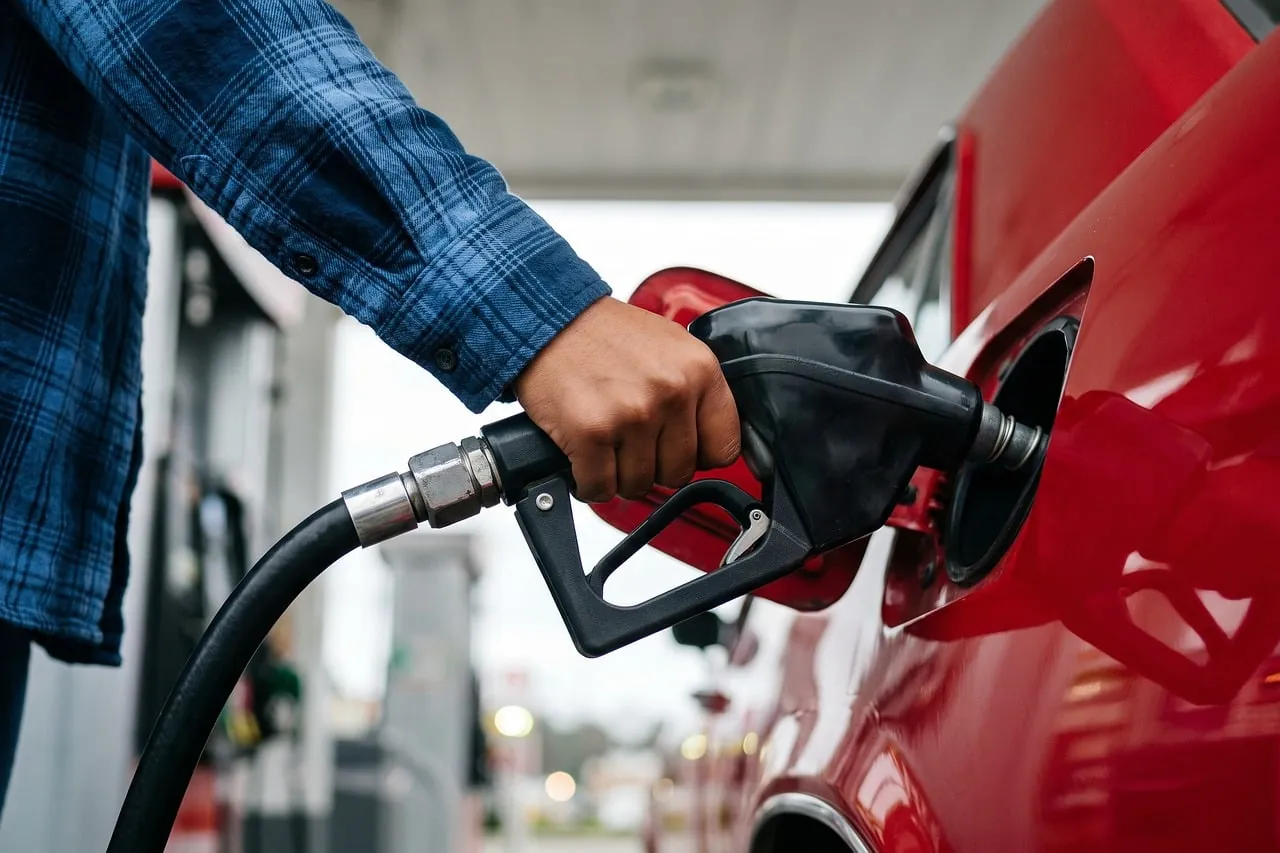
Geopolitical conflicts affect domestic gasoline prices because crude oil trades on a single, globally integrated market and accounts for just over half of what you pay at the pump. When wars, economic sanctions, or threats to major oil-producing regions disrupt global supply—or prompt futures traders to price in the risk of a shortage—international crude benchmarks rise, passing through to local gas stations at a rate of about 2.4 cents per gallon for every $1 increase per barrel of crude.
Even if you live in a major oil-producing country like the United States, your local station’s pump price is tied to those global benchmarks. Domestic refineries buy and sell on the international market to match the specific classes and grades of crude oil their equipment is built to process, meaning an overseas supply shock hits domestic drivers within days.
What makes up the retail price of a gallon of gasoline?
To see why overseas conflicts move local pump prices so quickly, it helps to look at how a gallon of fuel is priced. According to the U.S. Energy Information Administration (EIA) data published in 2026, the average US retail price for regular gasoline in 2025 was $3.10 per gallon, split across four components:
| Price component | Share of 2025 US retail price | 2016–2025 decade average share |
|---|---|---|
| Crude oil costs | 51.4% | 51.7% |
| Distribution and marketing | 17.8% | 15.6% |
| Federal and state taxes | 16.6% | 17.2% |
| Refining costs and profits | 14.3% | 15.5% |
Over the 2016–2025 decade, the average US retail price for regular gasoline was $2.89 per gallon, with crude oil consistently making up more than half of the total cost. Long-run economic research on US weekly data published in the Journal of International Money and Finance in 2021 shows that oil price shocks explain about three-fourths (75%) of the weekly volatility in retail gasoline prices.
The non-crude portions of the price vary by country, state, and season. In the United States, drivers pay a federal excise tax of 18.40 cents per gallon, while state taxes and fees averaged 33.55 cents per gallon as of January 2026, before adding local municipal and sales taxes. Refining costs also differ by region and time of year because states require specific fuel formulations to reduce air pollution, alongside mandatory summer-blend gasoline requirements. Across other countries, the consumer price impact of an oil shock depends on local fuel tax structures, how heavily the national economy relies on oil for industrial production, and whether the country is a net oil importer or exporter.
How do geopolitical conflicts push crude oil and pump prices up?
When a geopolitical crisis breaks out, you do not have to wait for physical oil wells or tankers to be damaged before domestic gasoline prices react. A 2026 discussion paper from the London School of Economics (LSE) shows that financial commodity markets price in geopolitical threats preemptively, driving oil prices up before any physical supply is lost. After an initial inventory drawdown to cover immediate supply shortfalls, market buyers engage in precautionary hoarding, building up and keeping oil inventories elevated to buffer against further conflict escalation.
You can estimate how a geopolitical crude spike translates to your local station using a standard industry rule of thumb. Because a barrel of crude oil holds 42 gallons, data from the National Association of Convenience Stores (NACS) published in 2026 shows that retail gasoline prices shift by an estimated 2.4 cents per gallon for every $1 change per barrel of crude oil.
Here is how the math works in plain numbers during a hypothetical supply shock:
- Start with the 2025 US average regular gasoline price of $3.10 per gallon, where crude oil accounts for 51.4% (about $1.59 per gallon).
- Suppose sanctions or military tensions near a major oil producer push global crude oil benchmarks up by $20 per barrel, and in severe shocks where $100 oil ignites inflation fears, central banks and consumers face immediate cost pressure.
- Multiply the $20 per barrel increase by 2.4 cents per gallon ($20 × $0.024 = $0.48).
- If distribution, refining, and tax costs stay flat, that $20 crude jump adds about 48 cents per gallon at the pump, raising a $3.10 gallon of gas to roughly $3.58.
Why do some conflicts lower oil prices instead of raising them?
A common misconception is that every international war or political crisis automatically triggers a lasting surge in gasoline prices. According to a 2024 analysis by the European Central Bank (ECB), geopolitical risk pulls crude oil prices in two opposing directions at the same time:
- The risk channel: When a conflict threatens oil supply or shipping routes, traders value holding immediate oil contracts more highly (known as a higher convenience yield) and demand a risk premium, which pushes Brent crude prices up.
- The economic activity channel: Heightened geopolitical uncertainty slows down global trade, consumer spending, and industrial production (reducing global industrial production by about 0.1% in the ECB’s model), which lowers expected demand for fuel and pulls oil prices down.
Which channel wins depends on whether the conflict involves a major oil producer or a strategic distribution route. Historical market reactions cited by the ECB and LSE illustrate the difference:
- Ahead of the 1990 Gulf War, oil prices jumped 14% as markets priced in direct threats to Middle Eastern supply (LSE, 2026).
- After the September 11, 2001 attacks in the United States, Brent crude rose 5% initially, but because the event did not cut physical oil supply and instead sparked fears of an economic slowdown, prices fell by around 25% within 14 days (ECB, 2024).
- When Russia invaded Ukraine in February 2022 and Western nations imposed economic sanctions on a major energy exporter, LSE researchers noted an immediate 8% jump in oil shock measures, and the ECB recorded that Brent crude surged by nearly 30% within the first two weeks before returning to pre-invasion levels after about eight weeks.
Why do gas prices rise fast during a crisis but fall slowly afterward?
Drivers often notice that local pump prices climb rapidly when a conflict dominates the news, yet take weeks to come back down after tensions ease. According to NACS (2026), this pattern comes down to how gas stations buy wholesale fuel and manage local competition.
Retailers buy fuel either through long-term supply contracts (which can last 10 years or more) or on the open wholesale spot market. When a geopolitical shock tightens supply, wholesale prices jump first. Suppliers may place volume allocations on contracted stations to ration inventory, while uncontracted stations have to pay steep premiums on the open market just to keep their underground tanks full.
Even then, retail pump prices typically lag wholesale price spikes by several days because station owners price their fuel based on nearby competitors and their next scheduled delivery. Because drivers compare prices across the street, stations often absorb part of the wholesale surge at first, shrinking their retail profit margins. Once the geopolitical crisis cools and wholesale fuel costs drop, retailers lower their pump prices slowly so they can widen their markup and recover the profits they lost while prices were peaking.