
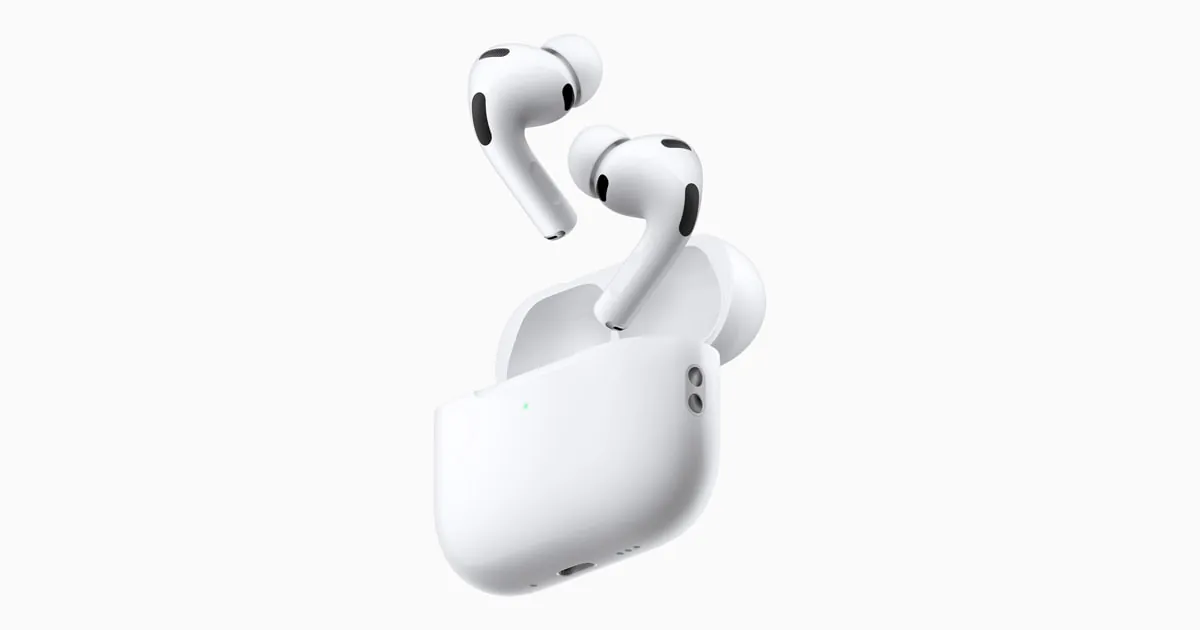
Active noise cancellation in earbuds uses tiny microphones to measure surrounding sound, a digital processor to invert those waves, and the speaker to play the opposing anti-noise into your ear. When outside noise meets anti-noise in your ear canal, their opposite pressure changes cancel out. A snug ear-tip seal then blocks sharper high-pitched sounds.
ContentsToggle
How do earbuds cancel sound waves?
Every sound you hear travels through air as rapid waves of higher pressure, called compressions, followed by lower pressure, called rarefactions. The size of those pressure swings sets the loudness, while the speed of oscillation sets the pitch.
To erase an unwanted sound electronically, an earbud builds a mirror-image wave with the exact same frequency and matched pressure amplitude, shifted half a cycle out of phase. Physicists call this an antiphase wave, and it must arrive at your eardrum at the same instant as the incoming noise.
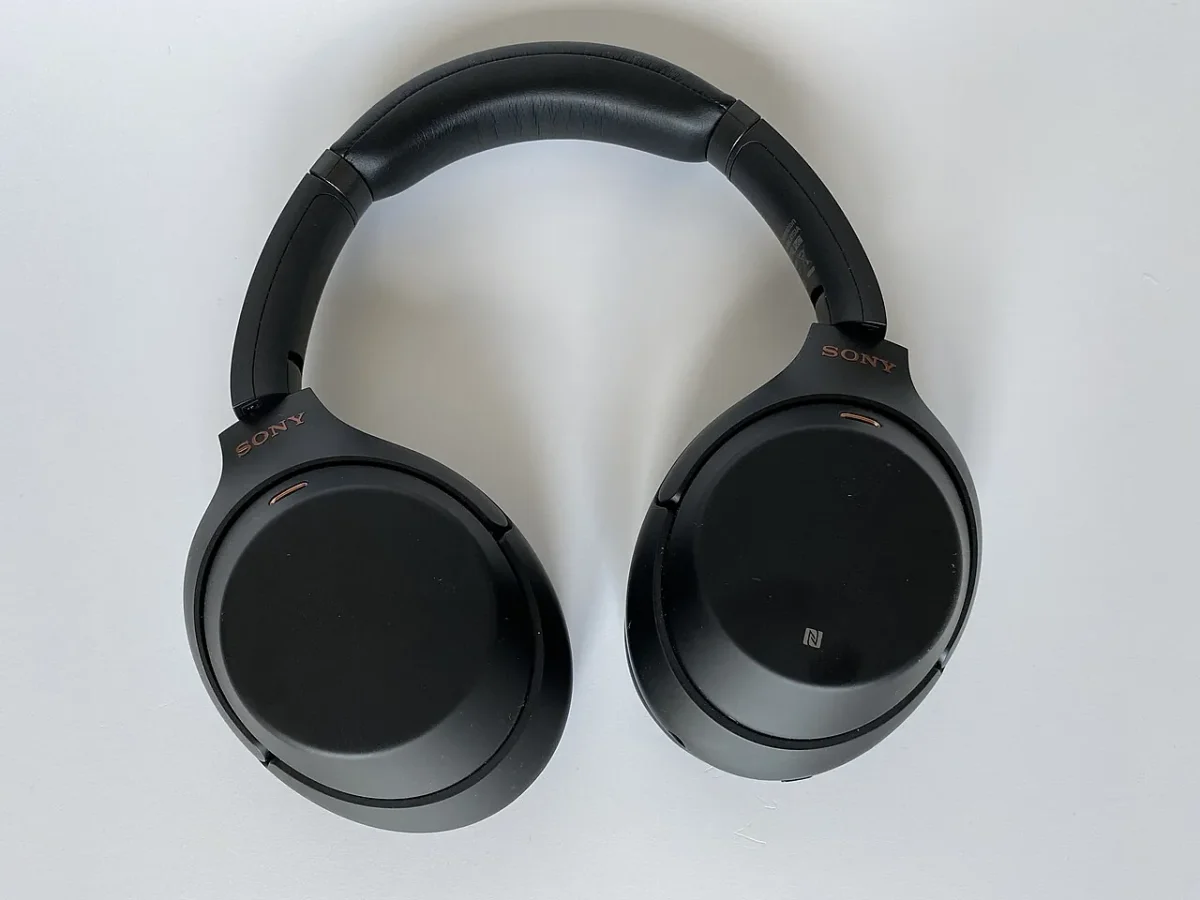
When a peak of positive air pressure from a jet engine collides with a trough of negative pressure from your earbud speaker, the two forces flatten each other out. That principle, known as destructive interference, reduces the net vibration reaching your eardrum without removing the music or podcast you want to hear.
Paul Lueg patented the idea of silencing sound oscillations in 1936 under US Patent 2,043,416, long before pocket-sized electronics existed. The first commercial active noise reduction headsets appeared in aviation during the late 1980s, delivering roughly 20 dB of attenuation across a narrow 50 to 500 Hz range.
What hardware runs feedforward, feedback, and hybrid ANC?
Shrinking that physics into a wireless earbud takes three parts working in a tight loop: miniature microphones, a low-latency digital signal processor (DSP), and the speaker driver. According to the IEEE Technology Navigator, controllers rely on adaptive filters such as the filtered-x least mean squares (FxLMS) algorithm to update the anti-noise signal continuously as surroundings shift.
Where engineers place those microphones changes how well an earbud handles wind, movement, and fit. Most consumer earbuds use one of three active architectures paired with passive physical blocking.
| Method | Microphone placement | Main strength | Key trade-off |
|---|---|---|---|
| Feedforward ANC | Outside the earbud shell | Samples noise early and fits compact shells | Cannot hear ear-canal leaks and can amplify wind |
| Feedback ANC | Inside the canal facing the speaker | Handles wind well and tracks low frequencies | Less processing time and weaker high-end blocking |
| Hybrid ANC | Both outside and inside the earbud | Broadest frequency coverage and fit correction | Higher manufacturing cost and battery draw |
| Passive isolation | None (silicone or foam ear tip) | Blocks sharp, sudden, high-pitched sounds | Cannot block long low-frequency wavelengths well |
Feedforward earbuds listen from the outside, giving the chip extra reaction time before sound enters your ear. Because the outer mic cannot hear what actually leaks past the shell, a sudden gust of wind across the grille can confuse the filter and create a harsh howl.
Feedback earbuds flip that setup by placing an error microphone inside the ear canal in front of the speaker. That mic hears the leftover noise your eardrum hears and tweaks the filter on the fly, though the shorter travel path leaves less time to cancel faster oscillations.
Modern flagship earbuds combine both setups into digital hybrid ANC and add custom silicon to recalculate the filter thousands of times each second. Apple’s 2024 announcement noted that computational audio on AirPods Pro 2 processes environmental noise reduction 48,000 times per second.
Other makers pair dedicated chips with physical acoustic tuning. Sony’s HD Noise Cancelling Processor QN1 senses ambient noise and driver-to-ear acoustics more than 700 times per second, while its Dual Noise Sensor designs with the Integrated Processor V1 add a Wind Noise Reduction Structure around the outer mics. Bose uses CustomTune, playing a brief chime inside your ear canal and measuring the echo with an inner microphone to tailor the cancellation filter to your ear shape.
Why does active noise cancellation block engines better than voices?
Low-frequency sounds like cabin roar, train rumble, and air conditioners have long, repeating wavelengths. Because those waves stay steady from one millisecond to the next, the earbud’s DSP can predict the next pressure peak and emit a matching antiphase wave in time.
Human voices, car horns, and barking dogs sit higher in frequency and change volume and pitch abruptly. Short, unpredictable wavelengths run straight into physical limits of causality and acoustic path delay, so the processor cannot always invert them before they hit your eardrum.
Passive isolation fills that exact gap. Physical materials easily absorb and reflect short, high-pitched sound waves, whereas blocking deep bass rumble passively would require walls far too thick and heavy to wear in your ears.
Those same outward microphones also flip the script when you want to hear your surroundings. Transparency or Aware modes pass outside audio cleanly into your ear without inverting it, while adaptive settings blend cancellation and passthrough automatically when noise levels spike or you start talking.
How much does ear-tip seal matter for noise cancelling?
Electronic cancellation only reaches its peak when a physical silicone or foam-infused tip seals your ear canal. That seal blocks high-pitched chatter passively and gives the internal feedback microphone a consistent acoustic chamber to measure.
Open-fit ANC earbuds rest outside the ear canal without silicone tips, which avoids a plugged-in sensation. Because outside sound leaks freely around the hard plastic shell, open designs lose both passive blocking and low-end cancellation depth.
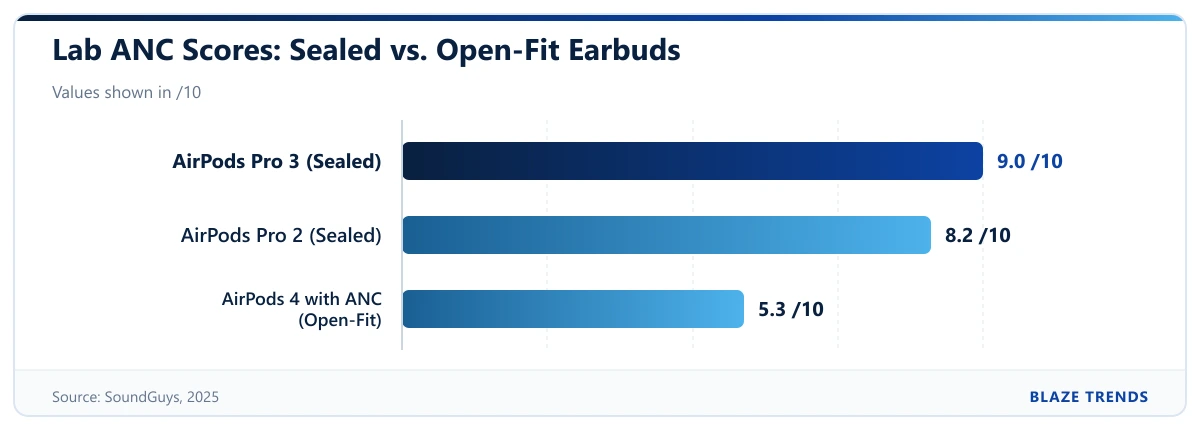
Lab measurements show how wide that hardware gap gets. In November 2025 SoundGuys lab testing, sealed Apple AirPods Pro 3 earbuds cut outside noise by an average of 90% and scored 9.0 out of 10, edging out flagship over-ear models including the Apple AirPods Max at 88%, the Sony WH-1000XM6 at 87%, and the Bose QuietComfort Ultra Headphones 2nd Gen at 87%.
Within the same brand, SoundGuys measured sealed AirPods Pro 2 at 8.2 out of 10, while open-fit AirPods 4 with ANC scored 5.3 out of 10 and attenuated roughly 20 dB in ideal conditions. Getting close to those lab figures in daily use depends on configuring your listening modes and dialing in the physical seal:
- On Apple AirPods Pro, AirPods 4 with ANC, AirPods 5, and AirPods Max, switch between Noise Cancellation, Transparency, Adaptive Audio (which adds an ambient-sound slider on iOS 27 and iPadOS 27 or later), and Off Listening Mode, or enable Noise Cancellation with One AirPod under Accessibility if you wear a single bud.
- On Bose QuietComfort Ultra Earbuds, pick Quiet mode for maximum blocking, Aware mode with ActiveSense to dampen sudden loud spikes automatically, or save up to two Custom modes inside the Bose app.
- On supported Sony headphones and earbuds, adjust 20-level Ambient Sound Control and toggle Focus on Voice in the Sound Connect app to let speech through while suppressing low rumble.
If active noise cancellation suddenly sounds weak or makes a sharp whistling sound, start by troubleshooting the physical seal rather than resetting Bluetooth. A whistle signals a poor fit or microphone feedback issue, and built-up debris can degrade attenuation.
- Run the built-in fit check if your earbuds support one, such as the Acoustic Seal Test on AirPods Pro.
- Test multiple ear-tip sizes independently in each ear, since left and right ear canals often need different sizes (AirPods Pro 3 ship with five sizes of foam-infused tips).
- Inspect and gently clean earwax or lint from the ear tips and outer microphone openings, then retest in a room with steady fan or appliance hum.
Can noise-cancelling earbuds replace certified hearing protection?
Quieting background roar lets you listen to music or podcasts at lower, safer volumes instead of cranking playback to overpower train or engine noise. Even so, regular consumer earbuds are not automatically rated to protect your hearing in loud environments.
In its official NIOSH hearing protection guidance, the CDC notes that active noise cancellation “can be added to headphones or earbuds which will cancel noise but should not be considered hearing protection unless labeled with an NRR” (Noise Reduction Rating).
Rules vary by region and workplace standard. In the United States, OSHA regulations (29 CFR 1910.95 and 29 CFR 1926.52) treat repeated workplace noise at or above 85 dBA as hazardous and require employers to verify protection through an EPA-labeled NRR or individualized fit testing called a Personal Attenuation Rating (PAR). In regions following European EN 352 standards, Apple AirPods Pro 3 include a dedicated EN 352 Hearing Protection setup inside Settings.
Even earbuds with tested attenuation modes have hard limits. Apple’s 2026 support documentation states that AirPods Pro 2 and AirPods Pro 3 Hearing Protection draws on ANSI/ASA S12.68-2007 attenuation data and World Health Organization exposure limits (80 dBA for up to 40 hours per week for adults), but warns the feature is not suitable for sudden impulse blasts like gunfire, fireworks, or jackhammers, or sustained noise above 110 dBA.
Situational awareness and ear hygiene matter too. Cleveland Clinic audiologist Dr. Valerie Pavlovich Ruff noted in April 2026 that wearing noise-cancelling earbuds while sleeping or in hazardous settings can block alarms or emergencies, and prolonged in-ear wear can push earwax deeper or trap moisture and cause outer-ear infections.
Frequently asked questions
Can you use active noise cancellation without playing music?
Yes. Most ANC earbuds let you keep noise cancellation running in silence with no audio streaming. Some models, such as Bose QuietComfort Ultra Earbuds, also support a Noise Cancelling Only mode even while disconnected from Bluetooth.
Does active noise cancellation drain earbud battery faster?
Yes, because running multiple microphones and a real-time digital signal processor continuously draws extra power compared with passive playback. Newer low-power chips have narrowed the gap: Apple rates AirPods Pro 3 for up to 8 hours of listening with ANC turned on, and SoundGuys measured 8 hours and 42 minutes at 75 dB.
Why do some people feel ear pressure when ANC turns on?
Strong hybrid cancellation can trigger a cabin-pressure feeling or mild dizziness in sensitive listeners, though ANC itself does not harm your hearing. Manufacturers build pressure-equalizing vents into sealed earbuds like AirPods Pro to ease that sensation, and lowering the ANC level or switching to an adaptive mode usually helps.