
The U.S. Senate voted 62 to 33 on Thursday night, November 19, 2026, to pass the Bipartisan American Affordability and Jobs Act, a broad permitting bill designed to speed up federal approvals for energy and infrastructure projects across the country. The New York Times reported that nearly every Republican senator supported the measure, while only 15 senators who caucus with Democrats voted yes.
Four senators negotiated the package: Environment and Public Works Chair Shelley Moore Capito of West Virginia, Energy and Natural Resources Ranking Member Martin Heinrich of New Mexico, Mike Lee of Utah, and Sheldon Whitehouse of Rhode Island. Senators originally introduced the legislation on September 30 as S. 5653 and passed it Thursday as substitute amendment No. 6883 to H.R. 2347. President Donald Trump endorsed the bill on Truth Social and has indicated he will sign it if it reaches his desk.
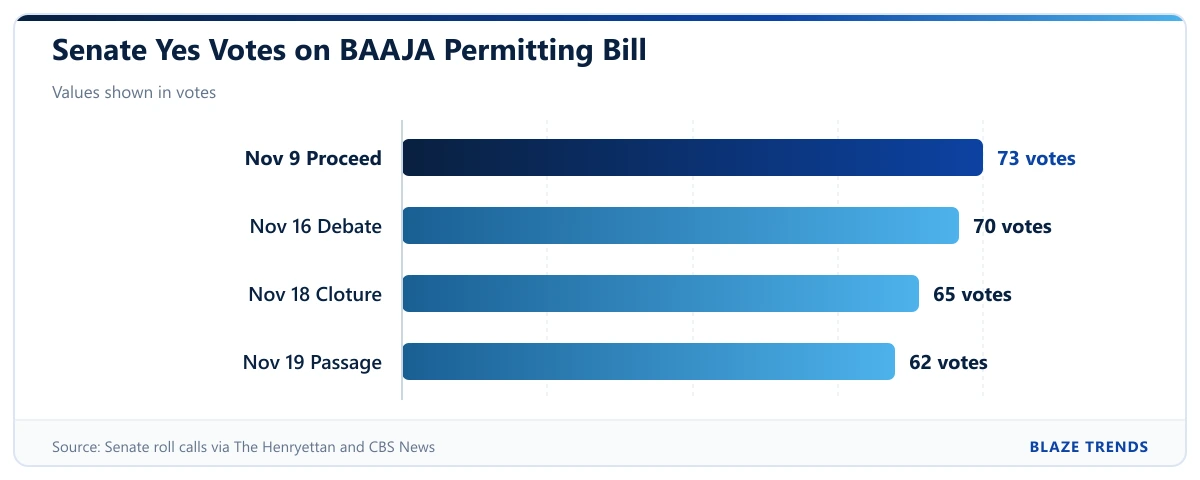
Support in the Senate narrowed across ten days of floor votes as environmental groups and tribal leaders stepped up their opposition. The chamber voted 73 to 25 on November 9 to begin debate, 70 to 27 on November 16 on a debate motion, and 65 to 31 on November 18 to end debate before Thursday’s 62 to 33 passage.
What the permitting bill changes
The bill amends federal environmental review laws, including the National Environmental Policy Act (NEPA), to accelerate approvals for high-voltage electric transmission lines of 230 kilovolts (kV) or more, wind and solar farms, natural gas pipelines, gas-fired power plants, railway expansions, broadband, and housing. According to the Bipartisan Policy Center, it shortens the statute of limitations for legal challenges under NEPA and the federal FAST-41 permitting program to 150 days, down from two years under FAST-41. It also directs appellate courts to assign judges randomly where practicable and standardizes public comment windows at 45 to 60 days, extendable to 75 days if the lead agency and project sponsor agree.
A permit-durability clause makes issued federal permits nearly impossible for future administrations to revoke except in narrow cases such as fraud, a court order, or an immediate threat to health or the environment. Inside Climate News reported that the rule covers permits in effect on or after November 6, and federal agencies found to have interfered in bad faith could owe developers 25% to 50% of their spending. The measure also allows agencies to forgo separate NEPA reviews when state, tribal, or other federal reviews serve a similar function, and grants categorical exemptions for interstate natural gas pipeline repairs and upgrades inside existing corridors up to a quarter-mile limit.
For electricity ratepayers, the bill requires data centers to pay their own electric grid and transmission upgrade costs instead of shifting them onto other customers, a provision Capito described as the Ratepayer Protection Act. In Heinrich’s press release, the New Mexico Democrat said the deal will bring more affordable energy onto the grid faster, require data centers to pay their share of grid costs, and create more than 100,000 jobs while maintaining environmental protections and tribal consultation. “Because this bill seeks to cut some of the red tape of getting that supply of energy online, it would then put a downward pressure on some of those price increases,” Jack Andreasen Cavanaugh, director of the carbon management program at Columbia University’s Center on Global Energy Policy, told TIME.
Supporters and critics split over environmental and tribal rules
Business groups, labor unions, the AI and energy sectors, and major oil companies including ExxonMobil and Chevron backed passage, pointing to long permitting delays on major projects such as the SunZia clean energy transmission line, which came online in New Mexico in June 2026 after nearly two decades. Heinrich argued the bill could cut major power line permitting to about five years, while Whitehouse said in a Wednesday video on X that the measure produces gigaton-scale carbon emissions reductions and urged colleagues to pass it now rather than wait for the next Congress. National Ocean Industries Association President Erik Milito praised the vote in a statement, saying, “We urge the House to quickly send meaningful permitting reform to the President’s desk.”
Most Senate Democrats voted no, including California Sen. Alex Padilla, joining opposition from the Sierra Club, Earthjustice, the National Wildlife Federation, the ACLU, the National Trust for Historic Preservation, and the National Congress of American Indians. Environmental groups warned that shorter lawsuit limits restrict communities from fighting polluting facilities, while Earthjustice said Section 1401 of the bill could lock in seabed mining leases. Ahead of the November 9 vote, the Environmental Defense Fund acknowledged the bill’s power-line provisions but said it unwinds air, water, and community protections.
Tribal provisions drew sharp disagreement between sponsors and Indigenous groups. While the bill adds a federal Freedom of Information Act (FOIA) exemption for Tribal Historic Preservation Officer databases, it gives agencies control over when tribal consultations end if a tribe does not respond. A coalition of tribal organizations said the revised amendment “does not adequately address the serious concerns raised by Tribal Nations across the country,” as reported by The Henryettan.
Uncertain path in the House before January
The legislation now moves to the Republican-controlled House of Representatives, where lawmakers face a crowded lame-duck schedule. Congress is away from Washington next week and must still fund the federal government before the new Democratic-controlled Congress takes office on January 3, 2027. Speaking to reporters Thursday, Sen. John Thune urged House lawmakers to approve the Senate bill without edits, saying, “The best way to get anything done around here is for them to pick up the bill and pass it,” according to CBS News.
House Democratic leaders signaled they will not quickly accept the Senate package as written. “Leader Jeffries will not rubber-stamp legislation that emerges from the Senate without more constructive involvement with our caucus as we fight to make life more affordable for the American people,” a spokesperson for House Democratic Leader Hakeem Jeffries told CBS News, and if the bill is not passed and signed before January 3, it expires and lawmakers must start over.