
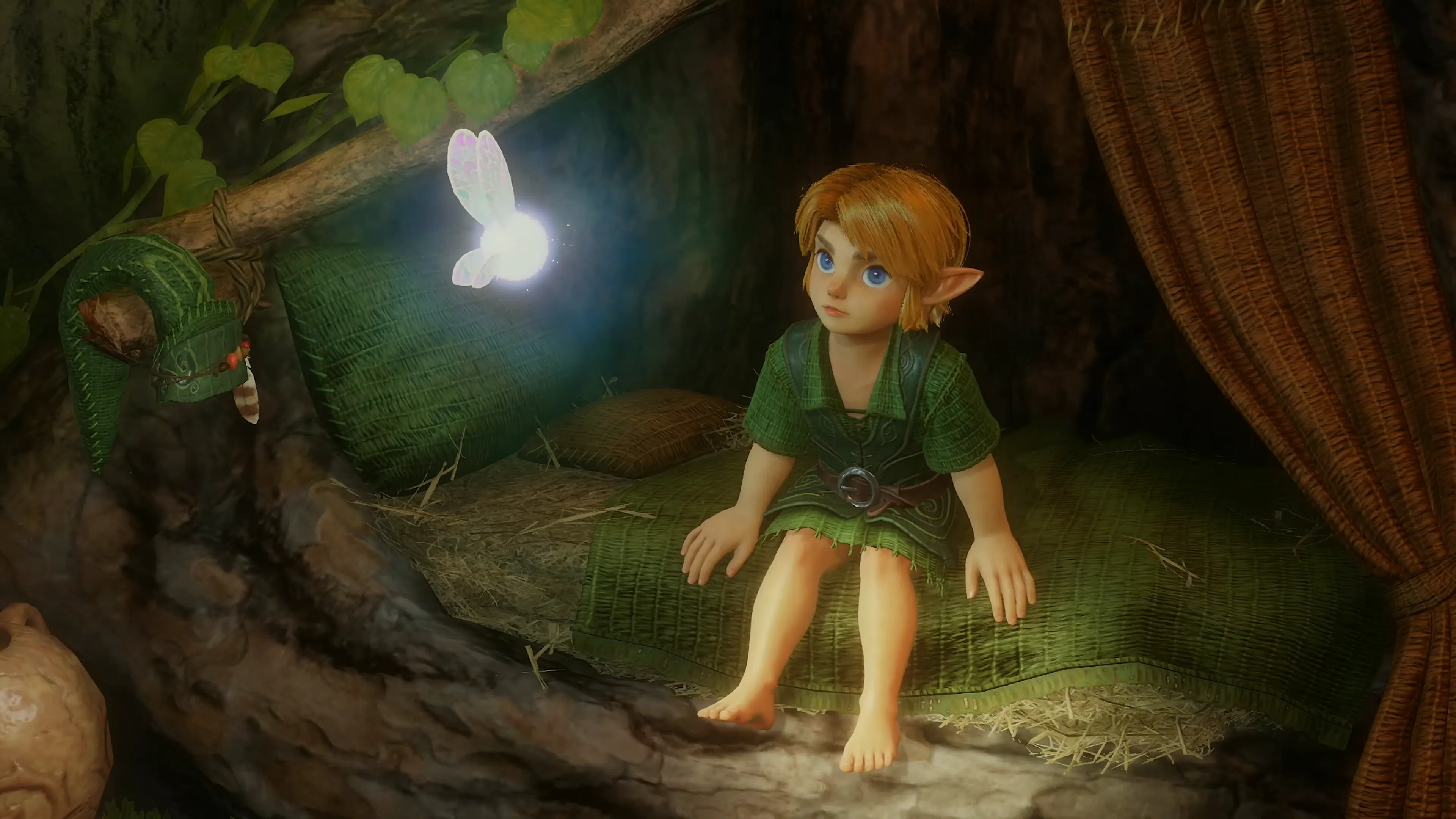
Modders have the Ocarina of Time remake running on Windows PCs and Apple Silicon Macs just days after its November 5 launch as a Nintendo Switch 2 exclusive. Players who dump their own legally owned copy of the game from a jailbroken console can now run it on desktop hardware using a native Windows recompilation tool called Hookshot, experimental Switch 2 emulators with NVIDIA DLSS 5 support, or the macOS translation layer Nxnative.
The fastest results on Windows come from Hookshot, an experimental static recompiler released by developer NotRexed and detailed by Videocardz. Instead of emulating the Switch 2 hardware in real time, Hookshot translates the game’s ARM64 code into C and compiles it into a native 64-bit Windows application running on the Vulkan 1.3 graphics API.
How Hookshot and DLSS 5 perform on Windows
According to developer NotRexed, Hookshot runs the game’s opening Kokiri Forest area at roughly 50 frames per second without frame generation on a mid-range desktop equipped with an AMD Ryzen 5 7600X processor and an NVIDIA GeForce RTX 4060 Ti 16GB graphics card. Pressing the Insert key opens an in-game menu that adds 2x, 3x, and 4x frame generation, Catmull-Rom and Lanczos upscaling, resolution scaling from 50 percent to 100 percent, ultrawide monitor support, and two game-speed modes (Per-frame and Real-time).
Building the native Windows executable through HookshotBuilder takes about 40 minutes, according to Windows Forum. Users must provide their own dumped copy of game build e0f3ccfa along with Visual Studio C++ Build Tools, the Windows SDK, at least 16 GB of RAM, and roughly 60 GB of free storage space.
Alongside static recompilation, traditional Switch 2 emulators are also running the remake on Windows 11. The open-source emulator Lichii, a C++20 and Vulkan fork of Eglantine maintained on GitHub by developer zortos293, booted the game on launch day and reaches 40 to 60 frames per second inside the Great Deku Tree on top-tier graphics cards such as the GeForce RTX 4080, RTX 4090, and RTX 5080. Open-world areas still suffer from graphical glitches, and the Lichii project notes in its documentation that passing automated checks does not guarantee accurate rendering or stable frame rates.
Community forks of Lichii are already layering AI graphics tools onto the remake. As XDA Developers reported, YouTuber ItsOOGWAY posted footage of the game running on PC with NVIDIA DLSS 5 and Live Flow Multi Frame Generation using a Lichii fork named Fritzi and a community-built DLSS 5 manager. Those tools add AI upscaling and extra surface detail missing from the official Switch 2 release, which relies on AMD’s older spatial upscaler FSR 1.0 and drew player complaints over foliage clarity.
Native ARM64 execution on Mac and iPhone
Switch 2 titles are running even more smoothly on Apple hardware because both the console and Apple Silicon devices use ARM64 processors. The open-source compatibility layer Nxnative works similarly to Wine on Linux: it executes the game’s original ARM64 code directly on Apple chips while recreating Switch system services and translating the console’s NVN2 graphics calls to Apple’s Metal API.
According to the project’s GitHub documentation, Nxnative runs version v131072 of the remake at a locked 60 frames per second at a 1536×864 internal resolution on an M6 Mac with 16 GB of RAM, using about 11 GB of memory through Kokiri Forest. While the official Nxnative repository lists only the macOS build as formally tested on macOS 26.6 with Xcode 27.2, both XDA Developers and Videocardz report that developer Joe Jiang (@happyjoejiang on X) has also demonstrated a working iPhone port built with the tool.
None of the PC or Mac tools distribute copyrighted Nintendo code or encryption keys, requiring owners to extract files from their own jailbroken Switch 2 hardware. Nintendo has not commented publicly on Hookshot, Lichii, or Nxnative, though the company recently pulled the programming app SmileBASIC 4 from the Nintendo eShop after modders used it as an entry point for the ns2jb console exploit.