
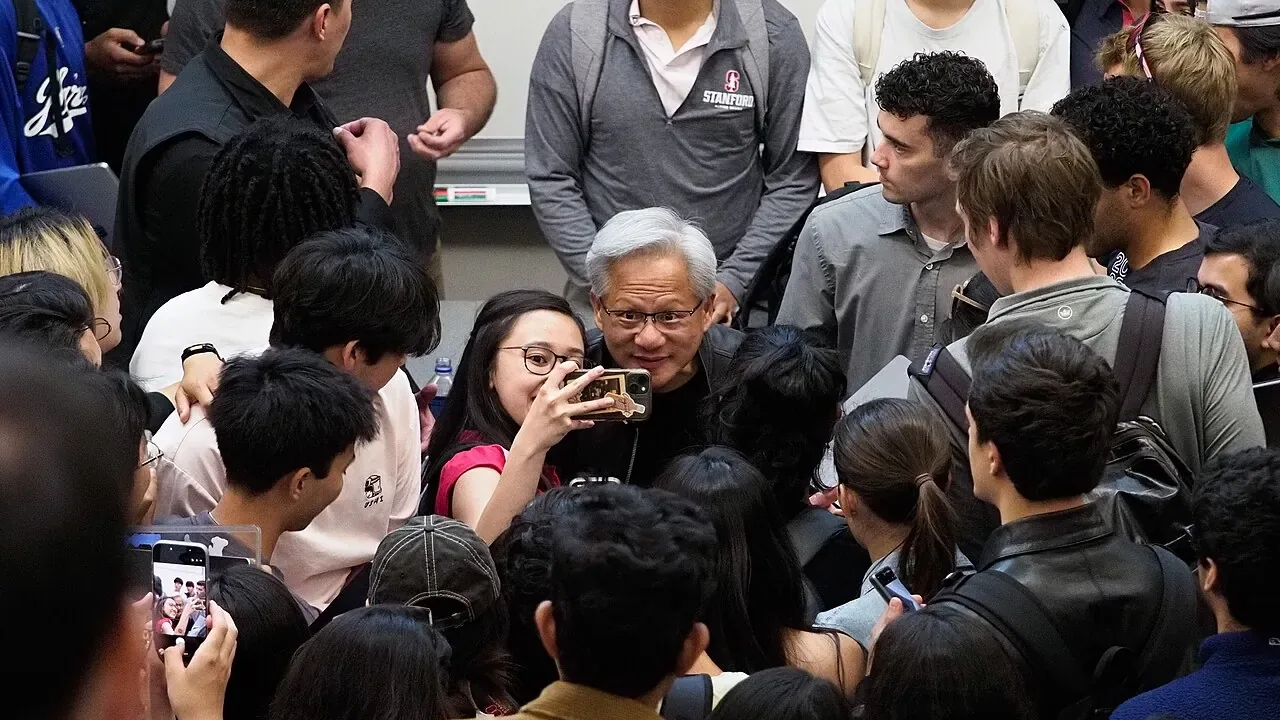
Nvidia co-founder Jensen Huang resigned as president, chief executive officer and board member effective immediately on Thursday, Nov. 12, ending a 33-year run that turned the Santa Clara chipmaker into the backbone of the artificial intelligence boom. Longtime finance chief Colette Kress took over as interim CEO while keeping her chief financial officer duties, and prominent tech, AI and crypto founders quickly warned that Huang’s departure could hurt both Nvidia and open-source AI development.
According to Nvidia’s official announcement, the board also named longtime director and former Synopsys CEO Harvey C. Jones as its first-ever Chair of the Board. Nvidia stock plunged 14% at Thursday’s opening bell to $151.01, hitting an intraday low of $148.80 and wiping more than $500 billion from U.S. stocks in a single minute. Shares later pared those losses to close down 4.59% at $165.75, knocking Nvidia down to the world’s third-most-valuable company while rival chipmakers AMD and Broadcom rose about 6% each.
The exit followed reports of two extramarital affairs. One involved Alice Huang, a former executive at Singapore-based Nvidia cloud partner Megaspeed whom U.S. intelligence officials reportedly suspected of links to Chinese intelligence. A second reported affair, detailed by the New York Times and New York Post, involved Kimberly Powell, Nvidia’s vice president of healthcare. Huang admitted to being unfaithful to his wife in an email to employees on Sunday, Nov. 8, and the board opened an independent investigation the same day.
Nvidia’s board said it had no reason to believe corporate secrets or national security were compromised. Singaporean authorities stated they lacked sufficient evidence to establish that Alice Huang committed a crime, and Beijing denied she is a spy. Even without confirmed leaks, the fallout already revived a push for chip bills in Washington before Thursday’s resignation.
Crypto and AI executives push back
Across X, crypto and AI founders argued that Nvidia’s board overreacted. Binance co-founder Changpeng “CZ” Zhao wrote on Thursday that “it’s a mistake for Nvidia to let Jensen resign.” Bitcoin entrepreneur and former Kraken executive Dan Held agreed that Huang should not have stepped down, arguing his personal failings should be weighed against the company he built.
Erik Voorhees, founder of crypto exchange ShapeShift and privacy-focused AI platform Venice, challenged the intelligence claims directly, as reported by Decrypt. “The entire coup against Jensen Huang can be halted by asking a single question,” Voorhees wrote on X. “What evidence is there that Alice Huang is actually a Chinese spy? The answer, unsurprisingly, is absolutely zero.”
Developer Peter Steinberger also criticized the board’s timing, writing on X, “If that Spy’s goal was to destabilize one of the most successful American companies, they achieved their goal. Ousting Jensen feels rushed and not right.” Perplexity AI co-founder and CEO Aravind Srinivas posted a tribute stating, “Thank you Jensen Huang for 33 years of bold leadership,” while Teslarati reported that Tesla and SpaceX CEO Elon Musk replied to an X post urging him to hire Huang by saying it would be “an honor.”
What Huang’s exit means for open-weight AI
For software builders and AI researchers, the immediate concern is whether Nvidia under new leadership will continue backing open-weight AI models, which are downloadable models whose underlying parameters, or weights, can be run locally outside the companies that trained them. Bitcoin investor Anthony Pompliano urged developers to look past the boardroom drama. “Do not get distracted by the headlines,” Pompliano wrote on X. “Open-source AI is essential to the freedom of billions of people in the future.”
Open-source AI advocate and hardware entrepreneur Jun Song argued that Huang had been a rare corporate counterweight against proprietary AI labs. Referring to the “Pace the Frontier” lobbying campaign, Song wrote on X, “OpenAI and Anthropic have spent millions lobbying the US Congress to ban open weights. When they formed the” coalition “group to push for strict limits on open models, Jensen stepped up right away. He created the Open Secure Alliance to fight back.” While online speculation suggested Huang’s ouster was designed to weaken open-source development, those conspiracy claims remain unproven.
As background, Nvidia joined Microsoft, IBM, Hugging Face and dozens of other organizations in July 2026 to launch the Open Secure AI Alliance, which builds open AI security tools and standards. Two months later, in September 2026, Nvidia agreed to acquire the open-source AI repository Hugging Face for roughly $12.9 billion, a deal expected to close in the first half of 2027 pending regulatory approval. With that acquisition now under interim leadership, Voorhees asked on X, “Is there a decentralized Hugging Face yet?”
Washington reactions and next week’s earnings
The leadership shakeup also drew reactions from U.S. officials. President Donald Trump suggested on Thursday that former Apple CEO Tim Cook should replace Huang at Nvidia, after saying earlier in the week that Huang told him he had no idea Alice Huang was an alleged intelligence operative. House Speaker Mike Johnson said choosing the right successor was important amid Congressional efforts to limit chip exports to China, while House Minority Leader Hakeem Jeffries called for lawmakers to receive a classified briefing. Prior to Thursday’s announcement, Sen. Kevin Cramer, Rep. Suhas Subramanyam and Rep. Don Bacon had called for Huang to step down as FBI and Congressional inquiries got underway alongside a shareholder lawsuit.
Nvidia had already shed roughly $1.27 trillion in market value between Oct. 6 and Nov. 6 amid concerns over AI spending and the unfolding scandal, which began with an October 2025 New York Times report on Megaspeed. Kress, who stated that “Nvidia’s strength has always come from its people,” will lead Nvidia’s third-quarter fiscal 2027 earnings report on Tuesday, Nov. 17, at 1:20 p.m. Pacific, followed by an investor call at 2:00 p.m. Pacific, while the board searches internal and external candidates for a permanent CEO.