
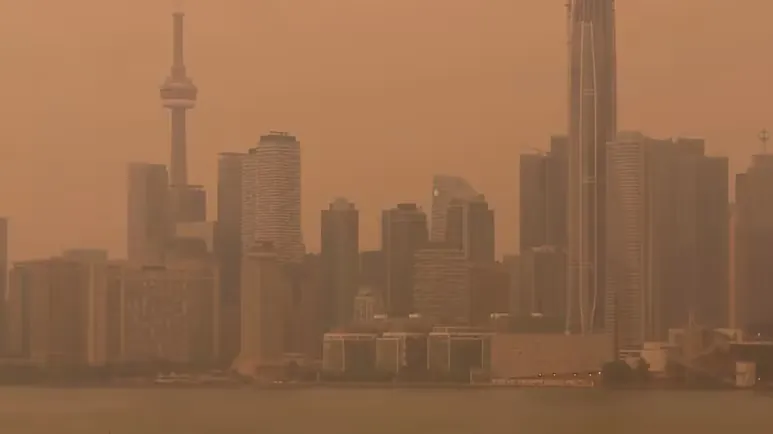
The air you breathe across southern Ontario is taking a serious hit this week. Hundreds of uncontrolled wildfires are currently raging across northwestern Ontario, fueled by an intense heatwave that pushed temperatures past 40 degrees Celsius in communities like Armstrong. That crisis is moving south.
A strong jet stream is carrying thick plumes of wildfire smoke over 1,000 kilometers directly into heavily populated regions. This is fundamentally degrading outdoor air quality. Things are deteriorating quickly. Health officials have issued urgent warnings for residents to limit their outdoor exposure, seek shaded environments, and reschedule any strenuous outdoor activities through at least Friday.
Tracking the Smoke Plume
The London region is facing a dual threat right now. Afternoon temperatures are spiking to 33 degrees and carrying a stifling humidex of 38 degrees. To understand the scope of the problem, you just need to look at the government alerts. Officials have issued Environment Canada warnings spanning the entire province, stretching from Thunder Bay all the way down to Kingston and London.
The situation in the Greater Toronto Area escalated rapidly Wednesday morning. The heavy volume of fine particulate matter moving through the atmosphere caused Toronto to briefly record the worst air quality in the world, according to global IQAir metrics.
But the immediate physical danger remains up north. The extreme fire behavior forced mandatory evacuation orders for several First Nations communities, including Whitesand and Armstrong. Officials are moving residents out of the direct line of the flames.
Local municipalities further south are not taking any chances. Due to the persistent hot and dry conditions accompanying this smoke, officials enacted a comprehensive burn ban across the entirety of Middlesex County. That restriction stays in place until weather patterns improve.
What Particulate Matter Actually Does to Your Lungs
When wildfire smoke rolls into a city, the primary medical concern is fine particulate matter, often referred to as PM2.5. These particles are microscopic. Because they are so small, they bypass your body’s natural respiratory defenses and travel deeply into the lungs.
From there, they can enter the bloodstream. For individuals with asthma, COPD, or existing cardiovascular conditions, this exposure triggers immediate inflammation. Even healthy adults might notice a scratchy throat, stinging eyes, or unusual fatigue after a short walk outside.
Bottom Line
You need to take these air quality alerts seriously. Treat the outdoors like a hazardous environment until the smoke clears this weekend. Keep your windows closed, run an air purifier if you have one, and absolutely skip the outdoor run or heavy yard work. Your respiratory system needs a break until the jet stream shifts.