
Mark your calendars. Today leaves exactly 1,000 days until Friday, April 13, 2029. That is when the near-Earth asteroid 99942 Apophis—widely known by its intimidating nickname, the “God of Chaos”—will make an exceptionally close flyby of our planet.
The 375-meter-wide space rock will pass just 32,000 kilometers (roughly 20,000 miles) above the Earth’s surface. To put that distance into perspective, Apophis will fly ten times closer to us than the Moon. It will actually cruise well within the orbital ring of our geostationary weather and telecommunications satellites.
But you do not need to panic. Impact with Earth has been completely ruled out. Instead of a disaster, astronomers are treating this as a once-in-a-millennium scientific opportunity. The encounter will be so close that the asteroid is expected to be visible to the naked eye for up to two billion people stretching across Europe and Africa.
Chasing the Rock
When astronomers first discovered Apophis in 2004, it caused a genuine stir in the scientific community. Early calculations gave the asteroid a 2.7% chance of striking Earth in 2029. It became the most hazardous asteroid ever tracked at the time. Thankfully, subsequent planetary radar observations mapping its exact trajectory ruled out a collision entirely.
Now, space agencies are racing to meet it in orbit.
To capitalize on the flyby, the European Space Agency (ESA) is rapidly advancing its Rapid Apophis Mission for Space Safety (RAMSES). The spacecraft is scheduled to launch in April 2028 and arrive at Apophis in February 2029, as detailed in ESA’s official mission overview. RAMSES will accompany the asteroid for six months. The primary goal? To watch in real-time as Earth’s intense gravitational pull alters the asteroid’s rotation, shifts its surface, and potentially triggers internal tremors.
What the ESA-JAXA Partnership Means for Planetary Defense
Watching a 375-meter rock warp under Earth’s gravity is fascinating, but the logistical coordination happening behind the scenes is just as important. The RAMSES project is not flying solo.
Through a May 2026 joint agreement, the Japan Aerospace Exploration Agency (JAXA) officially joined the effort, turning RAMSES into a collaborative planetary defense mission. JAXA is stepping in to provide crucial hardware components, including lightweight solar array wings and a specialized thermal infrared imager. Furthermore, the spacecraft will launch aboard JAXA’s H3 rocket.
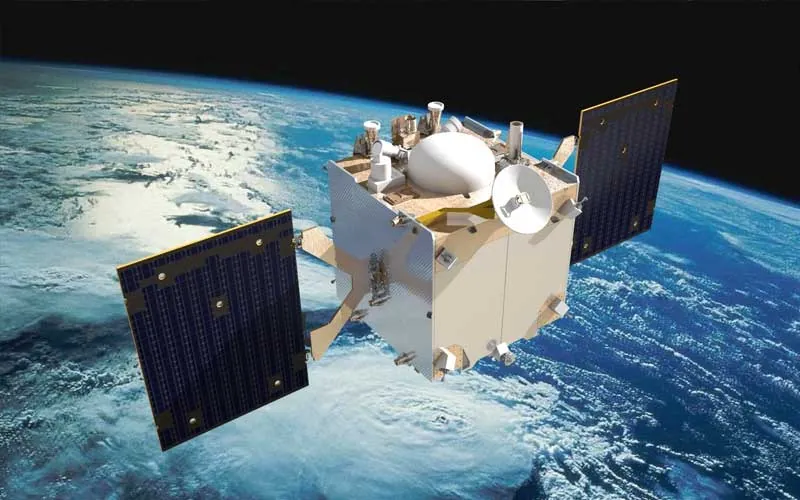
And NASA is getting involved from the other side of the timeline. The American space agency is targeting Apophis with its OSIRIS-APEX mission—the repurposed spacecraft formerly known as OSIRIS-REx. OSIRIS-APEX will arrive roughly one month after the asteroid’s Earth flyby. By comparing ESA’s real-time observations during the closest approach with NASA’s post-encounter data, scientists will get a complete before-and-after picture of exactly how the Earth warped the God of Chaos.