
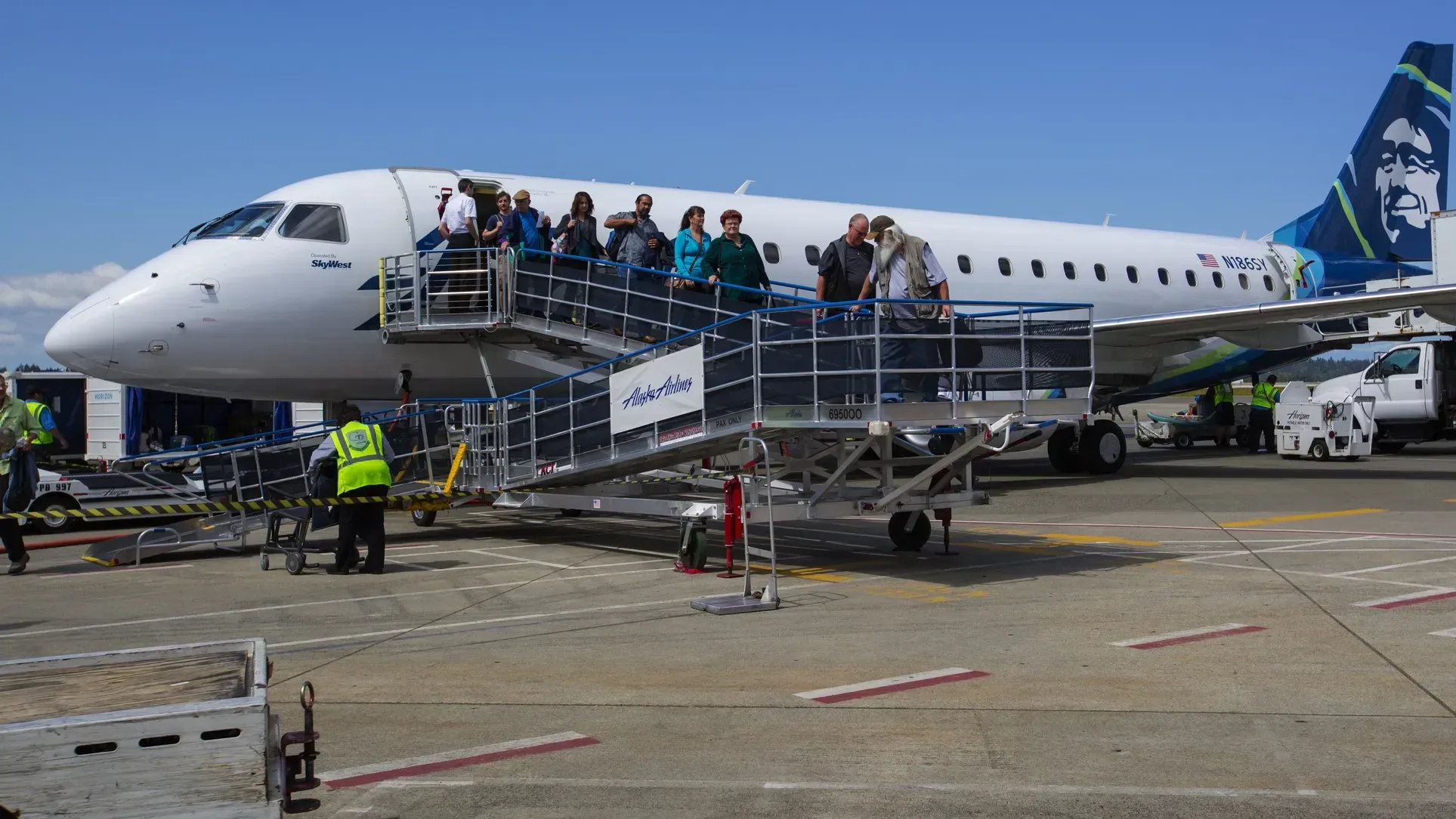
You buy a ticket on United, Delta, or American, walk down the jet bridge, and spot a small decal by the boarding door reading operated by SkyWest Airlines or Envoy Air. A mainline flight is flown directly by a major airline using its own pilots, flight attendants, and larger jets with more than 76 seats, whereas a regional flight is sold under that major airline’s brand and flight number but flown by a separate company on a smaller plane with 76 seats or fewer. That operational split is the core difference between mainline and regional airline flights, even though both run under the exact same federal aviation safety and pilot licensing rules in the United States.
Regional flights are not a side business for major carriers. In 2025, regional airlines operated 3.16 million departures across the United States, averaging 8,661 flights per day and carrying nearly 143 million passengers, according to the 2026 annual report from the Regional Airline Association. Those flights accounted for 34.2% of all scheduled U.S. passenger departures and connected 635 airports, or 94.3% of all U.S. passenger airports, to major airline hubs.
How do mainline and regional airline flights split ticket revenue?
When you book a flight labeled United Express, Delta Connection, or American Eagle, you are looking at a regional sub-brand rather than a standalone airline. Major network carriers use these sub-brands to feed passengers from smaller cities into large hub airports, where travellers connect onto larger mainline narrowbody and widebody jets for high-volume domestic and international routes, as outlined in an April 2026 Government Accountability Office report.
The companies that actually own or fly those regional jets fall into two groups. Some are wholly owned subsidiaries of a major airline parent company: Delta Air Lines owns Endeavor Air; American Airlines Group owns Envoy Air, PSA Airlines, and Piedmont Airlines; and Alaska Air Group owns Horizon Air. Others are independent regional airlines, including SkyWest Airlines, Republic Airways, GoJet Airlines, and CommuteAir, that sign multi-year flying contracts with one or more major carriers at the same time.
In North America, nearly all of these partnerships run on Capacity Purchase Agreements, also called fee-for-departure contracts. Under a Capacity Purchase Agreement, the major airline controls route scheduling, ticket pricing, reservations, and loyalty programs, and it keeps 100% of passenger ticket fares, baggage fees, cargo revenue, and mail revenue. Instead of splitting ticket sales, the major airline pays the regional operator a fixed rate per completed departure, a rate per flight or block hour, and a monthly fixed fee per aircraft in service, while directly paying or reimbursing pass-through costs such as jet fuel, airport landing fees, and gate rents.
To see how the math works in plain numbers, look at the 2025 annual report in the SkyWest Form 10-K filing with the U.S. Securities and Exchange Commission. As of December 31, 2025, SkyWest owned or leased 637 total aircraft and had 487 jets in scheduled service or under contract across four competing mainline carriers at once, completing 1,140,443 flights during the year:
- United Airlines accounted for 44.4% of SkyWest’s contracted fleet, or roughly 216 aircraft flying as United Express.
- Delta Air Lines accounted for 28.1% of the contracted fleet, or roughly 137 aircraft flying as Delta Connection.
- American Airlines accounted for 18.9% of the contracted fleet, or roughly 92 aircraft flying as American Eagle.
- Alaska Airlines accounted for 8.6% of the contracted fleet, or roughly 42 aircraft flying under contract for Alaska.
About 84% of SkyWest’s flying agreement revenue in 2025 came from those fixed-fee Capacity Purchase Agreements. If a 76-seat SkyWest jet flies from Boise to a major hub half-empty or completely sold out, SkyWest collects its contracted departure and block-hour payment while the major airline absorbs the commercial ticket gain or loss. The remaining 15.7% of SkyWest’s 2025 flying agreement revenue came from prorate and charter agreements. Under a prorate agreement, the regional carrier takes on commercial risk, pays its own fuel and airport bills, and keeps an agreed percentage share of passenger ticket revenue on that route. Across the industry, these outsourced commitments represent billions in long-term liabilities: Delta Air Lines reported $6.0 billion in estimated minimum fixed obligations under its third-party regional Capacity Purchase Agreements as of December 31, 2025.
Why do US regional jets stop at 76 seats?
If regional airlines cost less to run per departure, a natural question is why major airlines do not put 120-seat jets on regional contracts. The cap comes from labor contracts, called scope clauses, negotiated between major U.S. airlines and their mainline pilot unions, including the Air Line Pilots Association and the Allied Pilots Association.
Scope clauses protect mainline pilot jobs by setting strict physical limits on any airplane flown by a regional partner. Under Section 1 of the 2023 Allied Pilots Association contract with American Airlines, a regional commuter aircraft cannot exceed 76 passenger seats and cannot have a certificated maximum gross takeoff weight above 86,000 pounds, aside from a narrow grandfathered group of 2013 US Airways regional jets configured at 79 and 80 seats. Any single-aisle jet with more than 76 seats, including the Airbus A319, A320, and A321 or the Boeing 717, 737, and 757, is classified as a mainline narrowbody aircraft and must be flown by pilots on the mainline carrier’s seniority list.
Mainline pilot contracts also cap how many 51-to-76-seat regional jets each major airline is allowed to deploy relative to its mainline fleet. Those fleet ratios turn scope clauses into concrete arithmetic for airline fleet planners:
- At American Airlines, regional jets with more than 65 seats are capped at 40% of the mainline narrowbody fleet, meaning American can field at most 40 large regional jets for every 100 mainline single-aisle jets it operates.
- At Alaska Airlines, regional aircraft with 51 to 76 seats are capped at 43% of the mainline fleet, or 43 large regional jets per 100 mainline aircraft.
- At United Airlines, regional partners can fly at most 255 aircraft in the 51-to-76-seat bracket, and no more than 153 of those jets can carry the 76-seat maximum, leaving at most 102 jets in the 51-to-75-seat range.
- At Delta Air Lines, contracts allow up to 125 regional jets with 50 or fewer seats, 102 jets with 70 seats, and 223 jets with 76 seats, for a combined ceiling of 450 regional aircraft across those three tiers, and require at least 85% of regional block hours to stay on routes shorter than 900 miles.
Those two numbers, 76 seats and 86,000 pounds, explain why every U.S. regional flight you board uses one of two aircraft families: the Embraer E175 or the Bombardier CRJ series (CRJ550, CRJ700, and CRJ900). Newer, more fuel-efficient regional jets like the Embraer E175-E2 exceed the 86,000-pound U.S. weight limit, leaving the first-generation Embraer E175 as the only scope-clause-compliant regional jet still in active production for the U.S. market as of 2026.
This 76-seat wall is specific to North America. In Europe, Latin America, and Australia, regional subsidiaries such as KLM Cityhopper and Lufthansa CityLine are not bound by the U.S. 76-seat and 86,000-pound rule. European and Asian regional fleets routinely fly larger 90-to-114-seat Embraer E190, E195, and next-generation E2 regional jets that would be restricted to mainline pilot seniority lists in the United States.
How can you tell if a regional carrier is operating your flight?
You do not have to wait until you reach the airport gate to find out which company is flying your plane. In the United States, federal Department of Transportation rules under 14 CFR Part 257 require every airline and online travel agency to disclose the corporate name of the operating carrier before you purchase a ticket.
Under 14 CFR Section 257.5, the operating carrier’s legal corporate name and any brand name under which the flight operates must appear directly on desktop and mobile flight search results next to the flight number and schedule. Hiding the regional carrier’s name behind a mouse rollover, a pop-up window, or a separate hyperlink violates federal law as an unfair and deceptive practice under 49 U.S.C. 41712. You can confirm whether a flight is mainline or regional during booking in three quick checks:
- Look directly beneath the flight number and departure time on the search results screen for the operating carrier disclosure line stating which company operates the aircraft and under which regional brand name.
- Check whether the named operator is the mainline carrier itself or a regional subsidiary or contractor such as SkyWest Airlines, Republic Airways, Endeavor Air, Envoy Air, PSA Airlines, Piedmont Airlines, Horizon Air, GoJet Airlines, or CommuteAir.
- Check the aircraft model listed in the itinerary details: an Embraer E170 or E175 or a Bombardier CRJ550, CRJ700, or CRJ900 indicates a regional flight, while any Boeing 717, 737, 757, 767, 777, or 787 or Airbus A220, A319, A320, A321, A330, or A350 indicates a mainline flight.
A common misconception is that regional airlines still fly slow propeller planes without premium cabins. While regional carriers grew out of shorter turboprop routes decades ago, today’s U.S. regional fleets are dominated by twin-engine jets. Modern two-cabin regional jets like the Embraer E175 and Bombardier CRJ550, CRJ700, and CRJ900 include a dedicated first-class cabin, flight attendant beverage and snack service, and enclosed lavatories. They also cruise at Mach 0.82, matching the cruising speed of mainline narrowbody jets, with a flying range of roughly 1,600 miles on a CRJ and 2,100 miles on an Embraer E175.
Are regional airline pilots trained to the same FAA standards as mainline crews?
Passengers sometimes worry that a smaller plane operated by a contractor is held to a looser safety standard than a major airline’s flagship fleet. In the United States, both mainline airlines and scheduled passenger regional carriers are certificated and inspected by the Federal Aviation Administration under the exact same regulatory code: Title 14, Code of Federal Regulations Part 121.
Following the Airline Safety and FAA Extension Act of 2010 and the FAA’s 2013 Pilot Certification and Qualification Requirements Final Rule, every First Officer (second-in-command) at a Part 121 regional or mainline airline must hold an Airline Transport Pilot certificate with at least 1,500 total flight hours, or a Restricted Airline Transport Pilot certificate with reduced hours for qualifying military pilots and graduates of accredited collegiate aviation degree programs. To upgrade to Captain (pilot-in-command) under 14 CFR Section 121.436, a pilot at either a regional or mainline airline must hold a full Airline Transport Pilot certificate, a first-class medical certificate, an aircraft type rating, and at least 1,000 flight hours of air carrier operational experience.
Because the regulatory floor is identical, the practical difference for cockpit crews comes down to daily schedules and career progression. According to the April 2026 Government Accountability Office report, regional airlines are the primary entry point for commercial airline pilots building turbine Part 121 flight hours before applying to a mainline carrier. A regional pilot typically flies three to six short flights per day between smaller airports and large hubs, whereas a mainline pilot typically flies one or two longer domestic or international flights per day.
That career pipeline creates steady turnover at regional carriers whenever mainline airlines hire. With the Regional Airline Association reporting in 2025 that nearly half of the Part 121 qualified pilot workforce will reach the federal mandatory retirement age of 65 within 15 years, mainline hiring waves frequently pull experienced regional captains up to larger jets. When captain shortages force regional carriers to trim schedules at smaller airports, the U.S. Department of Transportation supports rural connectivity through federal subsidies under the Essential Air Service program and grants from the Small Community Air Service Development Program, as detailed in June 2026 Congressional testimony to the House Committee on Transportation and Infrastructure.
Frequently asked questions
Do all major US airlines use regional carriers?
No. Only hub-and-spoke network airlines, specifically American Airlines, Delta Air Lines, United Airlines, and Alaska Airlines, contract regional carriers to connect smaller cities into their hub airports. Point-to-point low-cost carriers in the United States, including Southwest Airlines, Spirit Airlines, Frontier Airlines, Allegiant Air, and Breeze Airways, operate 100% mainline fleets with their own employees and do not use regional affiliates.
Which US states rely on regional flights for most of their air service?
According to the Regional Airline Association’s 2026 annual report covering 2025 operations, regional airlines provide the only scheduled passenger service at 63.8% of commercially served U.S. airports and account for more than half of all scheduled flights in 12 states: Wyoming (67.9%), Idaho (65.3%), Montana (63.7%), Maine (63.2%), Iowa (59.4%), New Hampshire (59.3%), Wisconsin (58.2%), Indiana (53.7%), Virginia (53.4%), Kentucky (53.2%), Oklahoma (50.7%), and New Mexico (50.5%).
Do frequent-flyer miles, status upgrades and checked bags carry over on regional flights?
Yes. Because the major airline controls ticketing, pricing, and reservation codes under a Capacity Purchase Agreement, you check in through the major airline’s app, earn standard frequent-flyer miles and elite qualifying credits, qualify for first-class cabin upgrades on two-cabin regional jets, and have your checked bags transferred directly between your regional feeder flight and your connecting mainline flight.