
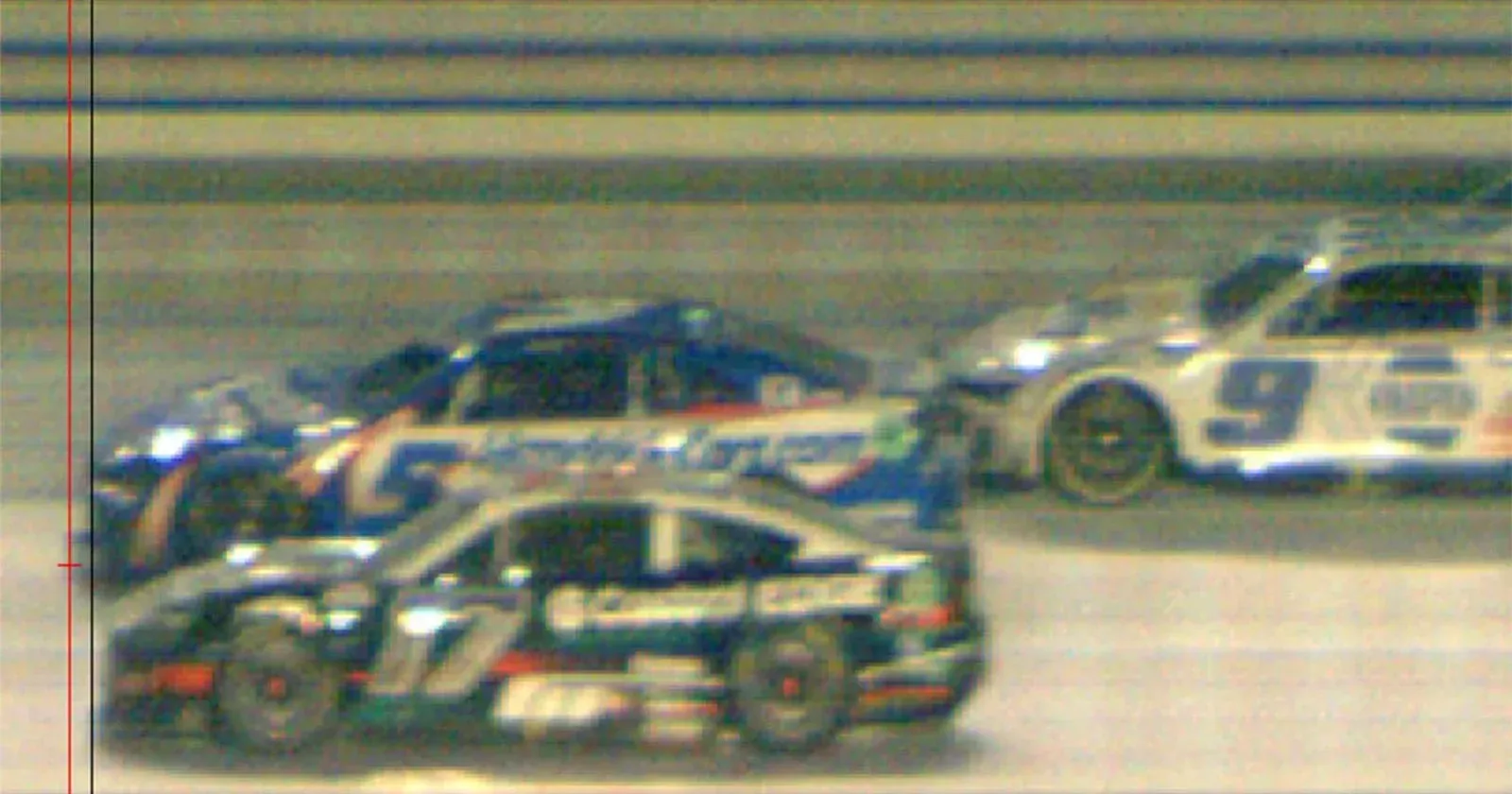
When two cars cross the finish line side-by-side at 200 miles per hour, the human eye cannot tell who won. It happens too fast. To measure photo finishes in professional auto racing, officials rely on a two-part system. Primary timing comes from electronic radio transponders attached to the cars. But when the gap between drivers shrinks down to mere milliseconds, leagues discard those electronic trackers. They rely entirely on high-speed “slit-scan” or “line-scan” cameras to make the final call.
These cameras do not take standard photographs. They are actually visual timelines. They capture thousands of vertical slices of the finish line every single second. They stitch those tiny slices together sequentially. This builds a visual record of exactly when each car’s nose broke the digital plane.
How Line-Scan Cameras Work
Traditional video cameras create problems at high speeds. Perspective angles and lens depth trick the eye. A camera sitting slightly ahead of the finish line will make the outside car look further ahead than the inside car. Racing leagues eliminate this optical illusion by ditching traditional lenses. They use line-scan technology instead.
A line-scan camera looks exclusively at a razor-thin vertical plane spanning the width of the track. It completely ignores the rest of the raceway. The camera stays constantly on. The actual image capture triggers the moment a car’s front splitter breaks that specific focal plane.
Top-tier timing systems used in Formula 1, IndyCar, and NASCAR push this hardware to the absolute limit. They capture up to 40,000 frames per second to ensure flawless accuracy. Each of those frames is just a single sliver of pixels wide. For context, standard television broadcasts run at just 60 frames per second.
The software then compiles these slivers left-to-right. The resulting picture shows the passage of time rather than physical distance. The horizontal axis of the final image is measured in fractions of a second. The far left of the image is the earliest moment in time. The right side is later. This allows officials to see the exact chronological order of objects crossing the threshold, stripping away all visual depth tricks and angles.
Why Racing Leagues Use This Dual System
You might wonder why leagues need cameras at all if every car has a digital tracker. Radio transponders handle the heavy lifting for the vast majority of the race. They track lap times, set the running orders during cautions, and log pit stop durations. This data updates the scoring pylons automatically.
These transponders sit securely inside the vehicle. In NASCAR, mechanics mount the transponder to the chassis behind the right-rear tire. This placement keeps the sensitive electronics safe from wall scrapes and front-end collisions during tight pack racing.
But mounting the tracker in the back creates a mechanical blind spot at the finish line. The winner is the first driver whose front nose crosses the line. It is not the first driver whose right-rear tire gets there.
Electronic transponder systems carry an approximate margin of error of 1.5 milliseconds because of this physical gap between the nose and the chassis. A driver with a heavily damaged, caved-in front bumper might technically trigger their transponder at the exact same time as a perfectly intact car next to them. If the gap between the top two cars falls inside that 1.5-millisecond window, officials toss out the transponder data. The electronic system becomes too imprecise to make a definitive call. The line-scan camera takes over as the only accepted proof.
Famous Examples from Major Races
We saw exactly how this dual system functions during the NASCAR Cup Series in May 2024. The AdventHealth 400 ended up featuring the closest recorded finish in the history of the sport. Kyle Larson and Chris Buescher came off the final turn in a dead heat.
They crossed the line side-by-side. The electronic transponder system instantly flagged Chris Buescher as the race winner. His right-rear tire crossed the line just quickly enough to trigger the initial automated victory alert. Fans saw his name flash on the scoring screens.
The time difference between the two drivers sat at exactly 1.5 milliseconds. NASCAR officials recognized this fell directly into the transponder’s known margin of error. They immediately initiated a video review and threw out the automated electronic call.
They pulled the composite image from the FinishLynx line-scan camera setup positioned high above the track surface. The visual evidence showed a completely different outcome. Kyle Larson’s front splitter pierced the invisible vertical plane just fractions of an inch before Buescher’s car arrived. Officials overturned the initial transponder ruling. They gave Larson the official win based strictly on the timeline photograph.
Common Misconceptions
Fans naturally look down at the physical track when watching a close finish. The thick white line painted across the asphalt seems like the ultimate boundary line. This is a complete myth in professional auto racing.
Hand-painted lines are wildly imperfect. They feature wavy edges and uneven thickness. As dozens of cars repeatedly drive over the paint throughout an afternoon, the hot rubber tires smear and wear down the edges even further. The line-scan camera projects a laser-straight digital focal plane across the track. In the event of a tiebreaker, this invisible digital plane completely supersedes the physical paint on the ground. The paint is just a visual guide for the drivers. The digital line is for the rulebook.
Another point of confusion involves the weird way the cars look in the final released photographs. The images look broken. Sponsor logos look squished, tires turn into strange ovals, and the physical proportions of the cars stretch out across the screen.
This visual distortion comes from the “rolling shutter” effect. Because the camera records a single vertical slit thousands of times a second, objects moving through that slit at 200 miles per hour experience stretching and warping based on their speed relative to the camera’s fixed capture rate. A car moving slightly slower than the camera’s optimal setting will look elongated.
The camera also creates a bizarre, artificial background. The lens only stares at one specific, tiny slice of the track wall. The final stitched image just repeats that exact same stationary slice over and over again. The background turns into a solid, heavily striped blur behind the highly detailed race cars. It looks like a computer glitch, but it is just a timeline of a completely still object.
Frequently Asked Questions
How many frames per second do racing photo-finish cameras capture?
Top-tier motorsports photo-finish systems capture an incredible amount of data. Hardware used by NASCAR, Formula 1, and IndyCar can capture up to 40,000 frames per second. These frames are actually tiny vertical slices that allow officials to accurately record vehicles traveling at speeds well over 200 mph without blurring the absolute front edge of the car.
Why don’t officials just use the transponder data to decide a close race?
Transponders are used to time the majority of the race, but they have physical limitations. They are attached to the vehicle’s chassis, often behind the right-rear tire. They are not attached to the absolute front nose of the car. In finishes closer than a few milliseconds, the transponder’s positional margin of error is too great to be conclusive. Officials must rely on physical visual evidence of the car’s leading edge to determine the true winner.
Why do cars look stretched or blurry in photo-finish pictures?
Photo-finish images are not standard photographs. They are chronological timelines. The camera records a single vertical slit thousands of times a second and assembles the final image based on time, not space. Because the car is moving through this narrow slit at high speeds, its proportions, wheels, and decals can stretch or compress on the image. This visual warping depends entirely on the speed of the vehicle relative to the camera’s capture rate.