
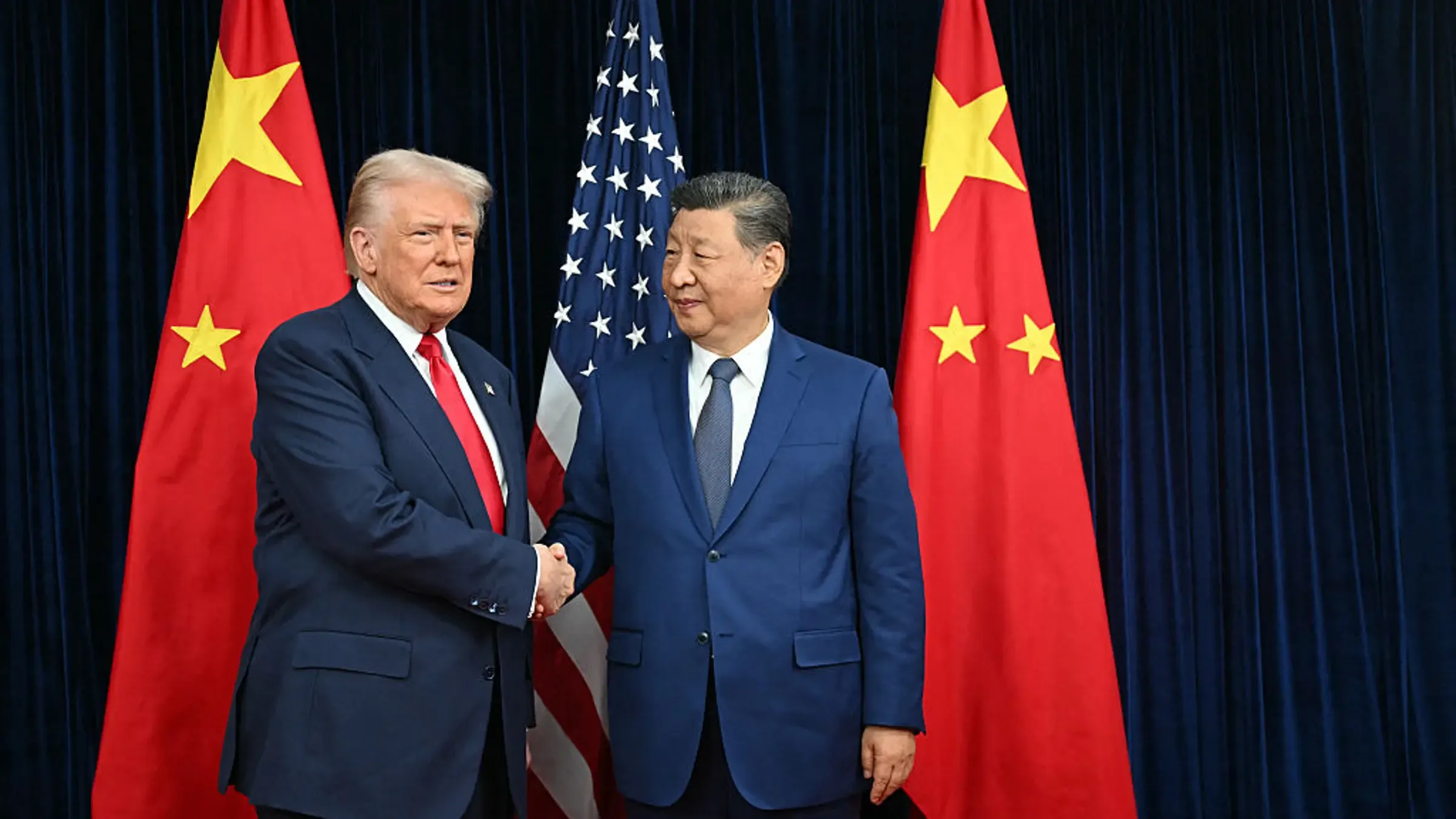
US President Donald Trump landed in Beijing on Wednesday for a critical two-day summit with Chinese President Xi Jinping, a meeting heavily overshadowed by the ongoing US-Israel conflict with Iran. The visit, originally planned for March, comes as the blockade of the Strait of Hormuz continues to drain American foreign exchange reserves and push global energy markets toward a breaking point. Washington is expected to lean on Beijing’s influence as the primary buyer of Iranian oil to help mediate a de-escalation in the Middle East.
The diplomatic push coincides with the release of new economic data illustrating a massive disparity between the two superpowers. According to a detailed report by Al Jazeera, China has solidified its status as the world’s top exporter, moving $3.59 trillion in goods in 2024. This trade dominance has resulted in a surplus exceeding $1 trillion, while the US remains saddled with a national debt that has surged past $39 trillion, representing 115% of its GDP. The economic leverage sits firmly with Beijing as the two leaders prepare to discuss a fragile trade truce established last October.
The American delegation isn’t just made up of diplomats. Tech and aviation giants are on the ground to protect commercial interests. Apple CEO Tim Cook and Boeing CEO Kelly Ortberg are among the high-level executives accompanying the President. Rumors of a massive 500-aircraft order for Boeing are circulating as the US tries to balance its geopolitical needs with a desperate bid for industrial growth. But the path to a deal is complicated by the 31.6% effective tariff the US currently maintains on Chinese imports.
Beijing has been preparing for this moment for weeks. Iranian Foreign Minister Abbas Araghchi visited the Chinese capital just last week to coordinate messaging before the Americans arrived. This coordination suggests that Trump arrives in Beijing facing a unified front between China and its Middle Eastern energy partners. While the US still outspends China on defense—allocating $954 billion to the military in 2025—China’s control over 44 million tonnes of rare earth minerals gives it a “chokehold” on the green energy and EV sectors that the US cannot easily replicate.
The stakes for the May 14-15 talks are at a decade-high. It is the first time a US president has made a formal state visit to China since Trump’s own trip in 2017. Back then, the focus was almost entirely on trade deficits. Today, the conversation has shifted toward survival in a war-torn global economy. With China accounting for nearly half of all global electric vehicle sales and investing $290 billion in green energy last year, the US finds itself negotiating from a position of relative fiscal exhaustion.
The Boeing-Apple gamble in the shadow of the Hormuz blockade
The presence of Kelly Ortberg and Tim Cook in Beijing signals that the US is attempting to use high-tech trade as a carrot to secure Chinese intervention in the Iran crisis. If Boeing secures the rumored 500-plane order, it would provide a massive lifeline to the US manufacturing sector, which is currently struggling under the weight of 4.9% inflation. However, the paradigm has shifted: China no longer just needs American tech; it now controls the raw materials required to build the future. By tying the resolution of the Strait of Hormuz blockade to these trade pacts, the US is acknowledging that it can no longer police global energy corridors without Beijing’s diplomatic blessing. This summit isn’t just about trade; it’s a formal recognition of a multi-polar world where the US dollar’s dominance is being actively tested by a $3.5 trillion export machine.