
Officially recorded in the rulebooks as “kicks from the penalty mark,” a shootout is a tie-breaking procedure used exclusively in knockout sports tournaments. When a match ends in a draw after standard regulation and mandated extra time, the bracket still needs a definitive winner. You cannot just keep playing forever. This format provides an immediate resolution, preventing the physical exhaustion and logistical nightmare of scheduling traditional match replays. And the mechanics operate completely differently than the math behind a group stage tiebreaker.
How the Shootout Mechanics Work
The procedure starts before anyone even kicks a ball. The coin toss procedures are highly specific. From there, a strict order of operations takes over:
- The First Toss: The referee flips a coin to determine which goal the teams will shoot at. This ensures both squads face the exact same pitch conditions and lighting.
- The Second Toss: A second flip decides the kicking order. Whichever captain wins this toss chooses whether their team kicks first or second.
- Player Positioning: Only eligible players and match officials remain on the pitch. Everyone else stays on the sidelines. All participating kickers must wait inside the centre circle.
- Goalkeeper Placement: Mandated by The Football Association, the defending goalkeeper stays on the goal line facing the kicker. When the ball is struck, they must have at least part of one foot touching or in line with that goal line.
- The Best-of-Five Limit: Teams take alternating kicks until both sides attempt five shots. But if a team builds an insurmountable lead—like a 3-0 advantage with only two kicks left for the opponent—the match ends immediately.
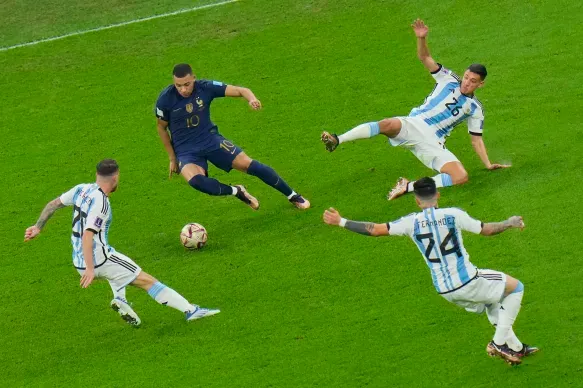
This early finish is exactly how knockout stage tiebreakers usually conclude on the biggest stages. In the 2006 World Cup Final, Fabio Grosso buried his fifth kick for Italy. That mathematically ended the match before France even got the chance to take their final attempt. The exact same scenario played out in the 2022 World Cup Final, according to Wikipedia, when Gonzalo Montiel scored Argentina’s fourth kick. Both teams still had remaining attempts, but the math made them irrelevant.
Sudden Death and Special Regulations
What happens if the score remains perfectly tied after all five rounds? The shootout enters sudden death. Teams take one alternating kick per round. The moment one side scores and the other misses in the exact same sequence, the match is over.
Then there is the player equalizer rule. The IFAB introduced this specific rule in 2000 to close a major loophole. According to the official IFAB rules, if a team has more players on the field than their opponent at the end of the match—usually because of a red card or an injury—they must exclude players from their shootout roster to match the opposing team’s numbers. Why? Because a team with a red card would cycle through their smaller roster faster, allowing their absolute best strikers to step up to the spot again sooner.
Rebounds are also completely banned. During a shootout, a kicker only gets one touch. If the goalkeeper parries the shot or it hits the post, the kicker cannot run up and tap it in. The attempt is officially over the second the ball stops moving, crosses the line, or rebounds safely away.
Historical Clarifications and The Skill vs. Luck Debate
Rules often adapt to bizarre real-world situations. Take the 1986 World Cup shootout between France and Brazil. French player Bruno Bellone took a penalty that hit the post. The ball bounced outward, struck the diving Brazilian goalkeeper Carlos in the back, and deflected straight into the net. The referee allowed the goal. The next year, the IFAB issued a formal clarification confirming that a ball can strike the woodwork or the goalkeeper multiple times before entering the net, as long as the forward momentum comes from the original kick.
Despite these rigid frameworks, football fans argue about shootouts endlessly. Critics despise the format. They argue that condensing an 11-on-11 strategic match into an isolated test of kicking technique fails to identify the better overall team. It strips the sport down to a psychological duel between two players.
But global confederations keep the system in place. Infinite extra time is a logistical nightmare for broadcasters and a physical health risk for exhausted players. Sudden-death open play (like the old Golden Goal rule) led to incredibly defensive, boring football. The penalty shootout remains the universally accepted standard.
And a few quick clarifications apply to disciplinary action during these moments. Yellow cards do not carry over. Any warnings or cautions handed out during normal or extra time are wiped clean before the shootout begins. But red cards are permanent. A player sent off during the match remains excluded from the shootout entirely. Finally, if a goalkeeper gets injured during the kicks and cannot continue, the team can swap them out for a named substitute, assuming they haven’t used all their allotted changes.