
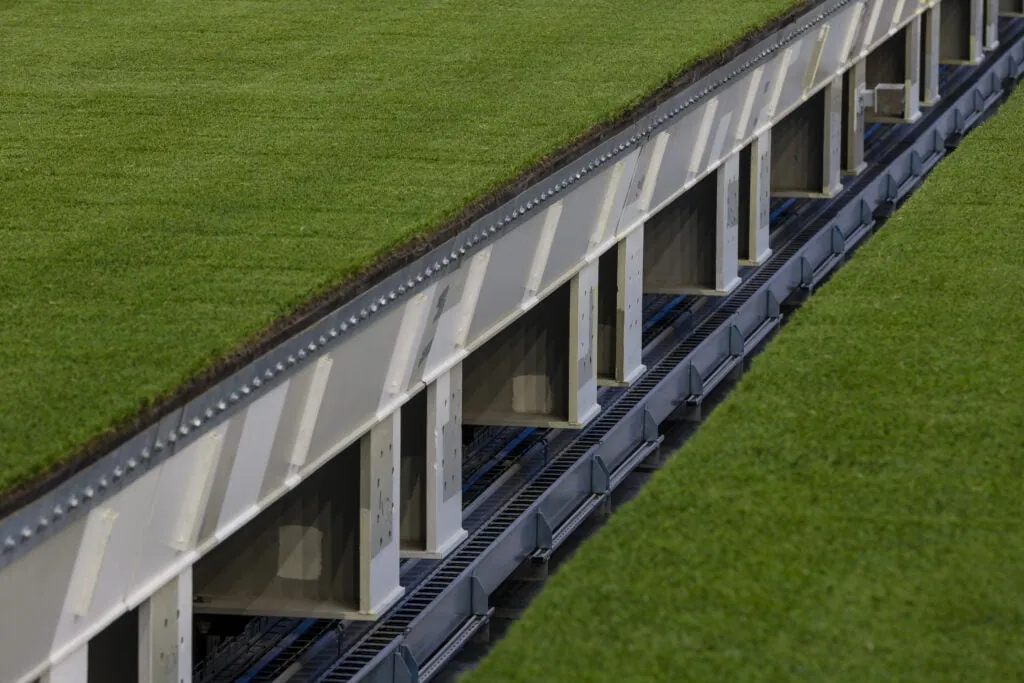
Transforming a stadium bowl between association football and rugby union requires intense coordination. Groundskeepers execute a mix of structural engineering, chemical paint removal, and agricultural adjustments. They often complete this work within a tight 24-to-48-hour broadcast window. Elite venues operate like a chameleon, shifting their playing surfaces to meet the distinct structural and kinetic requirements of both codes without breaking a sweat.
Dimensional Discrepancies and Field Layout
A standard professional football pitch is strictly regulated. The Department of Creative Industries, Tourism and Sport recommends senior dimensions measuring 105 meters long by 68 meters wide. Rugby union, however, demands significantly more real estate.
The primary structural variance lies in rugby’s mandatory in-goal areas and dead-ball lines. These zones add an extra 6 to 22 meters of length to each end of the pitch. That stretches the total required turf length up to 144 meters, according to equipment manufacturer RugbyBricks. To accommodate both sports, modern multi-purpose stadiums are engineered inside a maximum rugby-sized rectangular footprint.
When a football match takes place, groundskeepers adjust the perimeter boundaries inward. This results in disproportionately large run-off buffer zones behind the soccer goal lines. The extra space simply sits empty while the football match plays out in the center.
Structural Goalpost Conversions
Stadiums do not tear up the pitch to swap posts. Elite 11-a-side football goals feature rectangular nets measuring 7.32 meters wide and 2.44 meters high. They sit in wheeled cages that groundskeepers easily dismantle or roll away. Rugby goals are a completely different animal.
Rugby demands heavy, H-shaped structural installations. Their upright posts sit exactly 5.5 to 5.6 meters apart, with a horizontal crossbar positioned 3.0 meters off the ground. The uprights extend 15 to 17 meters into the air to aid referee visibility during high kicks, as detailed by equipment manufacturer Net World Sports.
To make the switch, specialized heavy-duty ground sockets are permanently cast into the stadium’s concrete foundations. These sit hidden directly beneath removable, capped turf plugs. During a changeover, groundskeepers pull up the turf caps. They use heavy-duty hydraulic hinges or specialized lifting tools to hoist the aluminum rugby uprights vertically before locking them deep into the sub-surface sleeves.
Line Marking Dynamics and Rapid Paint Eradication
Football requires relatively sparse line layouts. You have outer boundary lines, a center circle, and two penalty boxes. Rugby demands a hyper-dense matrix of markings. This includes solid halfway lines, 22-meter lines, solid try-lines, dead-ball lines, and various dotted lines running both parallel and perpendicular to the touchlines.
For rapid changeovers, groundskeepers avoid traditional permanent paints. Instead, they apply advanced, temporary water-soluble paints or low-volume ready-to-use formulas. These deliver high-contrast pigments under intense broadcast lights but lack long-term weather binding agents, according to suppliers Turfix and Pitchmark.
Automated walk-behind or ride-on scrubbing rigs are deployed to clear the lines completely. Major venues like SoFi Stadium use systems like the P-Rex. These machines spray a specialized eco-friendly paint-breaking solution to break down the binders. They agitate the grass blades using hard-bristled rotary brushes. Finally, a vacuum system instantly sucks up the liquefied pigment into a waste container to prevent it from staining the root zone.
Turf Height and Shear-Force Management
Elite football requires a short, dense grass canopy. Groundskeepers mow it down to a height of 20 to 25 millimeters. This offers zero ball rolling resistance and ensures predictable ball physics. Rugby scrums generate thousands of pounds of concentrated human torque that digs directly into the earth.
To provide impact absorption and prevent the surface from shredding, rugby pitches require a taller grass height. They are usually maintained between 35 and 50 millimeters. Pure natural grass would suffer severe structural damage from rugby scrums, making it unplayable for soccer.
To handle back-to-back scheduling without suffering catastrophic structural turf failure, modern elite venues rely on hybrid turf systems. The GrassMaster system installed at Cardiff’s Principality Stadium is a prime example. These advanced systems mechanically stitch millions of synthetic polyethylene fibers roughly 20 centimeters deep into the rootzone.
The natural grass roots entwine directly around these plastic filaments. According to research from Liverpool John Moores University, this anchors the turf matrix and prevents massive divots from ripping away during heavy rugby scrums. It also allows groundskeepers to mow the pitch short for subsequent football matches.
Modular Megastructures and Retractable Pitches
A standard line-stripping and goalpost swap takes several hours of intensive labor. But some extreme venues bypass the manual labor entirely. They build modular kinetic architecture into the foundation.
Venues like the Tottenham Hotspur Stadium or the GelreDome can completely roll away an entire grass pitch tray. These trays weigh thousands of tonnes. Engineering data from Ingenia and ARX shows these stadiums slide the turf into underground or outdoor storage slots in anywhere from 25 minutes to a few hours. The stadium then reveals a secondary artificial or hybrid surface underneath, ready for immediate use.
Key Takeaways
- Field dimensions dictate stadium architecture, requiring venues to build out for rugby’s larger in-goal areas while pushing boundaries inward for football.
- Groundskeepers rely on temporary water-soluble paints and heavy-duty scrubber vacuums to erase the hyper-dense matrix of rugby lines without leaving ghost marks.
- Protecting the soil from rugby scrum damage requires stitching millions of synthetic fibers deep into the rootzone, anchoring the natural grass so it survives short mowing for football.