
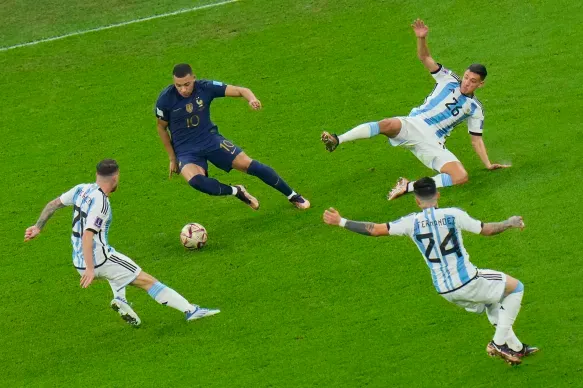
In the knockout rounds of the FIFA World Cup, a tie is not an option. If two teams are deadlocked after 90 minutes of regulation play—plus whatever stoppage time the referee adds on—the match immediately proceeds to extra time. That means an additional, guaranteed 30 minutes of soccer. The time is split evenly into two 15-minute halves, with a very brief pause in between just so the players can switch sides of the pitch. There is no sudden death. Even if a team scores in the first minute of extra time, they still have to survive the remaining 29 minutes to secure the win. If the score remains tied after 120 total minutes, the game goes to a penalty shootout.
How World Cup Extra Time Works
Extra time operates under the exact same basic laws as regulation play, but with a heightened sense of urgency. The referee still controls the clock and adds stoppage time to the end of each 15-minute period to make up for injuries, goal celebrations, and substitutions.
But as we look ahead to the expanded 2026 World Cup, fatigue management becomes a bigger issue. The tournament now includes a Round of 32. This means teams face the grueling threat of 120-minute matches a full round earlier than past tournaments. To combat the inevitable late-game stalling that happens when tired players want to force a penalty shootout, the IFAB introduced a strict pacing framework for modern extra time:
- The 10-Second Sub Rule: If a player taking too long to leave the pitch exceeds 10 seconds, their replacement gets penalized. The new player must wait a full minute of active play before entering.
- The Five-Second Restart Countdown: Referees now visibly count down with their hands if a goalkeeper stalls on a goal kick. If the keeper fails to restart play in five seconds, the opposing team gets a corner kick.
- The Injury Penalty: Any player who stops the run of play for a suspected injury and requires medical staff on the field must sit on the sidelines for one full minute after play resumes, completely neutralizing tactical flopping.
Why Teams Manage Substitutions Differently
Managers have to completely overhaul their tactical approach when a knockout game goes past 90 minutes. During a standard match, a team gets up to five substitutions. But if the game stays tied and pushes into extra time, FIFA grants every squad an automatic sixth substitution and an additional window to make that change.
That single extra sub alters how coaches spend their bench players. A manager might save a fast, attacking winger specifically for the 105th minute to run at exhausted defenders. And those defenders are genuinely exhausted. At the 2026 World Cup, players get mandatory three-minute hydration breaks around the 22-minute mark of each regulation half. But those authorized water breaks vanish completely during the 30 minutes of extra time. Players just have to push through the dehydration. Concussion substitutions are tracked entirely separately, so they do not count against the six-player limit.
Famous Examples from Major Games
Extra time often defines the history of a World Cup. The 1994 Final between Brazil and Italy stayed locked in a tense 0-0 gridlock through all 120 minutes of play. Brazil eventually lifted the trophy after a penalty shootout.
The 2006 Final between Italy and France also dragged deep into extra time, ending in a famous Italian shootout victory. And you cannot talk about extra time without mentioning the 2022 Final. Argentina and France battled to an exhausting 3-3 draw at the end of extra time, requiring Argentina to win it 4-2 from the penalty spot.
Common Misconceptions
The biggest point of confusion for casual fans is the idea of “sudden death.” People still think the first goal scored in extra time instantly ends the game. That was actually true for a brief period, but not anymore.
FIFA used to call this the “Golden Goal.” The rule was designed to speed up games and encourage attacking soccer. It was active during the 1998 and 2002 World Cups. France’s Laurent Blanc actually scored a famous golden goal in 1998 to eliminate Paraguay, and three sudden-death goals happened in the 2002 tournament.
But FIFA completely scrapped the format after the 2002 World Cup. Analysts realized the rule had the exact opposite effect of its intention. Instead of taking risks to score, teams were terrified of making a single defensive mistake. Managers packed the backfield and played incredibly boring, cautious soccer just to survive until the penalty shootout. Today, you play all 30 minutes no matter what.