
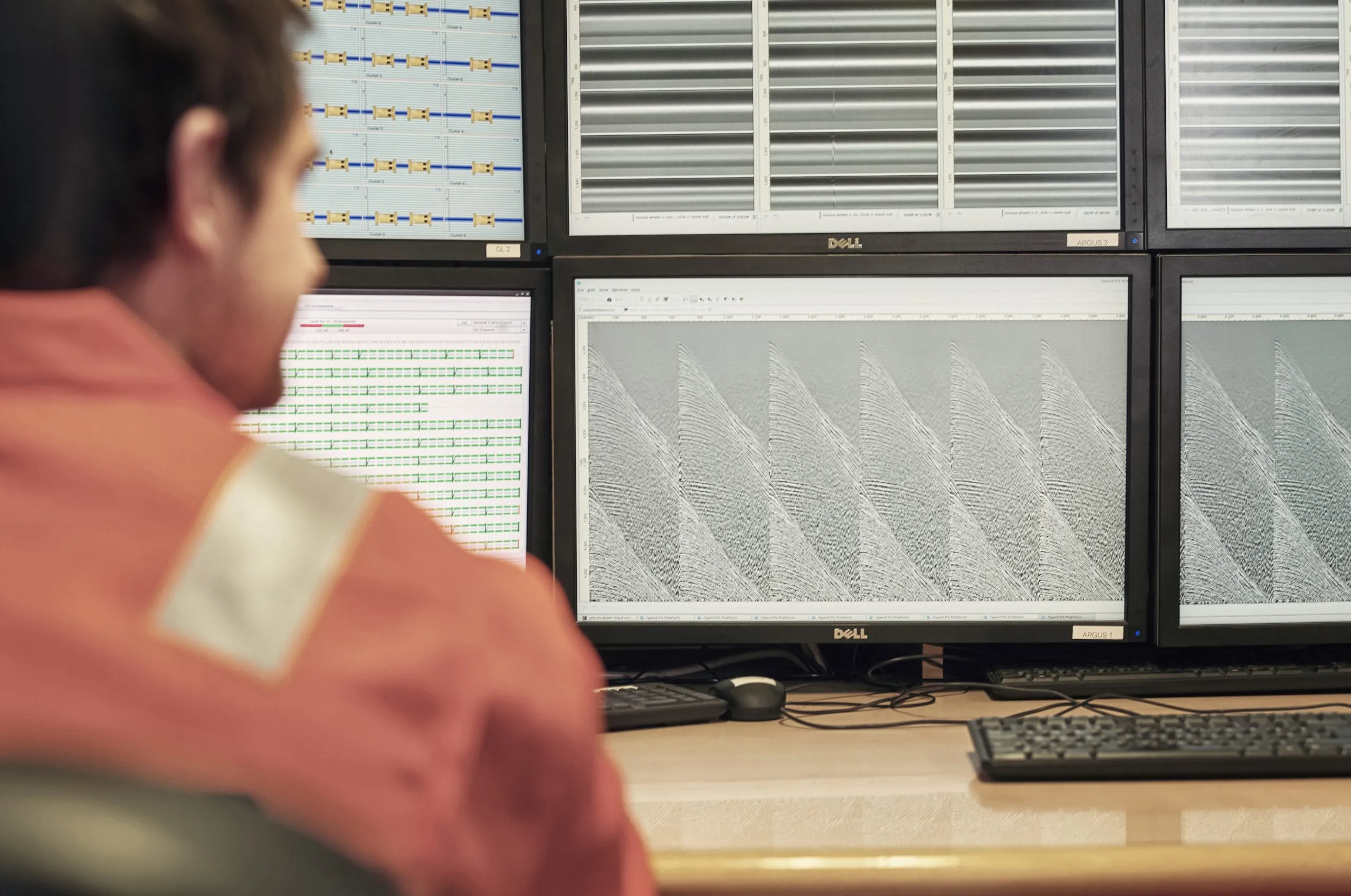
Earthquake warning networks don’t predict tremors. They detect ruptures that have already started. Sensors recognize the first energy waves that radiate from an epicenter—buying a few seconds for automated protocols to trigger. The margin is tight. We saw exactly what planners were preparing for when a recent 7.1 tremor collapsed a mall in Kyushu.
Background: How We Got Here
Earthquakes generate two distinct energy waves. They travel at vastly different speeds. And the absolute fastest are P-waves (Primary waves). These initial signals move through the planet’s shallow layers at 3.7 miles per second. Because of their push-pull compression motion, they move easily through solid rock, liquids, and the Earth’s molten outer core. Humans usually feel the wave as a sharp jolt.
S-waves (Secondary waves) follow seconds later. They roll outward at a slower pace of 2.5 miles per second. These waves move in a transverse, side-to-side motion that rigid structures aren’t built for. Buildings standing roughly eight stories tall often match the resonant frequencies of the radiated shear waves. The specific height pushes their collapse risk higher. Both wave types leave the epicenter simultaneously. So scientists rely on the geological mechanics of ground waves to calculate the origin point. Seismologists apply a mathematical formula to the time gap between the arrivals. The system combines distance data from three separate monitoring stations to triangulate the exact location almost instantly.
Key Players and Stakeholders
Regional governments engineer unique solutions to process the tremor data. The United States Geological Survey operates the ShakeAlert system. Officials designed the network to include nearly 1,700 planned sensors across the West Coast. P-wave data beams to a processing center at the speed of modern telecommunications. Automated algorithms assess the magnitude and shaking intensity, according to the official ShakeAlert detection framework. Human scientists remain on-call 24/7 to review all automated alerts for accuracy. The network is currently active in California, Oregon, and Washington. Planners are also exploring further deployment parameters for high-risk zones like Anchorage and Las Vegas.
The Japan Meteorological Agency built a nationwide network partially derived from UrEDAS. Japan Railways originally built that older detection grid to stop bullet trains during tremors. Taiwan relies on the localized P-Alert system alongside a specialized mathematical method. Professor Y.M. Wu developed the calculation to estimate the final magnitude from just the first few seconds of a P-wave.
But a massive shift involves everyday consumer hardware. Academic researchers built crowdsourced networks that tap into the built-in accelerometers found in modern smartphones. An active application monitors the phone’s hardware to detect ground shaking. Then, it grabs the user’s GPS coordinates and fires the data to a central MySQL database. A central server runs validation scripts to ensure the vibration isn’t just a passing truck. The server then pushes mass warnings out via Google Firebase Cloud Messaging. Academic engineers documented the specific method for testing consumer smartphones. Up to 95% of users receive the notification within 250 milliseconds.
What’s at Stake
Telemetry networks do more than warn individuals on their phones. A five-second head start allows technical partners to instruct computers to initiate massive infrastructural lockdowns before the S-waves arrive. Automated protective actions form the hidden backbone of modern urban grids. Transit systems automatically brake high-speed trains to prevent derailments. At the same time, utility networks close critical water and gas valves to prevent post-earthquake infernos. Firehouses are programmed to automatically roll up their garage doors. The vehicles won’t get trapped inside twisted frames.
Physics dictates a blind zone. The geographic region immediately surrounding the epicenter always experiences the heavy shaking before any digital warning arrives. The ground waves travel outward rapidly. You get more warning time the further away you are from the source. Physicists are currently researching Prompt Elasto-Gravity Signals (PEGS) to bypass the limitation. These gravity-based signals travel at the speed of light. They move exponentially faster than physical ground waves. The models represent a theoretical breakthrough to increase warning times for massive events.
Frequently Asked Questions
Do early earthquake warning systems predict earthquakes?
No. Early warning grids don’t predict seismic events before they happen. They detect an earthquake that has already started rupturing. The sensors pick up the initial P-waves. The system then transmits an alert through telecommunication networks before the slower S-waves physically arrive at populated areas.
What is the difference between P-waves and S-waves in an earthquake?
P-waves are primary waves that compress and expand materials. They travel at 5 to 8 kilometers per second and cause a minor initial jolt. S-waves are secondary waves that travel at 3 to 5 kilometers per second. They move rock side-to-side perpendicularly. S-waves are responsible for the severe shaking and structural destruction that topples buildings.
What is the “blind zone” in earthquake early warnings?
The blind zone is the immediate geographic area closest to the epicenter. The seismic waves travel outward rapidly from the origin point. People located in this zone will begin to feel the heavy shaking before the detection system has enough time to process the data. They feel the ground move before the digital warning reaches their devices.
How do smartphones help with earthquake warnings?
Modern smartphones contain built-in accelerometers that can detect distinct ground shaking. They also have GPS chips to pinpoint the exact location. Crowdsourced applications aggregate the data from thousands of plugged-in phones. They send the metrics to a central server. The server validates the tremor and pushes an early warning alert back to users in milliseconds. The method bypasses the need for expensive seismic stations.