
Silicone ear tips for wireless earbuds last longer, rinse clean with water, and cost less for everyday wear and workouts. Memory foam tips compress and expand inside your ear canal for tighter grip and stronger noise isolation, though they need replacing every few months. Stick with silicone if it seals comfortably, or switch to foam when earbuds slip.
ContentsToggle
How do silicone and memory foam ear tips compare?
Silicone tips are non-porous, flexible elastomer domes that sit against the wall of your ear canal. They rely on picking the right dome diameter to close off outside air and hold the earbud steady, which is why most manufacturers pack three to five sizes in the box.
Memory foam tips use open-cell polyurethane foam instead of smooth rubber. You roll or compress the foam lightly between your fingers before putting the earbud in, and the material expands to match the contours of your ear canal.
That mechanical expansion gives memory foam better grip during movement when stock silicone slides loose. Some listeners still find firm foam creates noticeable canal pressure over long sessions, and Sony notes in its documentation that tighter-fitting foam tips can cause ear strain for certain users.
Hybrid materials now bridge the gap between both designs. Aftermarket silicone-shielded foam tips wrap a foam core inside a thin silicone skin for extra durability, while thermoplastic elastomer (TPE) tips soften slightly with body heat to hug the canal wall without absorbing sweat.
| Feature | Silicone ear tips | Memory foam ear tips |
|---|---|---|
| How they seal | Flexible dome presses against the ear canal wall | Compressible polyurethane foam expands to match canal shape |
| Passive noise isolation | Good, especially if sized accurately | Stronger, especially against high-frequency treble noise |
| Workout and sweat resistance | High; non-porous surface resists moisture | Lower; porous foam absorbs sweat and skin oils |
| Cleaning method | Remove, rinse with plain water, and air dry completely | Wipe with a dry cloth; avoid water, wet wipes, and alcohol |
| Typical lifespan | Many months to over a year until torn or stiff | Average of 2 to 3 months per pair |
| Replacement cost (as of July 2026) | Around $9.99 for three aftermarket pairs | Typically $11.99 to $29.99 per pack |
How much extra noise do memory foam tips block?
Your ear tips create the acoustic seal that keeps bass from leaking out and blocks ambient sound before electronics ever get involved. Passive ear tips of every material attenuate high frequencies far more easily than low-frequency rumbles, which is why electronic active noise cancellation in earbuds handles engine hum while the tip blocks chatter and clatter.
Controlled SoundGuys lab testing in August 2025 measured both tip types on the exact same Sony INZONE E9 hardware. Hybrid foam-and-silicone isolation tips reduced overall outside noise by roughly 81 percent, blocking up to 51 dB in the treble and 15 dB in the bass, while standard silicone tips reduced overall noise by about 74 percent, reaching 40 dB in the treble and 14 dB in the bass.
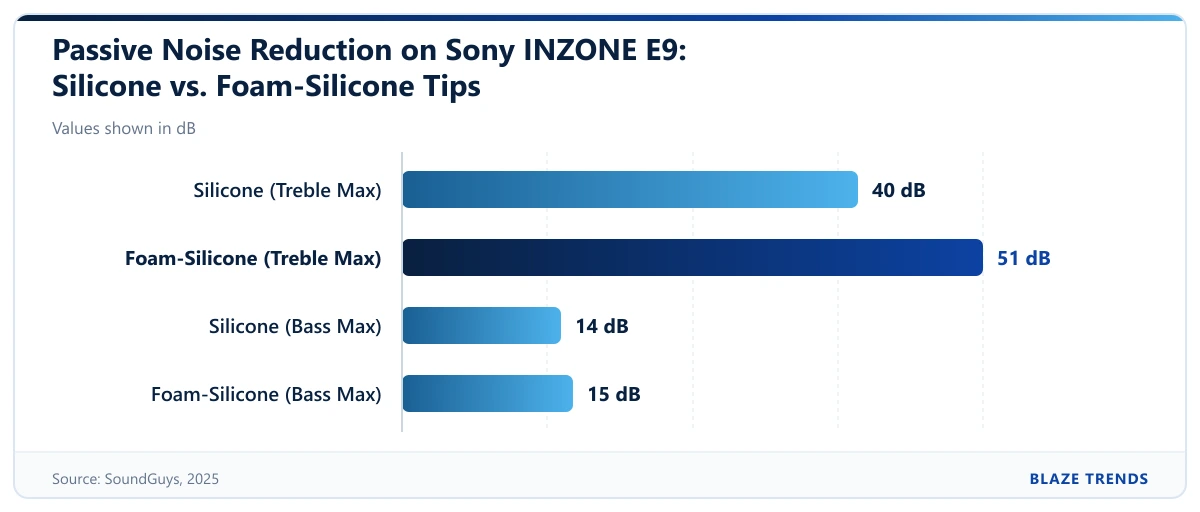
That 11 dB treble advantage explains why switching to memory foam often makes busy offices and train commutes sound noticeably quieter right away. Because a tighter foam seal closes tiny gaps around the canal wall, Active Noise Cancellation also has less high-frequency leakage left to manage.
Bass response benefits from that same seal. When a silicone tip sits slightly loose, low frequencies escape before reaching your eardrum, making music sound thin even on high-end earbuds.
How do you test your ear tip seal and swap tips?
Most flagship wireless earbuds include a built-in acoustic seal check that plays a short test tone and uses internal microphones to detect sound leaks. Run the test after trying different sizes, and do not assume both ears take the same tip because left and right ear canals are frequently asymmetric.
- On Apple AirPods Pro, insert both earbuds, open Settings, tap your AirPods Pro (or go to Settings, Bluetooth, and the Info button), and choose Ear Tip Fit Test on AirPods Pro 1 and 2 or Acoustic Seal Test on AirPods Pro 3 running iOS 26 or iPadOS 26 or later. Tap Continue, then tap Play to check each ear, as outlined in Apple Support fit instructions from October 2026.
- On Google Pixel Buds Pro, Pixel Buds Pro 2, or Pixel Buds 2a (this tool is not available on Pixel Buds 2020 or A-Series), open Settings, Connected devices, Pixel Buds’ settings, Device details, Sound, and Eartip Seal Check on a Pixel phone running Android 10 or later. On other Android phones, open the Google Pixel Buds app, tap Device details, Sound, and Eartip Seal Check.
- On Samsung Galaxy Buds, open the Galaxy Wearable app, tap Earbuds settings, select Earbud fit test, and tap Start. Put both earbuds in, tap Next, and adjust tip sizes until both ears report Good fit instead of Poor fit.
- Walk around for 10 to 15 minutes during normal activity. If an earbud gradually loosens, step up one tip size; if your ear canal aches or feels squeezed, drop down a size.
- Remove and attach replacement tips from the base rather than yanking the thin edge. On AirPods Pro, grip near the base or flip the silicone skirt inside out, pull straight off, then align the oval connector on the new tip and push until it clicks; on nozzle-mounted foam tips like Sony’s WF-1000XM5, twist and rotate from the base without pinching or pulling the foam end.
If your built-in fit test keeps failing with every included silicone size, try mixing a medium tip in one ear with a large or small tip in the other. Google specifically advises trying third-party memory foam tips such as Comply TrueGrip if Pixel Buds Pro users cannot get a reliable seal with stock silicone. On AirPods Pro 3, keep in mind that the heart-rate sensor needs steady skin contact, which can occasionally favor a slightly different tip size than acoustic seal alone.
How should you clean and replace each tip type?
Silicone is the easiest material to maintain. Both Apple and Samsung instruct removing silicone ear tips from the earbuds, rinsing them with plain water (Apple specifies using no soap or household cleaners), wiping them with a soft dry lint-free cloth, and letting them air dry completely before reattaching.
Polyurethane memory foam requires a gentler routine because moisture breaks down the open-cell structure. The Sony WF-1000XM5 Help Guide classifies its polyurethane foam tips (replacement series EP-NI1010) as consumables, recommends wiping them with a dry cloth and rotating a dry cotton swab lightly on the mesh, and warns against water, wet wipes, and alcohol or other organic solvents.
Audio maker Shure also warns against alcohol-based disinfectants on ear sleeves, notes that black foam sleeves take longer to dry than silicone if ever rinsed, and advises replacing any sleeve that grows brittle or loses its fit. Never keep wearing foam tips that look cracked, peeled, or chipped, because Sony warns damaged foam can detach and remain stuck inside your ear canal.
Factor upkeep into your budget before switching full-time to foam. According to a July 2026 SoundGuys ear tip guide, aftermarket memory foam tips average a 2 to 3 month lifespan per pair and generally sell for $11.99 to $29.99 per pack, compared with $9.99 for three pairs of replacement silicone tips (check current retailer listings as pricing fluctuates).
Clean tips protect your ears as much as your audio quality. Under April 2026 Cleveland Clinic guidance, in-ear earbuds can push earwax deeper into the canal and trap warm moisture, raising the risk of bacterial outer ear infections such as swimmer’s ear and fungal ear infections. Clean your earbuds at least weekly following the manufacturer’s directions—or after every workout if you sweat heavily—never put damp tips back into your ears or charging case, and stop using them and see a doctor if you develop ear pain, skin irritation, or hearing changes.
Frequently asked questions
Are foam-infused silicone tips the same as pure memory foam?
No. Apple’s AirPods Pro 3 ship with five sizes (XXS to L) of foam-infused silicone tips rather than the four-size pure silicone pack included with AirPods Pro 2. That silicone outer skin improves washability and helped AirPods Pro 3 reach 90 percent average total noise reduction with ANC on in SoundGuys’ 2025 testing, but it does not compress or block passive low-end noise the way pure open-cell memory foam does when ANC is turned off.
Why do memory foam ear tips feel stiff in winter?
Polyurethane foam reacts to temperature. Sony notes that cold air hardens foam ear tips, so warming them gently between your fingers before insertion helps them compress and seal, whereas high temperatures slow down how quickly the foam expands back to shape.
Will universal replacement ear tips fit any wireless earbuds?
Not always. Earbud nozzle diameters and charging-case depth vary widely across brands, and some models avoid standard round nozzles altogether: AirPods Pro ear tips click onto a recessed oval ring that is not interchangeable even across different AirPods Pro generations, while Samsung’s Galaxy Buds Live use flat wingtips instead of in-canal tips.