
The NBA Most Valuable Player award is decided by a panel of roughly 100 independent sportswriters and broadcasters who rank their top five choices at the end of the regular season. This media panel uses a weighted point system where higher-ranked selections earn more points toward a player’s final score. Fans also get a small voice through an online ballot that counts as one collective vote. The player who finishes with the highest point total wins the award, regardless of who got the most individual first-place votes.
How the NBA MVP Award Voting Works
The voting process relies entirely on a specific group of media members who do not work for individual basketball teams. These panelists are selected from various media markets across the United States and Canada. According to an award breakdown by the Hindustan Times, the panel routinely consists of approximately 100 sportswriters and broadcasters. This distribution ensures that local team biases do not skew the final results.
Voters cannot simply write down one name on their ballot. Instead, the league requires each voter to fill out a five-man ballot ranked from first place down to fifth place. The league applies a strict mathematical scale to these rankings to calculate the final scores. A first-place vote gives a player 10 points. A second-place vote grants 7 points, a third-place vote gives 5 points, a fourth-place vote awards 3 points, and a fifth-place vote gives 1 point.
This point structure creates scenarios where total consensus matters more than raw popularity. A player who receives a high number of first-place votes can still lose the award if another player accumulates an overwhelming number of second-place and third-place votes across all 100 ballots. The math ensures that the winner reflects the broader agreement of the basketball media community.
Public accountability is built into the modern system. Once the league announces the official winner, it publishes every single voter’s individual ballot online. Fans and teams can see exactly how each media member ranked their candidates. This public release was introduced to reduce questionable selections and keep voters accountable for their choices.
Regular fans also have a path to participate in the process. The league sets up an official online voting portal at the end of the regular season. Millions of fans can cast their personal choice for the award. All of these fan responses are aggregated into a single ballot. This fan ballot is thrown into the pool and holds the exact same weight as one individual media member’s ballot.
Why the League Uses This System and When It Applies
The timeline dictates that all votes are cast right after the final regular-season games conclude. This ensures the award is strictly an evaluation of the 82-game regular season schedule. Postseason games do not count. A player could score 50 points a night in the playoffs, but those performances will not alter the ballot boxes because the votes are already locked in.
In recent years, the league implemented a strict participation rule to combat player rest programs. An in-depth piece by The Ringer outlined how players must now appear in at least 65 regular-season games to qualify for the ballot. If a player sits out too many nights, they become completely ineligible for the honor, no matter how spectacular their individual statistics were during the games they did play.
The participation rule has specific floor-time parameters. To count as an official game played, the athlete must step onto the court for at least 20 minutes. The rules do offer a tiny bit of flexibility. A player can count up to two games where they played between 15 and 19 minutes toward their 65-game total. This prevents a player from losing eligibility due to a minor mid-game injury or an early ejection.
Special exceptions exist for severe medical situations. If a player suffers a verified season-ending injury, the qualification threshold drops slightly to 62 games. However, those 62 games must constitute at least 85 percent of the team’s total games played up to the exact point when the injury occurred. This protects stars who played the vast majority of the year before getting hurt right before the finish line.
Athletes can also appeal the system through an official award eligibility grievance process. If a basketball player believes their team intentionally benched them or restricted their minutes in bad faith, they can file a formal complaint. This mechanism prevents front offices from intentionally ruining a player’s award eligibility to avoid paying out contractual bonuses or to aid team rebuilding strategies.
Famous Examples and Historical Voting Races
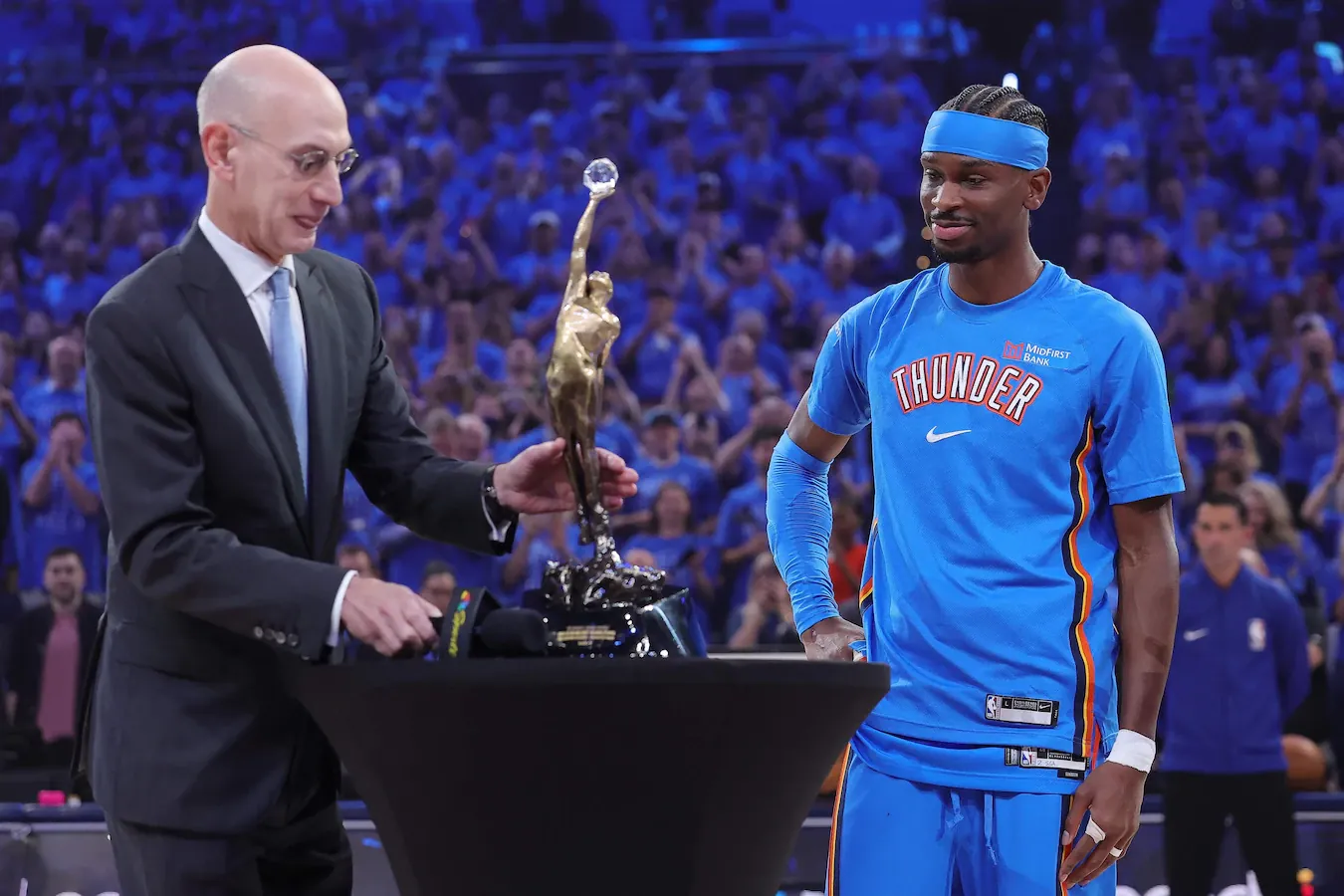
The modern application of these rules was fully visible during the recent award cycle. This approach stood out when Shai Gilgeous-Alexander won his second consecutive NBA MVP award. The voting panel favored his consistent season performance over other perennial candidates. The league distributed the trophy presentation live during the live broadcasting windows for the NBA Playoffs, keeping the announcement connected to high-profile game nights.
The 65-game participation rule heavily altered the ballot selections during that same cycle. Multiple high-profile athletes missed out on voting consideration because they fell just short of the 65-game line due to physical ailments and rest management. But certain stars managed to secure official eligibility exceptions through the league’s grievance panels due to unique life events and non-standard medical conditions, showing that the system evaluates cases individually.
Looking further back in basketball history reveals how shifting voter mindsets can change outcomes. In the 1997 voting cycle, Karl Malone won the award over Michael Jordan. Statistical analysts often point to this specific race because Jordan possessed superior raw scoring numbers and led his team to more total victories. The outcome proved that media voters frequently favor a fresh storyline over a player who has dominated the league for consecutive years.
Another classic historical case involves the back-to-back awards won by Steve Nash in the mid-2000s. Nash did not possess the high-scoring volume of contemporary stars like Shaquille O’Neal or Kobe Bryant. He won the media panel over because his style of play elevated his entire team’s offensive efficiency. The voters prioritized passing metrics and overall team transformation rather than traditional individual scoring volume.
These historical races created the concept of voter fatigue. When a single player dominates the league for five or six years, media members often become less likely to rank them first on consecutive ballots. This human element explains why all-time great players rarely win the award more than two or three times in a row, even if their nightly performance remains completely unchanged.
Common Misconceptions About the Ballot
A frequent error among casual observers is assuming that the league office or individual team executives have a say in the ballot. The league itself does not vote. No team general manager, coach, or player has an official ballot in the final tally. The process is isolated entirely within the independent sports media industry to prevent internal basketball politics from dictating the winner.
Another common misunderstanding is the actual name of the physical award. For decades, the winner received the Maurice Podoloff Trophy, named after the very first president of the league. However, as reported by CBS News, the league officially changed the hardware to the Michael Jordan Trophy ahead of the 2022-2023 season. Podoloff’s name was reassigned to a separate regular-season team achievement award.
Fans also regularly confuse the MVP criteria with a pure statistical championship. There is no rule stating the highest scorer or the player with the most rebounds must win. The word valuable is left intentionally undefined by the league. One voter might define value as the player who makes a mediocre team good, while another voter defines it as the best individual player on the top-seeded team in the standings.
Finally, people often think that a single dominant voter can swing the award. Because the league uses a 10-7-5-3-1 point distribution across roughly 100 ballots, a single rogue voter cannot ruin a player’s chances. Even if one writer completely leaves a top candidate off their ballot, the massive volume of total points available usually overrides individual anomalies, ensuring a fair democratic result.
Frequently Asked Questions
Can a player win the MVP award if their team misses the playoffs?
Yes. A player can technically win the award even if their team fails to make the postseason. Because the media panel submits all votes before the play-in tournament and playoffs begin, the selection is based purely on regular-season performance. However, historical voting patterns show that voters rarely select players from losing teams, as team success is heavily factored into the definition of value.
What happens if there is a tie in the total MVP voting points?
If two players accumulate the exact same number of total points from the media panel, they share the award as co-MVPs. While this is incredibly rare due to the large panel size and the five-tier point system, it has happened in other league awards historically. The point system calculation is final, and the league does not use a tie-breaking vote to separate players who finish with equal scores.
Are NBA players or coaches allowed to vote for the regular season MVP?
No. Active players and head coaches do not get a ballot for the official regular-season MVP award. The league limits the voting panel entirely to independent journalists, broadcasters, and one collective fan ballot. Players do voice their opinions through separate player-association awards, but those are completely distinct from the official historical trophy recognized by the league.
How does the single fan ballot affect the final MVP vote tally?
The fan ballot counts as exactly one ballot out of roughly 101 total ballots cast. The league opens an online voting portal for the public at the end of the regular season. The player who receives the most fan votes across the globe receives 10 points, the second-place finisher gets 7 points, and so on. This single fan score is added directly to the media scores, meaning the public has about a one percent impact on the final outcome.