
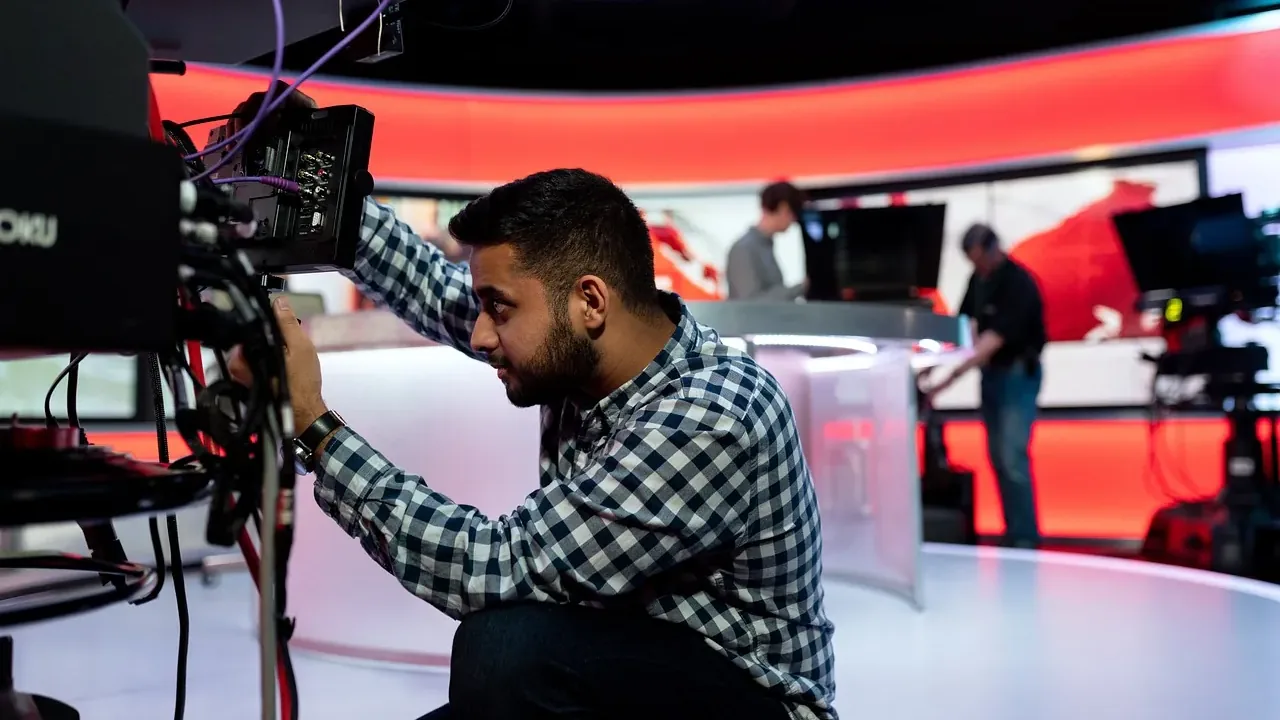
The fundamental difference between single-camera and multi-camera sitcoms comes down to how the cameras are staged on set and whether a live audience is present. A multi-camera sitcom uses multiple cameras, typically four, rolling at the same time to capture a scene like a stage play on permanent soundstage sets, usually in front of a studio audience. A single-camera sitcom is filmed like a movie, capturing one camera angle at a time on soundstages or real-world locations without a studio audience or laugh track.
How do camera setups and sets differ in single-camera and multi-camera sitcoms?
When you watch a multi-camera comedy such as Cheers, Seinfeld, Everybody Loves Raymond, The Big Bang Theory, or Fuller House, the living room or workplace on screen is built like a theater stage with the fourth wall removed. According to MasterClass’s 2022 sitcom guide, a typical multi-camera production lines up four cameras along the front of the permanent soundstage set so they can record wide masters and close-ups of different actors at the exact same time. The 2024 Video Production Handbook from the Academic Senate for California Community Colleges Open Educational Resources Initiative notes that this layout treats the television studio as a live theater stage.
That three-wall soundstage method dates back to 1951 on I Love Lucy. According to the Television Academy Foundation, producer and co-star Desi Arnaz recruited veteran cinematographer Karl Freund to film the comedy using three film cameras rolling simultaneously in front of a live studio audience, establishing the visual template that network sitcoms still follow.
Single-camera comedies such as The Office, Arrested Development, Modern Family, Curb Your Enthusiasm, and Abbott Elementary abandon the proscenium stage altogether, according to MasterClass’s 2022 guide. Instead of keeping cameras on one side of a room, the director and crew place the camera anywhere inside a four-wall set or on an exterior location. Every time the director switches from a wide shot to a close-up or a reverse angle over another actor’s shoulder, the crew stops to move the camera and adjust the lighting for that specific frame.
The label single-camera is also a common point of confusion for viewers. As a 2024 Backstage production guide explains, the term does not mean only one physical camera is allowed on set. Single-camera crews frequently run two cameras at once during dialogue scenes to capture both actors’ reactions simultaneously, but every setup is still blocked and lit shot by shot like a feature film rather than recorded as a continuous stage play.
How do live studio audiences and weekly schedules change the production?
Because traditional multi-camera sitcoms record in front of a live audience and keep the audience’s laughter in the broadcast mix, actors perform with stage instincts. According to Backstage’s 2024 breakdown, multi-camera actors angle their bodies toward the open side of the set—a theater technique called cheating out—and pause their delivery after punchlines so the audience’s laugh does not drown out the next line of dialogue. In a single-camera comedy, there is no audience laughter to wait for, allowing actors to overlap dialogue, speak quietly, or rely on subtle facial reactions and rapid visual gags.
The weekly work calendar for the cast and crew also splits sharply between the two formats. On a multi-camera show, the cast spends several shorter days during the week rehearsing scenes on the soundstage and performing run-throughs for network and studio executives while the writers rewrite jokes, according to Backstage (2024). Once the blocking is locked, the crew records the episode in front of the audience. On a single-camera sitcom, separate rehearsal days are rare; actors arrive on set, block the scene with the director, and immediately film their coverage across long shoot days.
A 2010 Directors Guild of America profile of director Pamela Fryman illustrates how scene counts dictate that schedule. According to DGA Quarterly (2010), a conventional network multi-camera sitcom averages 10 scenes per episode and films in a single day in front of a studio audience. When Fryman directed the CBS comedy How I Met Your Mother, the show used a hybrid multi-camera approach without a live studio audience because its rapid flashbacks required 60 to 80 scenes and 70 to 90 wardrobe changes per episode, which the crew filmed with multiple cameras across three 10-to-12-hour shoot days.
Why are multi-camera sitcom scripts twice as long as single-camera scripts?
One of the biggest surprises for aspiring television writers is that both comedy formats produce an episode running about 22 minutes for a half-hour broadcast slot, yet their scripts have vastly different page counts. According to a 2021 Final Draft script breakdown, single-camera sitcom scripts follow standard feature screenplay formatting in 12-point Courier font and run 22 to 32 pages, or occasionally up to 35 pages, with MasterClass (2022) noting an average of 28 to 30 pages. Multi-camera sitcom scripts run 48 to 50 pages on average according to MasterClass (2022), and regularly reach 52 to 58 pages according to Final Draft (2021) for that exact same 22-minute runtime.
Single-camera teleplays look almost identical to movie scripts, using single-spaced dialogue and standard uppercase-and-lowercase action lines. The main difference from a feature screenplay, according to the 2024 Video Production Handbook, is that television scripts label the start and end of each act with centered, underlined, all-caps headings and start each new act on a fresh page.
Multi-camera teleplays expand to nearly double the page count because their layout is designed as a working rehearsal blueprint for the cast and camera department. According to Final Draft (2021) and MasterClass’s 2021 teleplay guide, multi-camera script formatting uses four distinct conventions, though exact underlining rules can vary slightly from one studio or network to another:
- Dialogue is double-spaced throughout the script so actors, directors, and camera operators have blank space to pencil in blocking notes and joke changes during rehearsal week.
- Every action line and stage direction is printed in ALL CAPS so physical movements stand out visually from spoken lines.
- Every new scene starts on a new page and includes an underlined scene heading followed by a parenthetical list of the specific characters who appear in that scene.
- Character names are underlined the first time they appear in a scene, and character entrances, exits, and sound effects are also underlined in the action lines.
How do editing and Emmy rules separate the two comedy formats?
Once filming wraps, the post-production workflow diverges as well. According to Backstage (2024), a single-camera editor works with a more targeted pool of footage because the director planned and shot individual setups for each moment of the scene. A multi-camera editor assembles each scene by cutting among four simultaneous camera feeds recorded during multiple takes, matching actor performances with the timing of the studio audience’s reactions.
Because these editing challenges are so different, Hollywood’s major awards bodies evaluate the two formats separately at the craft level. While single-camera and multi-camera comedies compete in the same pool for Outstanding Comedy Series, the 2026 Television Academy Emmy rules for the 78th Primetime Emmy Awards split comedy editing into two distinct categories: Outstanding Picture Editing for a Multi-Camera Comedy Series and Outstanding Picture Editing for a Single-Camera Comedy Series.
Frequently asked questions
Are animated comedies considered single-camera or multi-camera sitcoms?
Adult animated comedies such as The Simpsons, Bob’s Burgers, and Futurama are classified as single-camera sitcoms, according to MasterClass’s 2022 sitcom writing guide. Their writers use single-spaced screenplay formatting, and the episodes cut rapidly across dozens of locations without a live audience track.
Which sitcom format costs less to produce per episode?
Multi-camera sitcoms are generally faster and less expensive to produce per episode than single-camera shows, according to Final Draft (2021). Shooting on standing soundstage sets with four cameras capturing coverage at once avoids the expense of moving a crew across locations and relighting every individual shot.
Why do multi-camera directors shadow on set before directing an episode?
Directing four simultaneous cameras alongside live script rewrites and a studio audience requires a specialized technical workflow. According to a 2025 Directors Guild of America report on its multi-camera directing panel, directors entering the format typically shadow a veteran multi-camera director on set first to learn camera-blocking shorthand before directing an episode of their own.