
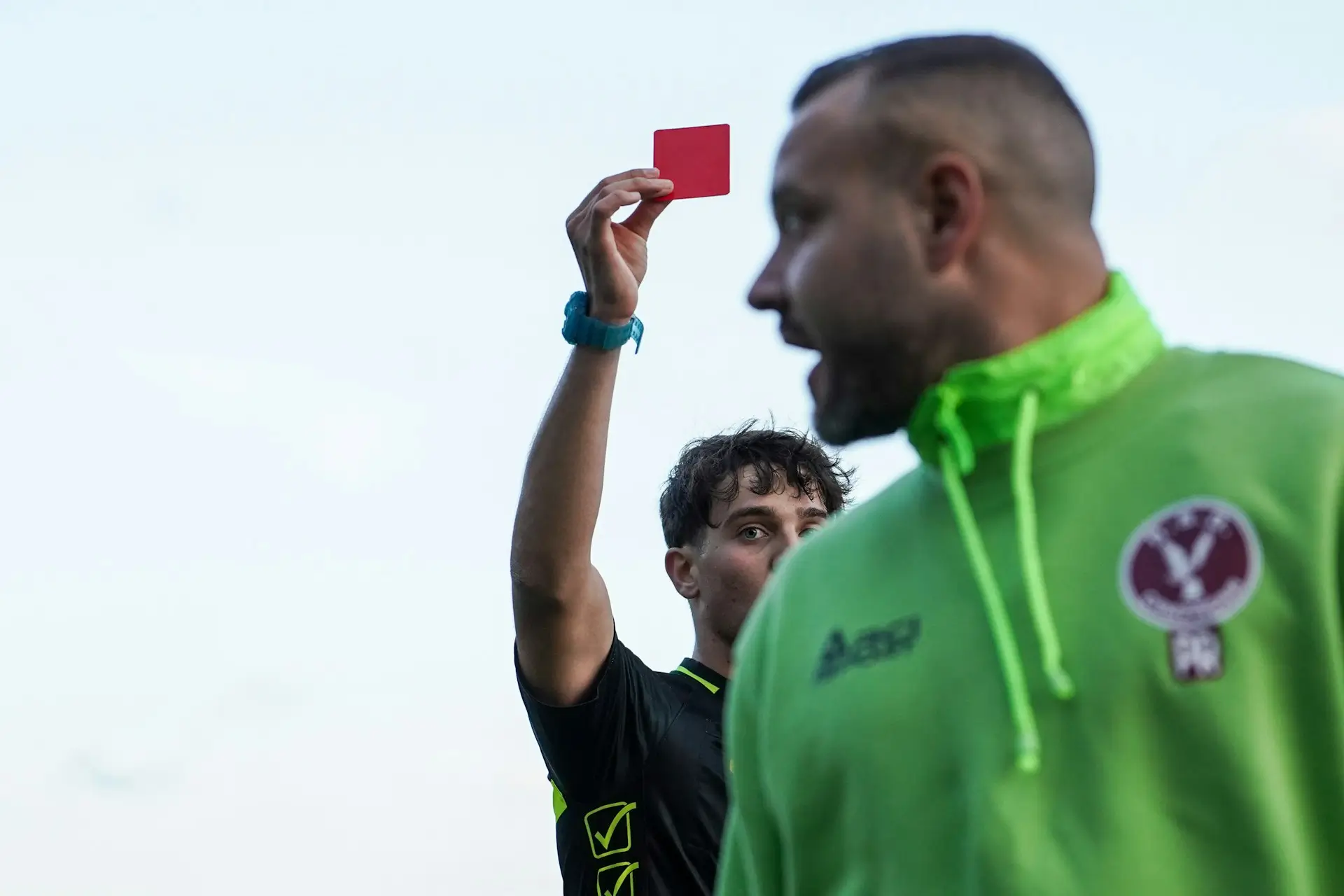
Red cards instantly alter a football match by forcing the penalized team to abandon their offensive strategies, reduce their attacking threat, and adopt a highly compact defensive formation. When a referee shows a player a red card, that player must leave the pitch immediately, and the team cannot replace them with a substitute. This numerical deficit shifts the balance of power, forcing the remaining ten players to cover more physical ground, concede possession of the ball, and rely on a defensive structure to salvage a result. Understanding how do red cards affect soccer tactics reveals the deep strategic battle that occurs when a manager has to plan for sudden survival on the pitch.
How Red Cards Work
The rules governing dismissals are straightforward but unyielding. A player receives a red card either directly for a severe offense or indirectly by accumulation. A straight red card is shown for serious foul play, violent conduct, spitting, or deliberately denying an obvious goal-scoring opportunity by handling the ball or fouling an opponent. The indirect method occurs when a player receives a second yellow card in the same match, which automatically results in a red card. In both scenarios, the player is banned from the rest of the game and must go straight to the dressing room, leaving their team short-handed.
The penalty extends far beyond the current match boundaries. A player who is sent off faces an automatic suspension from subsequent fixtures. According to guidelines listed by the Bundesliga, a second yellow card leads to a one-match ban, while a straight red card for serious violent conduct can trigger longer multi-game suspensions and financial fines determined by league officials. This means a single rash challenge disrupts a manager’s tactical options for several weeks.
If a goalkeeper receives a red card, the tactical dilemma intensifies. A team cannot play without a goalkeeper, so the manager has to make an immediate, forced substitution. They must take off an outfield player, usually an attacking midfielder or a forward, to bring the backup goalkeeper onto the pitch. If the team has already used all their permitted substitutions, an outfield player must put on a goalkeeper jersey and play the rest of the game in goal. This scenario completely disrupts the team’s organization and eliminates their ability to build attacks from the back.
There is also a strict structural limit to how many players a team can lose before a match is ruined entirely. Football regulations state that a match cannot continue if either team has fewer than seven players on the pitch. If a team receives five red cards during a single match, the game is abandoned on the spot. The offending team suffers an automatic forfeit loss, regardless of what the score was before the fifth dismissal occurred. This rule ensures that teams cannot simply resort to constant physical violence to stop an opponent from playing.
Why Teams Use This / When It Applies
When a team drops to ten men, the manager must act fast to adjust the team’s shape. The primary goal is to close the spaces that the opponent will try to exploit. Most managers choose to sacrifice their primary attacking outlet to preserve their defensive line. For instance, a team playing a standard four-four-two formation will often transition into a tight four-four-one shape. They keep their four defenders and four midfielders intact while leaving just one isolated striker upfront to chase long clearances.
This tactical shift means the short-handed team will consciously give up possession of the ball. They drop deep into their own half of the pitch, creating what analysts call a low block. In this setup, the defenders and midfielders form two compact lines close to their own penalty box. By packing the central areas of the pitch, they force the opposing team to pass the ball sideways and out wide to the wings. The strategy is to dare the opponent to cross the ball into a crowded box where tall center-backs can head the danger away.
But this defensive choice comes with a heavy price. Data published by football experts at US Soccer Players highlights that teams routinely modify their midfield responsibilities to ensure the wide players do not venture forward, which stops the full-backs from overlapping. The lone striker faces an incredibly difficult task. They must hold up the ball against multiple defenders to give their teammates a few seconds to breathe and step up the pitch. Without this hold-up play, the ball comes right back into the defensive zone, creating relentless pressure.
Sometimes, a player intentionally triggers a red card because the immediate alternative is worse. This tactic is known as the emergency brake or Notbremse. If an opposing forward runs past the defensive line and has an open shot at an empty net, a defender might intentionally trip the attacker from behind outside the penalty area. The defender knows they will receive a straight red card and a multi-game suspension. Yet, they accept that severe consequence to prevent a certain goal, betting that their team can defend a free-kick and survive the rest of the match with ten men.
Famous Examples from Major Games
The history of international football contains classic examples of teams executing these exact survival tactics on the biggest stages. During the knockout rounds of the premier global tournament, teams have shown how do red cards affect soccer tactics by turning matches into intense defensive battles. A classic case occurred during the tournament in Germany, where defensive organization overcame a long-term numerical disadvantage.
In a round-of-16 clash, Italy faced off against a stubborn Australia squad. Early in the second half, Italian center-back Marco Materazzi received a straight red card for a heavy challenge, leaving the favored Italian team with ten men for nearly forty minutes of play. The Italian manager did not panic. He immediately adjusted the team’s shape, pulling players back into a disciplined low block and relying on his remaining defenders to clear every incoming cross.
Australia dominated possession and moved the ball around the perimeter of the Italian defense. But they could not find a way through the narrow, compact lines. Italy waited patiently for a single opportunity to counter-attack. In the final seconds of stoppage time, an Italian fullback made a rare run into the Australian penalty area and won a penalty kick. Italy scored the penalty, won the match, and eventually went on to win the entire tournament, proving that perfect defensive tactical discipline can neutralize a red card.
These scenarios show that a dismissal completely reshapes the narrative of a match. The game stops being a fluid, tactical contest between two balanced teams. Instead, it becomes a psychological test of patience, where one team dominates the ball and the other focuses entirely on spatial denial and physical endurance.
Common Misconceptions
A widespread belief among casual fans is that a red card means the penalized team is doomed to lose the match. The reality is far more nuanced. While a dismissal certainly damages a team’s chances, it does not guarantee immediate defeat. In fact, a red card often produces a galvanizing effect within a squad. When a player is sent off, the remaining ten players frequently display a sudden burst of energy and focus. They understand that individual mistakes are now fatal, so they communicate better, run harder, and defend with greater intensity than they did with a full lineup.
Another misconception is that the team with the numerical advantage will immediately unleash an onslaught of goals. Academic data suggests otherwise. According to a specialized sports study available via ResearchGate, while the penalized team experiences a severe drop in their attacking intensity, the opposing team’s scoring intensity only increases by a small margin. The team with eleven players often struggles to break down a well-organized low block because the penalized team has eliminated all the open space behind their defense. The attacking team can become complacent or frustrated, passing the ball slowly and playing directly into the defensive trap.
Nevertheless, long-term trends show that playing short-handed catches up to teams over the course of ninety minutes. Analytical tracking from InnerDrive reveals that teams playing with ten men eventually go on to lose nearly three-fifths of those matches. They manage to secure a victory in less than a quarter of these situations, with the remaining games ending in a draw. The physical toll of covering extra ground eventually causes mental fatigue, which explains why so many goals against ten men are scored in the final fifteen minutes of a match.
People also get confused about when a red card must accompany a penalty kick. For a long time, if a defender fouled an attacker inside the penalty box to deny a clear scoring chance, the referee issued a red card and awarded a penalty. Fans called this the double penalty because it ruined the team’s current match and their next game through suspension. To fix this, football’s lawmakers modified the rules. Now, if a defender makes a genuine, legitimate attempt to play the ball during a challenge inside the box, the referee awards the penalty but only issues a yellow card, sparing the team from an automatic tactical restructuring.
Finally, the timing of the dismissal matters immensely. Football researchers note that the average time a referee issues a red card is around the one-hour mark of the match. This is not a coincidence. By the sixty-minute mark, players start to experience physical exhaustion. As muscles tire, the brain slows down, leading to poor positioning and late tackles. A manager who has already planned out his tactical substitutions for the final half-hour suddenly has to throw those plans away, proving that an understanding of how do red cards affect soccer tactics is an essential tool for anyone analyzing the sport.
Key Takeaways
- A dismissal forces an immediate structural retreat into a low block, requiring the short-handed team to sacrifice its attacking options and surrender ball control to protect the penalty area.
- The physical and psychological toll of playing with ten men creates a late-game vulnerability, as fatigue degrades defensive discipline during the final phases of the match.
- Rule adjustments have softened the impact of defensive fouls inside the penalty box, eliminating the automatic ejection if a player makes a fair attempt to win the ball.