
When an NBA team hands a star player a lucrative contract extension, the financial impact ripples through the entire organization for years. The league uses a “soft” salary cap system. This setup lets teams exceed their designated spending limit to re-sign their own players. But doing so triggers strict financial penalties and harsh roster-building restrictions once the payroll crosses specific luxury tax thresholds.
How The Soft Salary Cap Works
Unlike the NFL or the NHL, basketball front offices operate in a gray area of financial rules. The NBA ties its spending limit directly to Basketball Related Income. This income pool includes national television deals, local broadcasts, merchandise, and ticket sales. The salary cap figure is roughly 44.74 percent of the projected income for that year, divided evenly across all 30 franchises.
And teams cannot just hoard their cash to save up for future free agents. The league enforces a strict salary floor. Every front office must spend at least 90 percent of the salary cap by the start of the preseason training camp. If a team falls short, they face penalties. So, the money has to be spent. The soft cap system exists to encourage continuity. Fans want to see their favorite draft picks stay in town, and the rules give the incumbent team a financial advantage to make that happen.
The system forces general managers to operate like accountants just as much as talent scouts. When a front office drafts well, they inevitably face a financial crunch three or four years down the line. By using specific exceptions, such as Bird rights, a team can exceed the standard salary cap to pay their homegrown star a competitive market rate. Without these exceptions, small-market teams would constantly lose their best players to larger markets simply because they ran out of cap space.
Why Teams Use Extensions And When It Applies
Extending a player before they hit free agency eliminates the risk of losing them for nothing. But the math changes depending on the player’s experience level.
First-round draft picks get their first shot at a big payday following their third season. These rookie-scale extensions take effect in the player’s fifth year. Generally, these deals allow a player to eat up to 25 percent of the team’s salary cap. If the player meets specific performance markers—like winning the MVP award or making an All-NBA team—that number jumps to 30 percent under the so-called Rose Rule.
Veterans face different math. Players with at least three years left on their current deal can negotiate veteran extensions. Under the officially ratified 2023 agreement between the National Basketball Players Association and the league, the limits shifted. These agreements allow veterans a starting salary increase of up to 140 percent over their previous final year’s salary, or 140 percent of the estimated average salary, whichever is higher.
Then you have the Designated Veteran Player Extension, widely known as the Supermax. This is the biggest financial weapon a team has to keep a superstar. Players entering their eighth or ninth season can sign for up to 35 percent of the entire salary cap. But there are strict conditions. They must have stayed with their current team or been traded during their first four seasons. They also have to hit elite performance criteria. You can only sign a Supermax during the offseason, and the player cannot be traded for a full year after putting pen to paper.
Famous Examples from Major Contracts
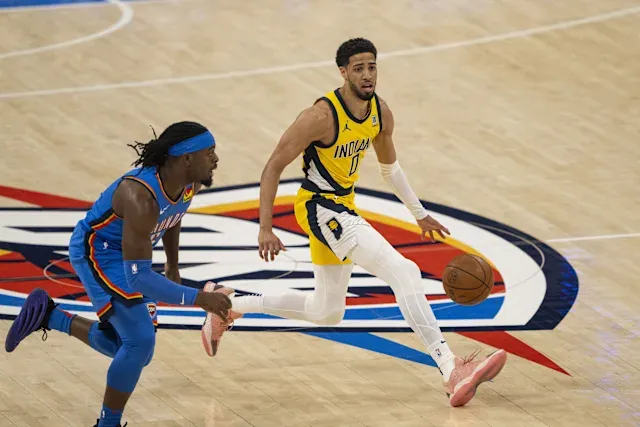
Looking at real contracts helps clarify the math. The Indiana Pacers locked up Tyrese Haliburton in July 2023 with a five-year maximum rookie extension. Because these deals are tied to a percentage of the salary cap rather than a fixed dollar amount, the actual payout fluctuates. Haliburton’s deal lands somewhere between $245 million and $260 million, depending on where the final cap number settles and his All-NBA status.
Even incoming rookies impact the cap before they play a game. Take 2025 prospect Cooper Flagg. His projected four-year, $62.7 million rookie deal factors into a team’s salary cap at 120 percent of the standard rookie scale. The collective bargaining rules dictate exactly how much cap room a top draft pick occupies, leaving teams with very little wiggle room.
The Luxury Tax and Punitive Aprons
For a long time, wealthy owners just paid the luxury tax and kept building super-teams. The luxury tax threshold sits at 121.5 percent of the salary cap. If contract extensions push a team’s payroll over this line, they pay an escalating tax to the league office. Spend $5 million to $10 million over the line, and the tax is $1.75 per dollar. That money gets redistributed to teams that stayed under the tax or goes toward league initiatives.
But the latest rules added teeth to the financial penalties. The First Apron triggers when a team surpasses the luxury tax line by about $7 million. Cross this line, and you instantly lose the Non-Taxpayer Mid-Level Exception, which is worth roughly $12 million. You also lose the Bi-Annual Exception and cannot acquire players via sign-and-trade if the move keeps you over the apron.
The Second Apron is where the real punishment starts. Set about $17.5 million above the tax line, this threshold ruins a team’s flexibility. Teams sitting above the Second Apron cannot use any Mid-Level Exception to sign free agents. They are forbidden from signing buyout players. The harshest penalty freezes the team’s ability to trade their first-round draft picks seven years into the future. It acts essentially as a hard cap for the most expensive rosters.
Common Misconceptions
Fans often think an expiring contract immediately creates dollar-for-dollar spending money in free agency. It doesn’t. Because of cap holds, an extended player usually occupies less cap space right now than they would as a free agent on the open market.
Another common error is assuming any star player can sign a Supermax extension at any time. The window is incredibly narrow. The rules limit these deals to the offseason. And the strict one-year trade restriction means a team is entirely locked into their decision once the ink dries. You cannot hand out a Supermax in February to keep a player happy ahead of the playoffs.
Frequently Asked Questions
What is the difference between a hard cap and a soft cap in the NBA?
A hard cap strictly prohibits teams from spending above a set salary limit under any circumstances. The NBA uses a soft cap, which allows teams to go over the salary limit to re-sign their own players using specific exceptions. However, they face financial taxes and roster-building restrictions if they exceed the luxury tax aprons.
How much can a veteran player’s salary increase in a contract extension?
Eligible veteran players can extend their contracts for a starting salary that is the greater of either 140 percent of their previous final year’s salary, or 140 percent of the estimated average NBA salary. Extensions generally cannot exceed five years in total length.
What are the NBA’s First and Second Aprons?
The aprons are punitive financial thresholds established above the luxury tax line to discourage super-teams. Crossing the First Apron strips a team of certain mid-level exceptions and sign-and-trade flexibility. Crossing the Second Apron enacts severe roster-building punishments, such as freezing the team’s ability to trade first-round draft picks seven years into the future and removing their access to the Mid-Level Exception.