

CMA Awards voting is closed to fans and run entirely by active Professional members of the Country Music Association. Every year, thousands of verified country music pros narrow the field across three separate online ballots to pick nominees and winners in 12 categories. Election Services Corp. delivers each ballot, and Deloitte independently tabulates the results.
Who actually gets a CMA Awards ballot?
If you’ve ever searched for a fan poll on awards night, you came up empty for a reason. The Country Music Association, founded in 1958 as the first single-genre music trade organization, treats its awards as a peer-voted industry honor rather than a popularity contest.
Paying dues alone won’t get you a ballot either. Under the CMA membership guidelines, the organization divides members into three tiers: Student, Industry, and Professional. Only the Professional tier includes voting rights.
- Student membership is free for full-time students age 16 and older and carries no voting rights.
- Industry membership costs $25 per year (check the CMA website for current dues) and carries no voting rights.
- Professional membership is reserved for people who work primarily within country music, including artists, songwriters, musicians, producers, engineers, and publishers.
Applicants for the Professional tier have to pick an industry role category and submit three professional references to verify their work. Voting privileges also belong to individual people rather than record labels or management firms, even when an employer pays dues through a Company Roster.
To vote in all three rounds of an awards cycle, prospective members have to apply by June 1. For the 60th Annual CMA Awards in 2026, 6,678 Professional members held eligible ballots, up from 6,468 in 2025, according to the Country Music Association.
How the three rounds of CMA Awards voting work
Every CMA Awards cycle covers a 12-month eligibility period running from July 1 of one year through June 30 of the next. For the 2026 ceremony, that window ran from July 1, 2025 through June 30, 2026. Singles, albums, music videos, and qualified music products have to be first released or reach peak national prominence during that span.
Once the eligibility clock closes, Election Services Corp. emails secure online ballots to every eligible Professional member across three rounds. Using the 2026 CMA Awards ballot schedule as a blueprint, the calendar unfolds in four stages, with each voting round closing at 6:00 PM CT:
- Nomination Ballot in July (July 6 to July 16 in 2026): Voters start with a blank slate and “write in any artist or project they think deserves a nomination,” as long as the entry fits the category rules.
- Second Ballot in August (August 4 to August 17 in 2026): For most categories, the top 20 qualified contenders with at least 10 write-in votes move forward. Voters then select up to five favorites in each category.
- Nominees Announcement in September (September 10 in 2026): The five highest vote-getters from the Second Ballot in each category become the official CMA Awards nominees.
- Final Ballot in October (October 1 to October 27 in 2026): Eligible members cast one final vote per category to decide the winners, and Deloitte tallies the envelopes behind closed doors.
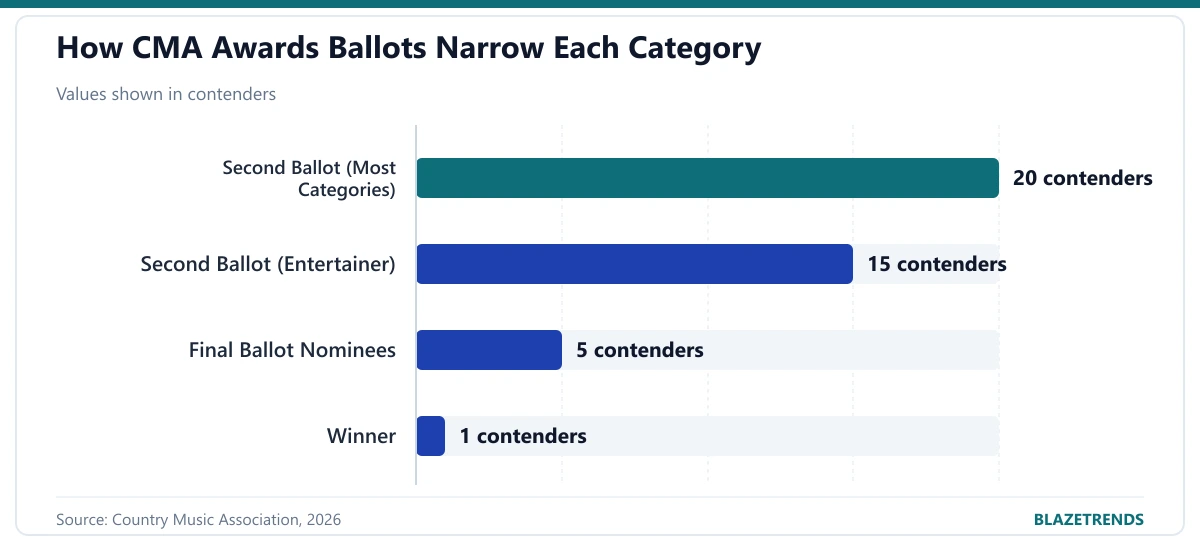
That three-ballot funnel decides all 12 categories: Entertainer, Single, Album, Song, Female Vocalist, Male Vocalist, Vocal Group, Vocal Duo, Musical Event, Musician, Music Video, and New Artist of the Year. Because voters have to back a contender across three separate rounds, a sudden fall viral hit won’t sneak in at the last minute.
Which categories play by different voting rules?
Even longtime country fans get tripped up by the fine print in the official CMA Awards criteria. Several flagship categories tighten who can vote, how many names survive Round 1, or who takes home the trophy.
Entertainer of the Year trims its Second Ballot down to the top 15 qualified contenders instead of 20. Voters weigh touring impact, live performance, leadership, and public acceptance alongside recorded music.
Two craft categories restrict the electorate itself. In Song of the Year, Round 1 and Round 2 ballots go only to members in five creative categories: Composer, Artist, Musician, Producer/Engineer/Studio, and Publisher/PRO. All Professional members regain voting rights once the final five nominees hit the Final Ballot.
Musician of the Year stays restricted across all three rounds, open exclusively to the Musician, Composer, Producer/Engineer/Studio, and Artist membership groups. Because that pool is smaller, the Second Ballot lowers its Round 1 minimum from 10 write-in votes to 5.
A few category definitions also catch casual viewers off guard every awards season:
- Single of the Year honors the recording’s commercial and cultural impact, with trophies going to the artist, producer, and mix engineer. Song of the Year honors songwriting craft and goes solely to the songwriters.
- Album of the Year requires at least 6 different songs and at least 15 minutes of total playing time. Music Video of the Year entries top out at 10 minutes and must feature a single song or medley.
- Vocal Duo (two performers) and Vocal Group (three or more) apply only to acts that normally perform together and aren’t primarily known as solo artists. Musical Event covers collaborations of two or more performers where at least one is known primarily as a country artist.
- New Artist of the Year bars anyone who has already been a final nominee in the category twice or previously won another CMA trophy. Wins in Song of the Year, Musical Event of the Year, or Music Video of the Year are the three exceptions and don’t disqualify a rising act.
How CMA voting differs from the ACM and CMT Awards
Country music fans juggle three big televised awards shows each year, and each one uses a different playbook. The Academy of Country Music also relies on industry members across three rounds, while the CMT Music Awards turn voting over to fans and center on music videos and televised performances.
Even the two industry-voted shows diverge sharply on timing and cutoffs, as outlined in the Academy of Country Music voting policy:
| Rule | CMA Awards | ACM Awards |
|---|---|---|
| Who votes | CMA Professional members (6,678 in 2026) | ACM industry members |
| Eligibility window | July 1 to June 30 | January 1 to December 31 |
| Voting schedule | Three online rounds in July, August, and October | Three rounds held in spring |
| Round 2 cutoff | Top 20 with 10+ votes (Top 15 for Entertainer; 5+ votes for Musician) | Top 20 with at least 2% of category votes plus Board eligibility review |
| Repeat-winner rules | New Artist bars most prior winners and two-time final nominees | Prior year’s winner barred from consecutive nomination in certain categories |
The CMA runs two separate industry awards programs on completely different schedules, too. CMA Broadcast Awards cover a June 1 to May 31 window and rely on a panel of radio and industry pros with no CMA membership required to enter, while CMA Touring Awards cover October 1 to September 30 across 20 behind-the-scenes categories.
Frequently asked questions
Do record labels submit songs to get nominated for a CMA Award?
No formal label or artist submission is required for the 12 main CMA Awards categories. Any release from the July 1 to June 30 window qualifies if enough Professional members write it in during the July Nomination Ballot.
Why do late-summer country albums miss that fall’s CMA Awards?
CMA eligibility cuts off on June 30 each year. An album or single released in July, August, or September competes in the following year’s awards cycle instead of that fall’s show.
What happens if a CMA member lets their membership lapse?
If a CMA membership stays lapsed for more than 60 days, the member has to resubmit their credentials for reinstatement. Missing active dues deadlines or the June 1 application cutoff keeps an industry pro from voting across all three rounds.