
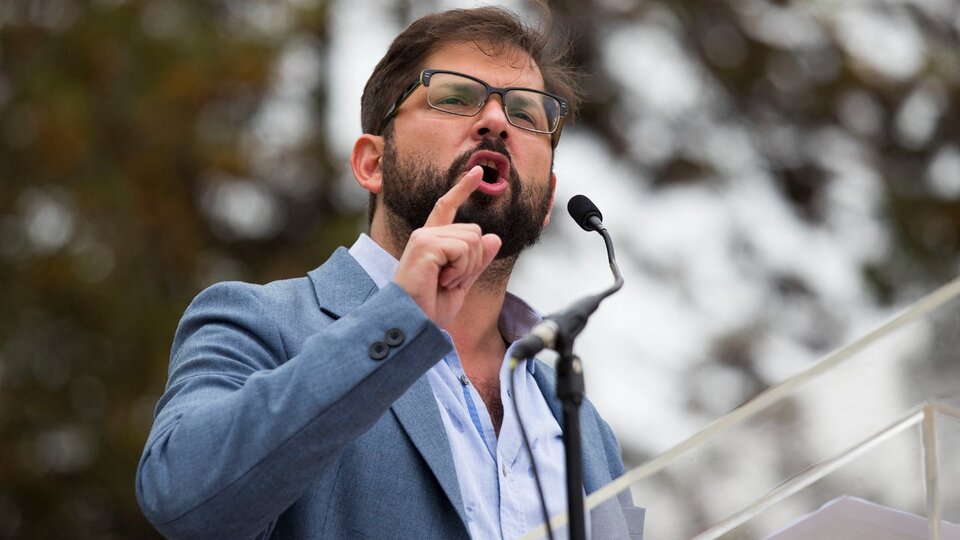
“Programmatic implementation agreement” is the name that the leftist candidate Gabriel Boric gave his proposal for this second round of the presidential elections in Chile. The text includes what was discussed with the teams of former candidates Marco Enríquez-Ominami and Yasna Provoste.
Boric said that in these programmatic lines it was clear that there are points of contact between the proposals of his former left and center-left competitors.
He explained that the “urgency of recovering quality jobs is shared, particularly in the case of women, decisively supporting SMEs, as well as promoting growth and advancing in a process of sustainable economic recovery and with adaptation to the climate crisis”.
There are also points of agreement on the need for a new pension system that “works in accordance with the principles of social security, increasing pensions to current and future pensioners and where the citizen’s desire for no more AFPs (pension fund administrators); and a new health system with a single insurance that does not distinguish between rich and poor”.
He also highlighted the agreements in which economic growth and progressive tax reform are required for these improvements, in order to “responsibly finance the reforms and thus ensure a path of fiscal consolidation, where each new committed expenditure has guaranteed financing.”
In the proposal, Boric outlines four main pillars: bases for sustainable growth and reforms of the pension, health and tax systems.
Sustainable growth
The first chapter proposes sustainable growth that reaches “everyone, especially women and MSMEs (micro, small and medium-sized enterprises)”, the text states.
It is proposed to recover the labor participation of the people most affected by the pandemic, and for this it is understood that it is necessary to redesign the subsidies and focus them on women.
Training and job retraining will also be promoted to face the impacts of technology.
As for small and medium-sized enterprises, the plan will support development and innovation.
Pension system
Regarding pensions, a new system without AFPs is proposed with the aim of “materializing the right to social security, increasing current and future pensions in a sustainable way”. This system will be public and will be financed with contributions from employers, workers and taxes.
A Universal Basic Pension of $250 thousand (US$297 at current value) is proposed that will benefit all adults over 65 years of age.
Within this chapter, gender equality is promoted to “guarantee de facto equality for women”. This will be achieved through: equal representation rules in the governing bodies of the system; use of unisex tables for life expectancy; subsidy for pension gaps due to unpaid care work, regardless of whether the caregiver is a woman or a man.
Healthcare system
Improving the health system will be a “priority” in a Boric government, the program says. The proposed model focuses on primary care, based on the public system and progressively financed by general taxes.
“It is necessary to increase the justice, equity and solidarity of the system, the efficiency of the use of resources, promote a healthier society, ensure that people have financial protection against health expenses and ensure access to timely, dignified and quality care”, the document states.
Tax reform
The last chapter refers to implementing a tax reform. An income tax is proposed for large companies. Today capital income in the country “pays proportionally a lower tax than income from work, generating an inequality that has no justification,” the document states.
Another point is the reduction of exemptions that “generate an unjustified tax expense”, putting a tax on wealth (including a tax on the wealth of the super rich); green taxes; a royalty on large-scale mining and measures against evasion and avoidance.
From the Regional News Agency
.