

When a U.S. governor declares a state of emergency, schools, roads, and businesses stay open unless separate closure orders follow. The declaration is a legal trigger that activates state emergency plans, releases disaster funds, mobilizes the National Guard, and lets states request interstate or federal aid. Exact powers and time limits vary by state law.
ContentsToggle
What changes inside state government right away
The first shifts happen inside state agencies rather than on local streets. According to the Association of State and Territorial Health Officials, a formal declaration activates the State Emergency Operations Center and the Incident Command System, which is the standardized chain of command agencies use to coordinate response teams.
Money and contracts also move faster once the order is signed. State agencies gain access to dedicated emergency funds and can bypass standard public bidding and procurement rules so they can buy fuel, generators, or medical supplies without normal waiting periods. Statutory liability immunities also switch on to shield emergency workers, volunteers, and participating agencies while they perform disaster duties.
Governors can apply a declaration to a single county, a group of municipalities, or the entire state, as the Massachusetts Emergency Management Agency explains. States frequently issue proclamations before a hurricane, coastal storm, or wildfire arrives so agencies can pre-position crews, clear supply routes, and activate consumer protections ahead of panic buying.
How the National Guard and neighboring states get deployed
A declaration gives a governor legal authority to call up the state’s National Guard for search and rescue, evacuation support, debris clearance, or security. Under rules outlined by the National Guard Bureau, governors typically activate units on State Active Duty, where Guard members operate under state command and state pay rules as state employees, though federal disaster grants can later reimburse some costs.
In larger or longer responses, Guard personnel can move into Title 32 status, which brings in federal funding while keeping troops under the governor’s command. Title 10 status is separate and places Guard units under federal command and federal funding.
A governor’s declaration is also a legal requirement to tap the Emergency Management Assistance Compact, known as EMAC. Congress ratified the agreement in October 1996 under Public Law 104-321, and as of 2021 it covers all 50 states, Washington, D.C., Puerto Rico, Guam, the U.S. Virgin Islands, and the Northern Mariana Islands.
EMAC removes legal roadblocks when responders cross state lines. Under National Response Team guidelines, the requesting state agrees to reimburse the assisting state’s costs and assumes tort liability for out-of-state personnel. After Hurricane Maria in 2017, governors used EMAC to send roughly 5,000 personnel from 35 states to Puerto Rico, and states also drew on the compact during Hurricanes Harvey and Irma in 2017, western wildfires in 2020 and 2021, Hurricane Ida in 2021, and the 2021 Colonial Pipeline cybersecurity incident, according to the National Governors Association.
Which state rules and consumer protections change
Governors often use emergency authority to temporarily relax regulations that slow down relief work. The National Governors Association notes in its 2021 guidance that common actions include waiving commercial truck weight limits or driver hours-of-service rules so fuel, food, and utility crews can reach affected areas faster.
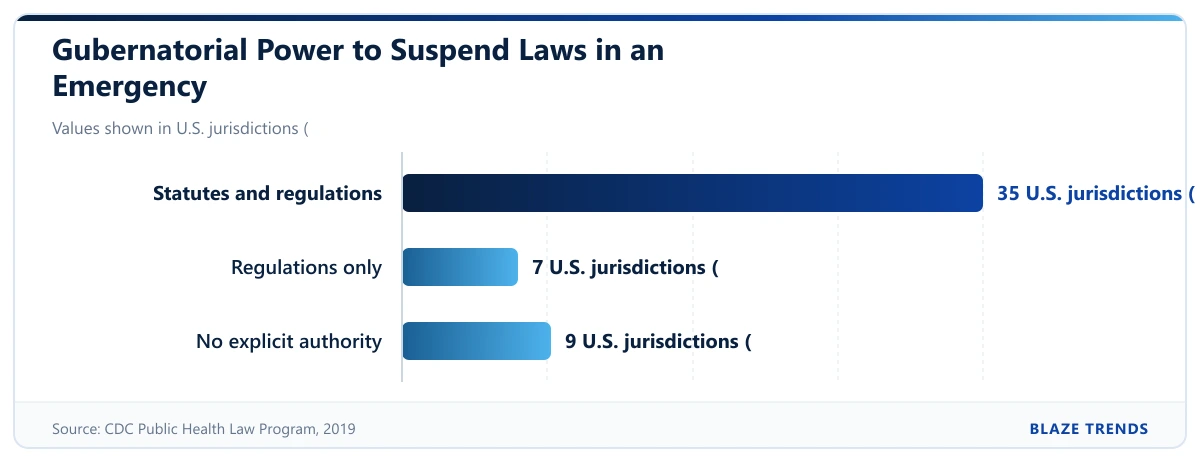
How far those waivers can go depends strictly on state statutes. A 2019 review of all 50 states and Washington, D.C. by the CDC Public Health Law Program found that 35 states explicitly allow governors to change both statutes and agency regulations during a declared emergency, while 7 states allow altering regulations only. Eight states (Kentucky, Massachusetts, Nevada, New Mexico, Ohio, Vermont, Virginia, and Wyoming) plus Washington, D.C. provide no explicit statutory authority to suspend either.
Depending on the threat and local statutes, governors may also issue separate executive orders imposing curfews, travel bans, mandatory evacuations, or temporary supply requisitions with compensation. During the COVID-19 pandemic, governors in at least 33 states used emergency powers to block utilities from shutting off customer service or charging late fees, according to 2021 National Governors Association data.
For shoppers, the most immediate legal shift is often consumer price protection. Because the United States has no general federal anti-price-gouging law, enforcement happens under state statutes across 39 states, Washington, D.C., Guam, Puerto Rico, and the U.S. Virgin Islands, according to a 2022 U.S. House Committee on Energy and Commerce hearing memo citing National Conference of State Legislatures data.
Price-gouging thresholds vary widely across the state price-gouging statutes compiled by the National Conference of State Legislatures in 2025:
- Alabama treats a price increase of 25 percent or more during a declared emergency as initial evidence of price gouging.
- Maine presumes a price hike above 15 percent on covered necessities is unconscionable.
- Kentucky sets a 10 percent safe harbor for price increases during an emergency.
- Alaska, Arizona, and Delaware have no specific price-gouging statute on the books.
Because state legislatures periodically update these thresholds and covered goods, residents should check their state attorney general’s office for current rules during an active emergency.
How a state declaration leads to FEMA aid
A state proclamation does not automatically bring in federal relief grants from the Federal Emergency Management Agency. Under the Robert T. Stafford Disaster Relief and Emergency Assistance Act of 1988, a governor must submit a formal request to the U.S. President within 30 days of an incident for a federal Emergency Declaration or Major Disaster Declaration. Since the 2013 Sandy Recovery Improvement Act, chief executives of federally recognized tribal nations can also request declarations directly from the President.
Before Washington approves aid, the governor must confirm that state emergency plans have been executed and show through joint damage assessments that state and local resources are overwhelmed. The U.S. President then decides whether to grant federal public or individual assistance.
Emergency declarations are sometimes confused with federal disaster status or martial law, though each operates under separate legal rules. During a state or federal declaration, elected civilian officials, local police, and courts stay in charge; by contrast, Brennan Center for Justice testimony to the Senate Judiciary Committee in 2024 explains that martial law occurs when military authority replaces civilian government.
| Action | Who declares it | Who stays in charge | Primary effect |
|---|---|---|---|
| State of emergency | Governor (or legislature in at least 7 states) | Civilian state and local officials | Activates state funds, emergency centers, Guard, EMAC, and state waivers |
| Federal disaster declaration | U.S. President after a governor or tribal request | Civilian federal, state, and local officials | Releases FEMA financial and logistical aid when state resources are overwhelmed |
| Martial law | Rare military assumption of authority | Military authorities replace civilian government | Separate legal mechanism that never triggers automatically under a state declaration |
How a state of emergency ends and who checks the governor
A governor can terminate a state of emergency at any time by issuing a new proclamation once conditions stabilize. Individual orders such as travel bans or curfews frequently end earlier while the broader declaration remains open to support cleanup contracts, utility restoration, and federal reimbursement paperwork.
State laws also place automatic expiration clocks on initial declarations unless they are renewed. According to a 2024 Wyoming Legislature compilation and 2022 National Conference of State Legislatures data, statutory limits include 5 days for a peacetime emergency in Minnesota without Executive Council approval, 30 days in Alaska and Maine, 45 days in Montana without legislative authorization, and 60 days in Florida.
Lawmakers and courts provide formal checks on executive action. Under the NCSL legislative oversight guide (2022), legislatures in many states, including Maine, Maryland, Nebraska, Nevada, Oklahoma, Oregon, and West Virginia, can end a governor’s declaration by passing a joint or concurrent resolution. At least seven states (Alabama, Missouri, Nevada, New Hampshire, North Carolina, Oklahoma, and West Virginia) also expressly allow the legislature itself to declare an emergency, and state or federal courts can strike down orders that exceed constitutional limits.
These structures reflect the U.S. federal system, where disaster response begins at the local and state levels. Outside the United States, emergency powers follow each country’s national constitution or parliamentary statutes rather than state-level executive proclamations.
Frequently asked questions
Can you drive during a state of emergency?
Yes, unless the governor or local authorities issue a separate travel ban, road closure, or mandatory evacuation order. The North Carolina Department of Public Safety noted in 2018 that a declaration on its own does not make driving illegal, though officials often urge residents to stay off roads so utility crews and ambulances can pass safely.
Do you still have to go to work or school?
Private employers and local school districts make their own closure decisions unless state or local officials issue a specific mandatory closure or travel-ban order. Even state offices remain open by default under a declaration until agency leaders or the governor announce otherwise, according to the Massachusetts Emergency Management Agency.
Why do governors declare an emergency before a storm arrives?
Issuing a proclamation ahead of landfall lets state agencies legally spend emergency funds, waive commercial trucking limits, pre-position National Guard and utility crews, and activate anti-price-gouging statutes before panic buying begins. Waiting until damage occurs can delay supplies and interstate mutual aid.