
As of 2026, NFL overtime rules give both teams a possession opportunity in the regular season and playoffs, even after an opening touchdown. The differences come down to the clock, ties, and timeouts: regular-season games get one 10-minute period that can end tied, while playoff games use unlimited 15-minute periods until a team wins.
Because NFL owners aligned regular-season possession rules with the postseason in April 2025, many fans assume the two formats are now identical. They are closer than ever under Rule 16 of the 2026 NFL Rulebook, which kept those rules unchanged for 2026, yet the remaining gaps still reshape how coaches manage every snap.
ContentsToggle
How do regular-season and playoff overtime compare side by side?
The easiest way to spot the split is to line up the clock, timeouts, and tie rules next to each other. Both formats start after a maximum three-minute intermission following regulation, and both guarantee the defending team a turn with the ball unless the opening drive ends in a defensive score or time expires in the regular season.
| Rule | Regular Season | Playoffs |
|---|---|---|
| Period length | One 10-minute period | 15-minute periods |
| Maximum periods | 1 (can end in a tie) | Unlimited until a winner is decided |
| Guaranteed second possession | Yes, unless the 10-minute clock expires | Yes, even if a second period is needed |
| Timeouts | 2 per team | 3 per team per half (every 2 periods) |
| Timing rules | Fourth-quarter timing rules (5-minute mark and 2-minute warning) | Second- and fourth-quarter timing rules at the end of OT2 and OT4 |
| Extra intermissions and coin tosses | None | 2-minute breaks between periods; choice flips at OT3; new toss after OT4 |
Several core procedures stay identical no matter when the game is played. The visiting team captain calls the midfield coin toss, disqualified players cannot return for overtime, and coaches receive no instant replay challenges because NFL replay officials initiate every review.
Scoring rules also match once play begins. If the kicking team scores a defensive touchdown or records a safety on the opening possession, the game ends on the spot without giving that team an offensive drive. If the score is still tied after both teams have had an opportunity to possess the ball, standard sudden death takes over and the next score by touchdown, field goal, or safety wins immediately, with no point-after try attempted on a game-ending touchdown.
One officiating detail catches plenty of viewers off guard: an “opportunity to possess” does not always mean running an offensive play. If the receiving team muffs a punt or kick that crosses the line of scrimmage and the kicking team recovers it, or if the defense intercepts a pass and fumbles it right back to the offense on the same play, the rulebook counts that sequence as the second team’s possession opportunity.
Why did NFL overtime rules change for the regular season?
Before 2022, a playoff coin-toss winner could march down the field for a touchdown and win without the other quarterback ever stepping onto the turf. That happened in 7 of 12 postseason overtime games prior to the 2022 change, prompting the league to guarantee both teams a possession in the playoffs first.
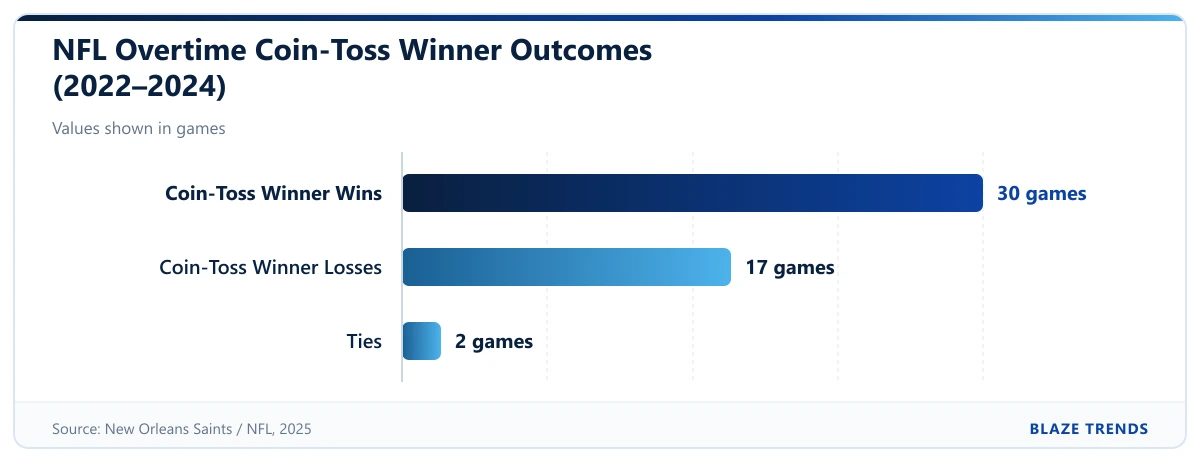
The coin-toss advantage lingered in the regular season for three more years. From 2022 through 2024, regular-season coin-toss winners went 30-17-2 overall, including 13-5-2 in 2022, 5-8 in 2023, and 12-4 in 2024, with zero ties across the 2023 and 2024 seasons.
On April 1, 2025, NFL owners approved a Philadelphia proposal reported by NFL Football Operations that brought the playoff possession guarantee to the regular season. Owners declined Philadelphia’s original request to expand regular-season overtime back to 15 minutes, keeping the 10-minute period introduced in 2017 to limit player fatigue and injury risk.
Because the league can revisit Rule 16 at future annual meetings, check NFL Football Operations before each new season to confirm whether the 10-minute limit or possession rules have been updated.
What happens when the overtime clock runs out?
Clock expiration is where regular-season and playoff overtime split most sharply. In a regular-season game, the 10-minute clock overrides the second-possession guarantee: if the first offense drains all 10 minutes on one drive, or if time runs out while the second team is still driving, the game ends as soon as the final play concludes and the scoreboard stands.
Regular-season overtime also activates fourth-quarter timing rules at the five-minute mark alongside a two-minute warning, which gives trailing offenses brief clock stoppages on out-of-bounds plays. If the game is still level at 0:00, it finishes as a tie, counting as half a win and half a loss in the standings and feeding directly into NFL playoff tiebreaking rules.
Postseason overtime works like a fresh mini-game where the first 15-minute clock cannot cut off a team’s opening turn. If the first period expires while the score is tied or while the second team is in the middle of its initial possession, the teams take a two-minute intermission and resume the exact same drive in a second 15-minute period.
That clock rule nearly came into play during Super Bowl LVIII overtime on February 11, 2024. After San Francisco kicked a field goal on the opening drive, Kansas City scored the winning touchdown with three seconds left in the first period to win 25-22; had the clock hit zero, Kansas City would not have lost, and play would simply have moved into a second overtime period. In the 2025 AFC Divisional Round on January 17, 2026, Denver beat Buffalo 33-30 on a 23-yard field goal with 4:44 remaining in the first 15-minute period after both teams came up empty on their opening drives.
If a playoff game stretches past two overtime periods, there is no halftime break after the second period. Instead, teams take a two-minute break, the original coin-toss loser chooses possession or direction to start the third period (unless the original winner deferred), and a brand-new coin toss takes place if the game reaches a fifth overtime period.
How do the rule differences change coaching strategy?
Keeping the regular season at 10 minutes makes going for two far more attractive for the second offense. When Team A eats five or six minutes on an opening touchdown drive, Team B knows a standard extra point leaves little time left for sudden death and invites a tie or a walk-off field goal by Team A.
Seattle put that math on display in Week 16 of the 2025 season on December 18, 2025. After the Los Angeles Rams scored an opening-drive overtime touchdown to lead 37-30, the Seahawks still received a turn under the aligned rule, answered with a touchdown, and threw a two-point pass from Sam Darnold to Eric Saubert to seal a 38-37 overtime win.
Ties remain very real when neither offense pulls ahead before the 10-minute horn. Earlier in the 2025 regular season, on September 28, Green Bay and Dallas finished in a 40-40 overtime tie, the highest-scoring tie since a 43-43 AFL game in 1964.
Coin-toss calls also work differently between the two formats. If a coach wins the coin toss and wants the defense on the field first so the offense knows exactly how many points it needs, that captain must elect to kick in the regular season because there is no second half of overtime to defer to. In the playoffs, a captain can defer and preserve the choice for the start of a third overtime period.
Frequently asked questions
Are Super Bowl overtime rules different from earlier playoff rounds?
No. The Super Bowl uses the exact same postseason overtime rules as the Wild Card, Divisional, and Conference Championship rounds, with 15-minute periods, guaranteed initial possessions, three timeouts per two-period half, and unlimited periods. Only two Super Bowls in NFL history, Super Bowl LI and Super Bowl LVIII, have reached overtime.
Is there overtime in NFL preseason games?
No. NFL owners eliminated preseason overtime in 2021, so any exhibition game tied after four quarters ends immediately as a tie.
How do NFL overtime rules compare to college football overtime?
NCAA college football uses no game clock in overtime and gives both teams untimed drives starting at the opponent’s 25-yard line. Starting in the second overtime period, teams must attempt a two-point conversion after a touchdown, and from the third overtime onward they trade single two-point plays from the 3-yard line until one side scores and stops the other.