
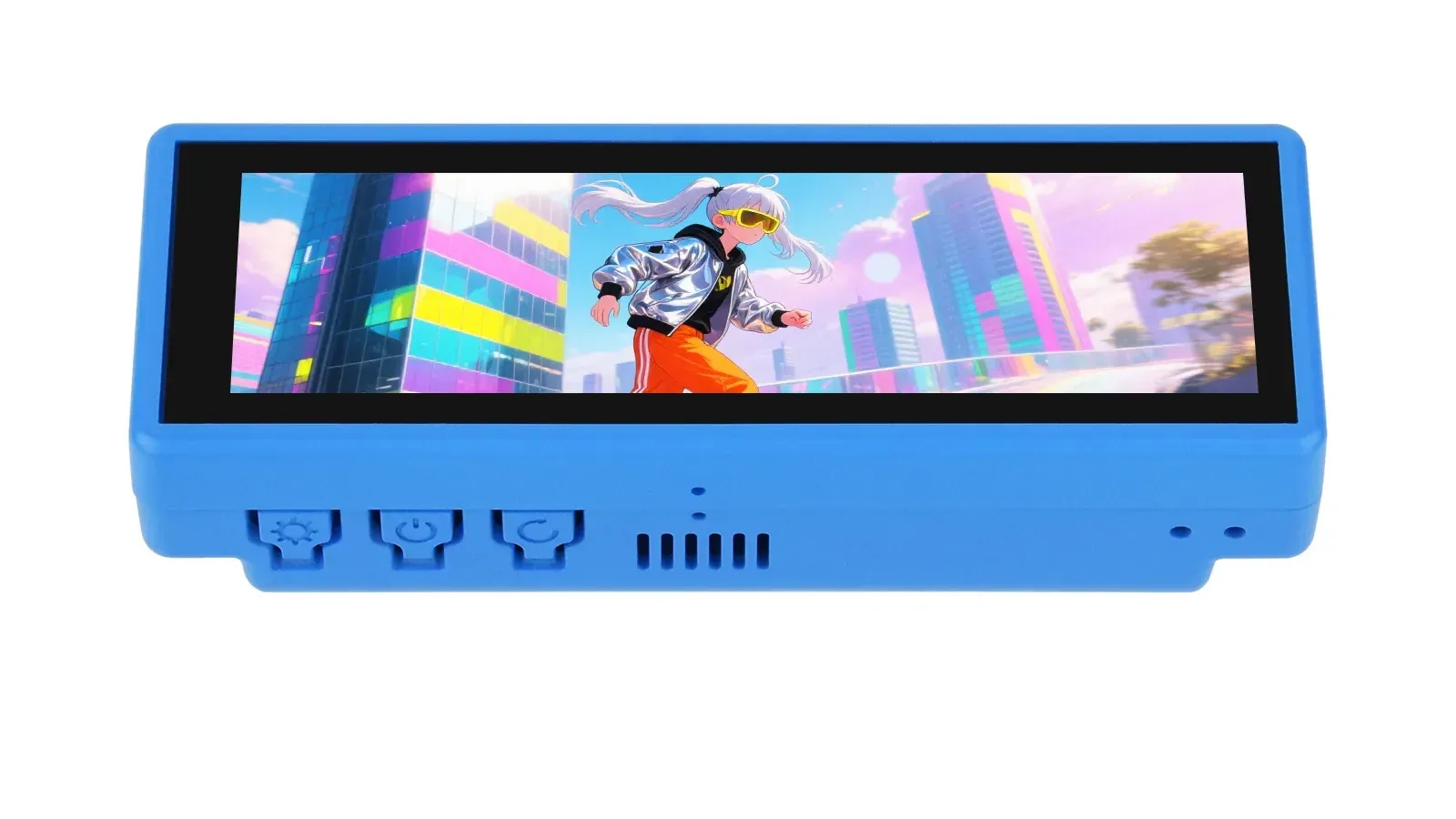
Anyone with a $29.99 to $31.99 Waveshare ESP32-S3 3.49-inch bar display can now flash it over USB from a web browser to turn the board into a retro desk clock, internet radio, and Pomodoro timer. The open-source firmware, called Phosphor, was shared on Reddit’s r/esp32 community by user u/Alive-Ad-5154 and reported by XDA Developers on Nov. 22, 2026.
Phosphor mimics the look of a vintage Vacuum Fluorescent Display (VFD), which uses phosphor-coated anodes inside a sealed glass envelope to emit a blue-green glow when struck by electrons, as explained by Utmel Electronics. On Reddit’s r/esp32 community, the release post reached at least 860 upvotes and 55 comments. XDA Developers reported that Phosphor’s source code is hosted on GitHub alongside a browser-based installer, and warned that flashing the firmware replaces everything currently on the board, including Waveshare’s factory demo, so owners should back up existing files first.
What Phosphor puts on the screen
In the r/esp32 post quoted by XDA Developers, u/Alive-Ad-5154 listed every tool and animated mode built into the firmware.
“Clock with alarm (it wakes you with the radio), weather, internet radio (stations editable from your phone), timer, pomodoro, and pixel scenes: aquarium, snowy cabin, fireplace with a sleeping cat, a seaside that follows the time of day, an ocean liner that tilts with the board, a lava lamp and an hourglass you flip over.”
Users can edit internet radio stations from a phone instead of recompiling firmware to change streams. Two of the seven pixel scenes respond to physical movement on the desk, while the seaside scene shifts with the time of day.
Hardware specs and a June 2026 revision catch
Phosphor’s motion and audio modes work without extra wiring because Waveshare builds the needed sensors directly onto the ESP32-S3-Touch-LCD-3.49 board. Its 3.49-inch, 172-by-640 IPS capacitive touchscreen (350 cd/m² brightness) runs on a dual-core 240 MHz ESP32-S3R8 chip with 8MB of PSRAM, 16MB of Flash, 2.4 GHz Wi-Fi, Bluetooth 5, a microSD slot, and a USB Type-C port.
Waveshare also includes a QMI8658 six-axis gyroscope and accelerometer for the tilting ocean liner and flippable hourglass, a PCF85063 real-time clock, and ES8311 and ES7210 audio chips paired with dual microphones and a two-pin speaker header. The board sells for $29.99 to $31.99 directly from Waveshare in two enclosure variants, Case A for an 18650 lithium battery and Case B (model 3.49B) for a 3.7V LiPo pack, each sold with or without a battery.
Owners planning to flash the board should check one hardware revision detail first. Waveshare discontinued its original V1 hardware and began shipping V2 (Rev1.1) units on June 8, 2026, and official Waveshare documentation confirms the newer board swapped the LCD_BL backlight pin with EXIO_INT, along with LCD_TE and LCD_RESET. According to LCD Ultra Pro, loading mismatched firmware onto a V2 unit can leave the backlight dark, and XDA Developers’ report does not specify whether Phosphor’s web installer supports both board revisions automatically.
Other open-source builds for the same bar display
Phosphor joins several other desk utilities built specifically around the 3.49-inch Waveshare bar display. Developer VaAndCob maintains TuneBar on GitHub, an open-source internet radio, weather, air quality, and digital clock build for the same hardware. Waveshare’s documentation also lists community projects including moononournation’s Live Weather Satellite Image Clock, cryptooth’s Home Assistant Touch Panel, and Positronico’s claudeq.