
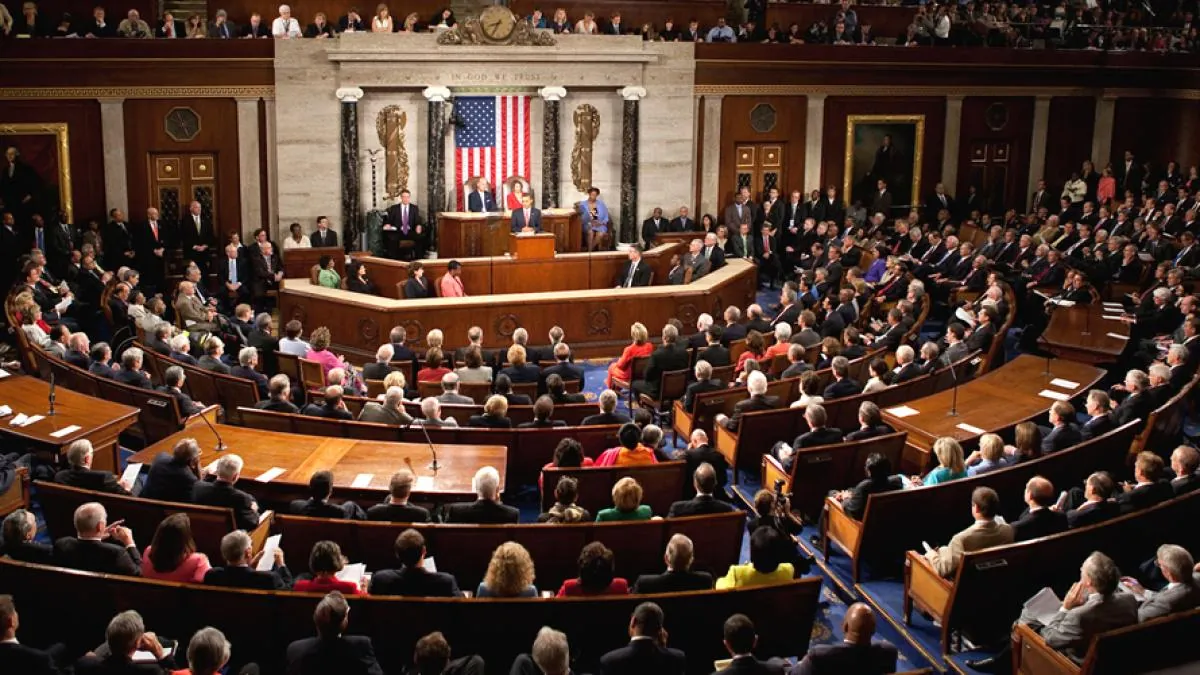
Under Rule IX of the U.S. House of Representatives, any lawmaker can bypass committee gatekeepers and party leaders by introducing a privileged resolution that raises a “question of the privileges of the House” on the chamber floor. Once a representative reads the resolution’s text aloud and gives formal notice, the Speaker is required to schedule the measure for floor consideration within two legislative days, according to a Congressional Research Service report updated in 2025. Forcing floor consideration does not guarantee a direct vote on the resolution’s merits, however, because the majority party can immediately call a procedural vote to table the measure or refer it to a committee.
What qualifies as a privileged resolution under House Rule IX?
In the U.S. House of Representatives, the majority party leadership and the Rules Committee normally decide which bills reach the floor and when they are debated. House Rule IX creates a narrow constitutional and institutional exception to that gatekeeping power by recognizing “Questions of the Privileges of the House” as matters that take precedence over all other business except a motion to adjourn.
As detailed in the House Practice manual published by the Office of the Parliamentarian in 2024, Clause 1 of Rule IX restricts this fast-track status to resolutions that address the collective rights of the House, its safety and dignity, and the integrity of its proceedings. Qualifying subjects fall into a few strict categories:
- Impeaching a federal civil officer, such as the president, a cabinet secretary, or a federal judge.
- Censuring, reprimanding, or expelling a fellow member of the House of Representatives.
- Filling vacancies among House officers or declaring the Office of the Speaker vacant.
- Resolving contested House elections or enforcing the chamber’s constitutional authority to originate revenue legislation.
Ordinary legislation cannot be fast-tracked through Rule IX. If a lawmaker attaches a non-privileged legislative proposal to an otherwise qualifying resolution, the entire measure loses its privileged status. You also cannot use Rule IX to change standing House rules or prescribe a special order of business for regular bills.
How does the two-legislative-day clock work on the House floor?
The procedure for calling up a privileged resolution depends on who offers it. Under House Rule IX, only the Majority Leader and the Minority Leader may call up “questions of the privileges of the House,” at any time on the floor without giving advance notice. Every other representative has to follow a two-step notice process that starts a two-legislative-day countdown.
- The representative drafts a simple resolution (designated as
H. Res.) that deals solely with a qualifying institutional matter under Rule IX, Clause 1. - Seeking recognition on the House floor, the lawmaker announces their notice of intent to offer the resolution under Clause 2(a)(1) of Rule IX, and the House clerk reads the full text aloud.
- The presiding officer announces that the Speaker will rule on whether the resolution constitutes a valid question of privilege at the time designated for its consideration, which the Speaker must schedule within two legislative days.
- When the Speaker calls the resolution up within that two-day window, the Chair (advised by the nonpartisan House Parliamentarian) formally rules on whether the text meets the requirements of Rule IX.
- If the resolution is ruled in order, the House immediately proceeds to either a procedural blocking motion or one hour of floor debate.
A legislative day is not always the same as a calendar day, though the two usually align when Congress is in session. A legislative day begins whenever the House meets after an adjournment and ends only when the House next votes to adjourn. Under the standing rules adopted via H. Res. 5 on January 3, 2025, for the 119th Congress (2025–2026), the two-legislative-day countdown clock also pauses during any Speaker-designated district work period when lawmakers are away from Washington.
Why do most privileged resolutions end in a motion to table or refer?
When headlines state that a lawmaker has forced a snap vote on impeachment or censure, the resulting roll call is rarely a direct yes-or-no vote on adopting the resolution itself. Rule IX only compels the Speaker to bring the resolution to the floor for consideration; once it is called up, the majority party retains full control over how the chamber disposes of it.
As explained in a 2019 Congressional Research Service guide on impeachment procedures, if the Speaker rules that a resolution raises a valid question of privilege, it is subject to debate under the House’s one-hour rule. Under Clause 2(a)(2) of Rule IX, that 60-minute debate window is divided equally, giving 30 minutes to the resolution’s sponsor and 30 minutes to the Majority Leader, the Minority Leader, or a lawmaker designated by the Speaker.
Before a single minute of that debate begins, however, any member, typically a party leader or committee chair, can offer a nondebatable “motion to lay on the table,” or a motion to refer the resolution to a standing committee. According to a Congressional Research Service procedural brief, the House can also invoke the nondebatable question of consideration to refuse to take up the measure at all.
A motion to lay on the table requires a simple majority vote and happens immediately without debate. If the House votes to table the resolution, the measure is permanently and adversely killed without anyone having to cast a direct vote on the underlying charges. Alternatively, the House can vote to refer (or commit) the resolution to a committee, such as sending an impeachment resolution to the House Judiciary Committee or a member discipline resolution to the House Ethics Committee. That procedural path played out in a recent 211-204 House impeachment vote, and it has been the standard way House majorities of both parties handle solo floor challenges.
For example, during the 114th Congress (2015–2016), Representative John Fleming of Louisiana bypassed his own party’s leadership to call up H. Res. 828 on the floor to impeach the IRS commissioner, and during the 115th Congress (2017–2018), Representative Al Green of Texas similarly forced floor action on H. Res. 646 and H. Res. 705 to impeach President Donald Trump. According to a 2019 Legislative Procedure analysis and Congressional Research Service records, all three resolutions were disposed of on the floor through motions to table or refer to committee rather than a vote on final passage.
What are the most common misconceptions about Rule IX?
Because floor confrontations over Rule IX often happen on short notice, three procedural details are frequently misunderstood in public coverage.
First, while a resolution to impeach an executive branch official or censure a sitting House member qualifies as privileged, a resolution to censure or condemn the president or a cabinet secretary does not. According to a 2018 Congressional Research Service report on censorship and condemnation resolutions, House precedents treat a resolution expressing disapproval of an executive branch official as an ordinary legislative measure with no privileged status under Rule IX, because the House has no constitutional authority to discipline officials outside its own chamber short of impeachment.
Second, a “question of the privileges of the House” is different from a question of personal privilege. Rule IX recognizes both, but a question of personal privilege applies when an individual lawmaker’s personal rights, reputation, or conduct as a representative have been impugned. Raising a valid question of personal privilege only grants the member up to one hour of floor time to speak in their own defense; no resolution is introduced and no vote takes place.
Third, the rules for forcing a vote to remove the Speaker of the House (known as a motion to vacate the chair) no longer work the same way as other Rule IX resolutions. Although a resolution declaring the Office of the Speaker vacant is handled under Rule IX, the House rewrites its standing rules at the start of every two-year term. In the 118th Congress (2023–2024), any single lawmaker could offer a privileged resolution to vacate the Speakership. Under the rules adopted on January 3, 2025, for the 119th Congress (2025–2026), a resolution declaring a vacancy in the Office of the Speaker only qualifies as privileged if it is offered by a member of the majority party who has secured at least eight cosponsors from the majority party at the time it is offered. Because the House adopts new standing rules every two years, you can check the current text of Rule IX on the official website of the House Committee on Rules.
Frequently asked questions
How does a privileged resolution differ from a discharge petition?
A privileged resolution under Rule IX applies only to internal House matters, member discipline, or impeachment, and a single representative can force it to the floor within two legislative days. A discharge petition can be used to pull ordinary legislative bills out of committee, but it requires the signatures of an absolute majority of the House (218 members) along with longer waiting periods before it can be called up.
Can a privileged resolution be amended on the House floor?
Rarely. Because floor debate takes place under the one-hour rule, an amendment can only be offered if the member controlling the floor time yields specifically for that purpose, or if a majority of the House votes to defeat the previous question when debate ends.
Can the Speaker refuse to schedule a valid privileged resolution within two legislative days?
No. Once a member gives formal floor notice of a resolution that raises a valid question of the privileges of the House under Rule IX, the Speaker is required to schedule it for consideration within two legislative days, though that two-day clock pauses if the House enters a designated district work period.
Has an impeachment resolution offered from the floor by a single member ever passed?
No. Every impeachment resolution ever adopted by the full House of Representatives was first reported by a committee before reaching the floor. Every impeachment resolution called up directly from the floor by an individual member under Rule IX has been laid on the table or referred to committee.