
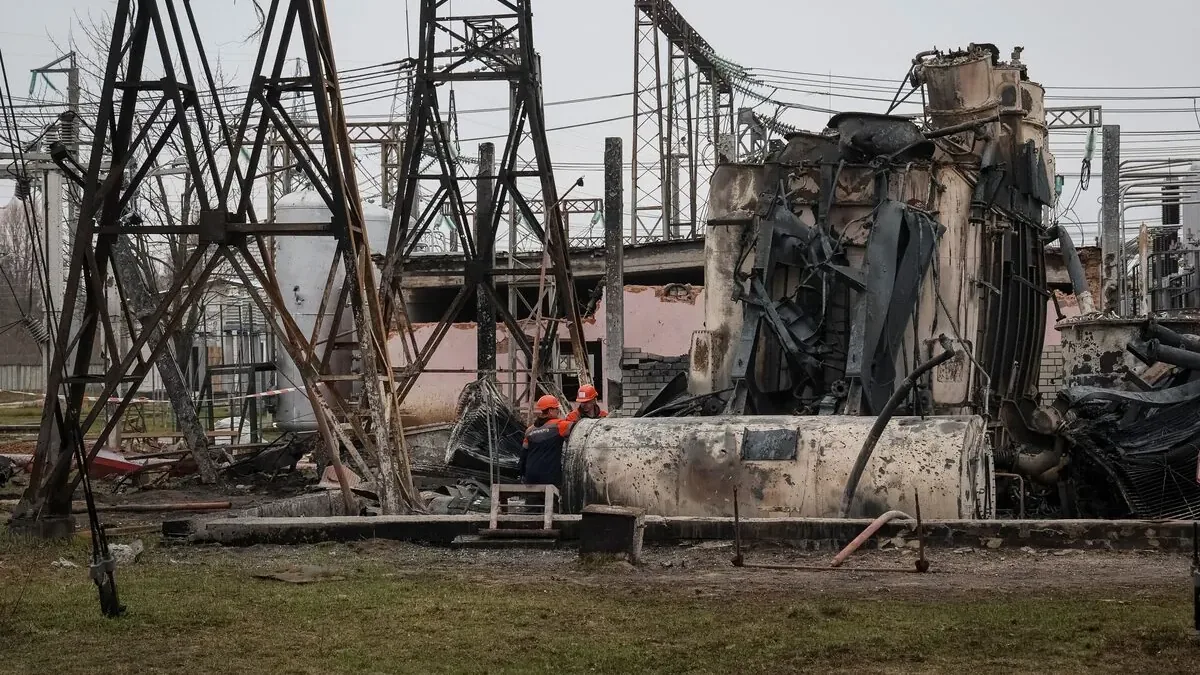
Russian air attacks struck 10 Ukrainian regions overnight into Tuesday, hitting five major electrical substations and killing two people as negotiators from Russia, Ukraine, and the United States opened two days of peace talks in Abu Dhabi.
Ukrainian Prime Minister Sergiy Koretskyi said on Telegram that the overnight bombardment hit electrical substations in the Poltava, Dnipropetrovsk, Vinnytsia, and Kirovohrad regions, Reuters reported. The two fatalities occurred in the Vinnytsia region.
State grid operator Ukrenergo and First Deputy Energy Minister Artem Nekrasov said Russian forces damaged energy infrastructure across eight regions: Kyiv, Kharkiv, Sumy, Poltava, Dnipropetrovsk, Vinnytsia, Cherkasy, and Kirovohrad. According to Ukrainska Pravda, the strikes knocked out electricity to households in six oblasts (Dnipropetrovsk, Donetsk, Kyiv, Sumy, Kharkiv, and Chernihiv) by Tuesday morning. Grid operators also introduced emergency power cuts in the Kyiv, Kharkiv, Poltava, and Sumy regions because of equipment damage and voltage drops in the high-voltage network. Nekrasov said repair crews were working around the clock to restore the damaged grid equipment.
Civilian Damage and Winter Air Campaign
The overnight strikes cut electricity to homes across multiple regions just as winter temperatures approach. Beyond the power grid, Russian attacks hit residential and commercial sites across several provinces. In the central Kirovohrad region, governor Andriy Raikovych said strikes damaged civilian facilities, including a major home improvement store. In the southeastern Dnipropetrovsk region, local officials reported that Russian forces attacked four districts with drones more than 20 times overnight. Residential areas in the Sumy and Kherson regions also sustained damage.
As background, Ukraine has struggled to intercept Russia’s mounting air campaign due to a shortage of air defense weapons capable of downing fast-moving ballistic missiles and jet-powered drones. In recent months, Moscow has expanded its targeting beyond energy infrastructure to hit Ukrainian businesses, consumer logistics, and other economic facilities in an effort to weaken Kyiv’s war effort.
Trilateral Negotiations in Abu Dhabi
The renewed strikes on Ukraine’s energy network coincided with the start of US-mediated three-way talks in the United Arab Emirates, marking the first trilateral meeting between Washington, Moscow, and Kyiv since February. According to the Associated Press, Ukraine’s delegation is led by Foreign Intelligence Service head Rustem Umerov and reportedly includes Presidential Chief of Staff Kyrylo Budanov, his deputy Sergiy Kyslytsya, and Servant of the People parliamentary faction leader Davyd Arakhamia.
Before entering the three-way session, the Ukrainian delegation met with U.S. envoys and representatives from the United Kingdom, France, Germany, Italy, NATO, and the European Commission. Umerov thanked the United States for its mediation efforts and expressed hope that the negotiations would bring a lasting peace for Ukraine. U.S. envoy Jared Kushner said prior to the session that recent contacts with both sides had “narrowed the gaps” between their positions.
Moscow, however, maintained a guarded stance heading into the discussions. Russian Foreign Minister Sergei Lavrov stated separately that Russia would not agree to an immediate ceasefire without knowing what would happen next. Russia also objected to European officials participating directly in the trilateral room, with Lavrov remarking that European representatives could “sit in hotel” during the three-way sessions, though Moscow indicated European Union officials could join at a later stage.
The first day of trilateral talks in Abu Dhabi concluded after lasting approximately 4.5 hours, Russian state media reported. Ukrainian reports indicated that the Russian, Ukrainian, and U.S. delegations are scheduled to resume negotiations for a second day on Wednesday morning, Nov. 11.