
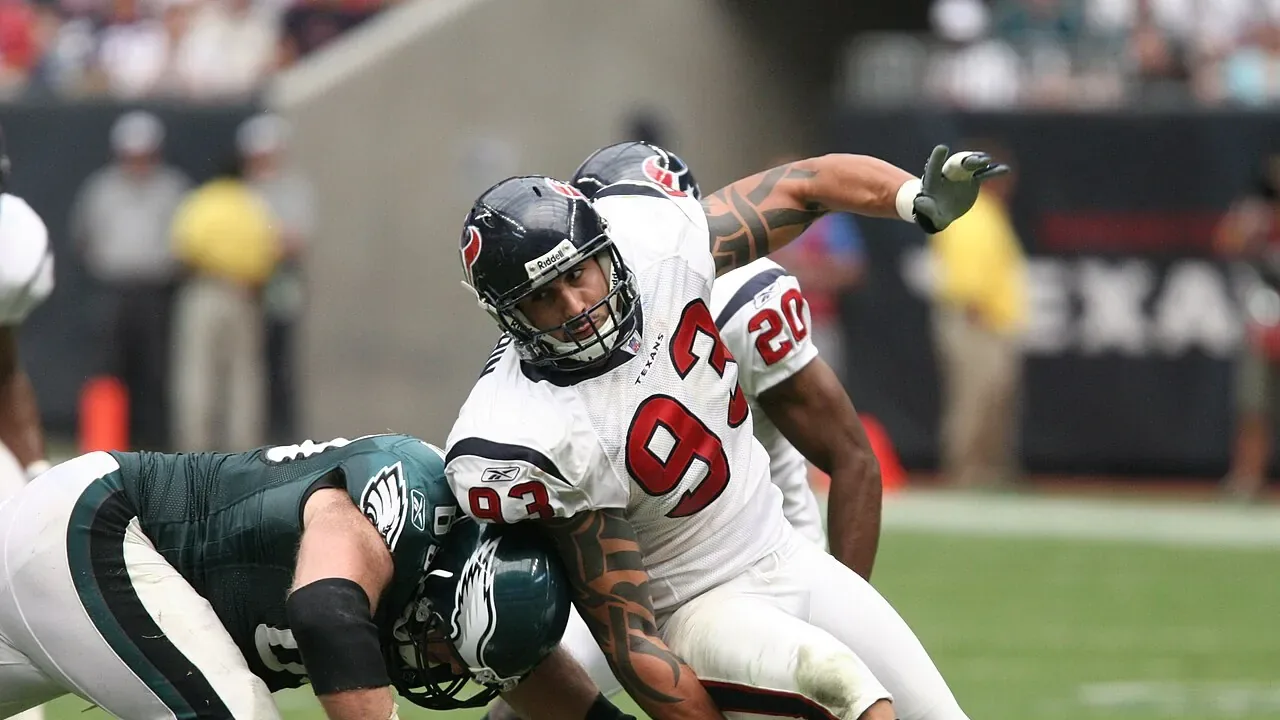
In the NFL, an official statistician credits a sack whenever a player making an apparent attempt to pass is tackled, forced out of bounds, or loses a fumble “at or behind the statistical line of scrimmage,” according to the 2022 NFL Guide for Statisticians. If one defender is primarily responsible for bringing the passer down, that player receives 1.0 sack, while two defenders judged equally responsible split the play for 0.5 sacks apiece. Because the league does not award fractions smaller than a half-sack, official scorers must assign credit to at most two defenders even when three or more rushers converge on the quarterback.
What qualifies as an official sack in the NFL?
Not every tackle of a quarterback behind the line of scrimmage goes into the box score as a sack. Under the NFL’s statistical rules, every snap from scrimmage starts as a rushing play unless there is a kick, a forward pass, or an apparent attempt to pass before the ball handler is downed, steps out of bounds, or fumbles at or behind the line.
When a quarterback drops straight back into the pocket with the ball held ready to throw, passing intent is obvious. The judgment call gets tougher on rollouts, RPOs (run-pass options), and trick plays where a non-quarterback takes the snap. To earn a sack on a rollout or option play, the ball handler must hold the ball in their throwing hand and look directly at an eligible receiver running a route before being tackled or forced out of bounds at or behind the line.
If the quarterback immediately tucks the ball to run, or executes a play-action fake to deceive the defense while offensive teammates block downfield on a designed run, the play is scored as a rushing attempt. Stopping a designed quarterback draw, sneak, or read-option behind the line gives the defender a tackle for loss rather than a sack.
A play also ceases to be a sack once a scrambling passer crosses the line of scrimmage. If a quarterback runs past the line and then retreats back behind it to evade tacklers, NFL statistical rules treat them as a runner for the remainder of the down.
On the other hand, a defense does not need to push the quarterback backward to record a sack. Because the rule applies “at or behind the statistical line of scrimmage,” tackling a passer right back at the original line of scrimmage for no gain counts as an official 0-yard sack.
How do official scorers split full sacks and half-sacks?
When a single pass rusher brings down the quarterback, the scorer awards that defender 1.0 sack along with a solo defensive tackle. When two defenders bring the passer down together and the official scorer judges them equally responsible, credit is divided into 0.5 sacks and an assisted tackle for each player.
Equal responsibility does not require both defenders to hit the quarterback at the exact same millisecond. The NFL statisticians’ manual notes that if one defender wraps up the passer around the legs or waist while a second defender arrives to prevent the passer from throwing the ball away or fighting forward for extra yardage, both players receive 0.5 sacks.
Three or more defenders frequently pile onto a quarterback in a collapsing pocket, yet you will never see 0.33 or 0.25 sacks on an NFL stat sheet. One-half sack is the smallest unit the league recognizes. When a group of three or four rushers converges on the passer, the official scorer has to watch the angle of attack and decide whether one primary initiator deserves the full 1.0 sack or which two defenders were most responsible for stopping the play to split 0.5 sacks apiece.
How are untouched sacks, strip-sacks, and out-of-bounds plays scored?
A defender does not always have to lay a finger on the quarterback to earn a sack. The NFL’s scoring manual covers several common pocket scenarios where a pass play ends without a traditional wrap-up tackle:
- Pushing a blocker into the quarterback: If a defensive lineman bull-rushes an offensive lineman or tight end backward into the passer, knocking the passer to the turf with no subsequent attempt to continue the play (or causing a fumble), the defender receives credit for the sack without directly touching the quarterback.
- Stepping out of bounds or sliding under pressure: If a potential passer runs out of bounds or gives themselves up at or behind the line of scrimmage to avoid imminent contact from a rushing defender, that pursuing defender gets credit for the sack.
- Unpressured out-of-bounds plays (team sacks): If a rolling passer accidentally steps on the sideline at or behind the line of scrimmage without imminent defensive pressure, the offense is charged with a team sack and the lost yardage, but no individual defender gets a sack on their stat line.
- Strip-sacks: When a defender knocks the ball loose from a potential passer at or behind the line of scrimmage and the fumble is recovered behind the line, the defender is credited with both a sack and a forced fumble—even if an offensive lineman dives on the loose ball to keep possession.
How does sack yardage affect NFL vs. college football stats?
If you watch both Saturday and Sunday football, you may notice that sacks change the box score differently depending on the rulebook. While both levels credit solo sacks as 1.0 and split sacks between two defenders as 0.5 each, they put the negative yardage in completely different columns.
In the NFL, a sack never counts as a pass attempt or a rushing attempt. According to 2026 statistical breakdowns from Football Nation USA, the yards lost on an NFL sack are subtracted only from the offensive team’s net passing yards, leaving the quarterback’s individual passing yardage intact. If an NFL quarterback throws for 250 yards and takes three sacks for a loss of 20 yards, the quarterback still finishes the day with 250 passing yards, while the team finishes with 230 net passing yards.
College football treats the exact same play as a run. Under the 2022 NCAA Football Statisticians’ Manual, every sack is officially logged as a rushing attempt by the quarterback, and all lost yardage is deducted directly from the quarterback’s individual rushing total and the team’s rushing yardage.
How do the NFL and Elias Sports Bureau review and correct sacks?
Every NFL stadium has a league-appointed statistics crew calling plays live from the press box. In real time, amidst a tangle of bodies in the trenches, telling whose hand pulled the quarterback down first is tough. That is why every sack and half-sack recorded on game day is provisional.
Following each game, all play-by-play classifications are subject to video review by the NFL and its official statistician, the Elias Sports Bureau. Using multiple broadcast and all-22 coaches’ film angles, reviewers verify whether a quarterback was truly attempting to pass and whether a second defender genuinely contributed to stopping the passer’s momentum or ability to throw.
These mid-week film reviews regularly change half-sacks into full sacks or vice versa. In Week 2 of the 2024 season, Kansas City Chiefs defensive tackle Chris Jones and defensive end George Karlaftis met at Cincinnati Bengals quarterback Joe Burrow. The stadium crew initially split the play, giving Jones and Karlaftis 0.5 sacks each. Days later, an official league stat correction stripped Jones of his half-sack and awarded the full 1.0 sack to Karlaftis—prompting Jones to joke to reporters on September 19, 2024, as reported by Sports Illustrated, that 29 pairs of eyes in the team film room saw his hand on Burrow at the same time.
Frequently asked questions
When did the NFL start officially counting sacks and half-sacks?
The NFL began recognizing individual player sacks and half-sacks as an official league statistic in the 1982 season, according to historical data compiled by Pro Football Reference in 2021. Before 1982, the league only tracked team sack totals and passing yardage lost.
Does an NFL sack also count as a tackle for loss?
Yes, with two exceptions. A defender who records a solo sack for negative yardage is also credited with a solo tackle and a tackle for loss. However, neither a 0-yard sack right at the line of scrimmage nor a 0.5 split sack earns an individual tackle for loss on an NFL stat sheet.