
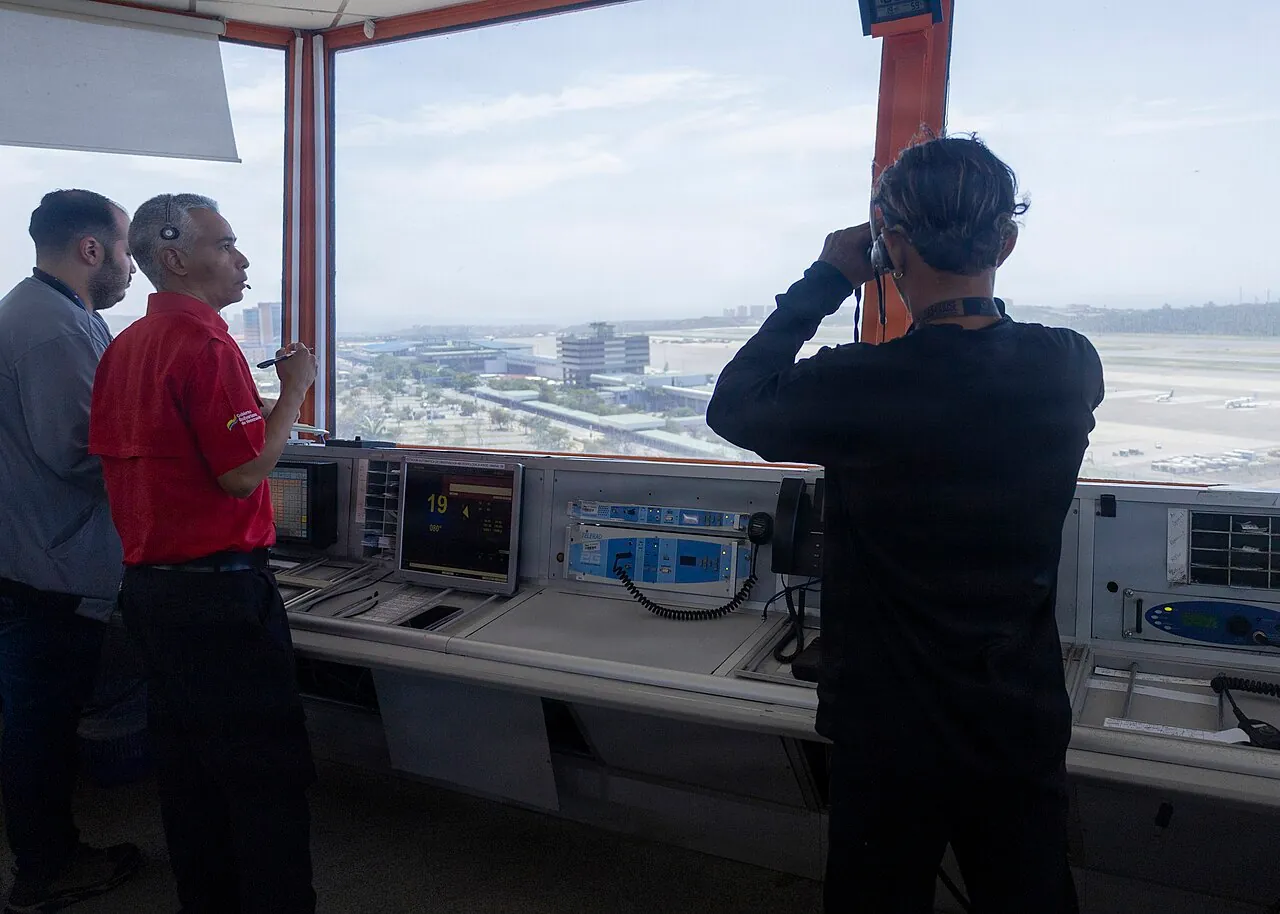
An FAA airport ground stop is an air traffic control order that holds departing flights on the ground at their origin airports before they can take off for a constrained destination or airspace sector. Issued when severe weather, equipment outages or emergencies suddenly cut an airport’s arrival capacity—sometimes down to zero—it prevents dangerous midair congestion and fuel-wasting holding patterns by keeping planes at their departure gates. Under FAA Order JO 7210.3EE (effective July 9, 2026), it is the most restrictive traffic management initiative in the United States, overriding all existing departure schedules until controllers either lift the order or switch to a scheduled delay program.
What triggers an FAA ground stop?
Every major airport operates with an Airport Acceptance Rate (AAR), which is the number of arriving aircraft its runways and air traffic controllers can safely land in an hour. According to the FAA’s National Airspace System documentation (2026), traffic managers trigger a ground stop for three main reasons: when projected arrival traffic briefly exceeds that acceptance rate, when the acceptance rate drops to zero, or when controllers need a quick pause on departures to set up a longer-term flow program.
Under the rules in FAA Order JO 7210.3EE (2026), controllers can implement a ground stop to prevent extended airborne holding, keep airspace sectors from reaching near-saturation levels, or avoid tarmac gridlock at the destination airport. They also use ground stops when a control tower, radar approach facility or regional center becomes wholly or partially unable to provide air traffic control services due to unforeseen circumstances, or when severe weather or catastrophic events block flight routings.
Those triggers aren’t limited to thunderstorms or blizzards. On October 13, 2026, a damaged fiber-optic cable disrupted communications and prompted the FAA to hold departures bound for Houston George Bush Intercontinental Airport between roughly 6:30 p.m. and 8:00 p.m. local time, with operations normalizing around 9:15 p.m., according to MigFlug’s 2026 operational report. In a rarer nationwide case on January 11, 2023, an outage in the federal Notice to Air Missions (NOTAM) database forced the FAA to temporarily halt domestic departures across the entire United States until the system was restored, as documented by the National Business Aviation Association (2023).
One built-in exception applies to rotorcraft: under FAA Order JO 7210.3EE (2026), helicopters are automatically exempt from weather-based ground stops unless the regional Air Route Traffic Control Center (ARTCC) specifically includes them in the restriction.
How do local and national ground stops set their scope?
Not every ground stop freezes traffic across the entire country. FAA Order JO 7210.3EE (2026) divides the procedure into two categories based on how long the bottleneck is expected to last and how many regional facilities it touches.
A Local Ground Stop can be started directly by an individual air traffic facility for airports wholly within its area of responsibility, provided the disruption is not expected to last more than 30 minutes. Local facilities cannot extend that stop past the 30-minute mark without prior approval from the FAA’s Air Traffic Control System Command Center (ATCSCC) in Warrenton, Virginia.
When a disruption crosses regional boundaries or lasts longer than 30 minutes, the ATCSCC coordinates a National Ground Stop after evaluating less restrictive options. Rather than halting every flight in North America bound for the affected airport, traffic managers define the “scope” of the stop by distance, by regional control center, or by tier, according to the NBAA’s ground stop operational guidance (2026). A first-tier ground stop holds departures only at airports inside the destination’s own regional center or immediately adjacent centers—flights roughly one to two hours away. A five-hour cross-country flight may be allowed to take off on time because the storm or outage at the destination is expected to clear long before that plane arrives.
How does a ground stop differ from a Ground Delay Program?
Passengers often hear “ground stop” and “ground delay” used interchangeably at the gate, but they work differently inside the FAA’s Traffic Flow Management System. In the hierarchy of traffic management initiatives, a ground stop takes top priority and overrides every other flow tool, including time-based metering and previously assigned departure slots (NBAA, 2026).
| Feature | Ground Stop (GS) | Ground Delay Program (GDP) |
|---|---|---|
| Destination arrival capacity | Severely restricted or reduced to zero (FAA ATCSCC, 2026) | Reduced below demand, but still accepting landings (FAA ATCSCC, 2026) |
| Takeoff time assigned | None; planes wait for an Expect Update Time (NBAA, 2026) | Each flight gets an Expect Departure Clearance Time (EDCT) (NBAA, 2026) |
| Priority level | Most restrictive; overrides all other initiatives (FAA JO 7210.3EE, 2026) | Second most restrictive; superseded if a ground stop is called (NBAA, 2026) |
| Typical duration | Up to 30 minutes for local stops; re-evaluated at set intervals for national stops (FAA JO 7210.3EE, 2026) | Multi-hour structured schedule spacing out arrivals (FAA ATCSCC, 2026) |
When your flight is caught in a ground stop, pilots cannot be given an Expect Departure Clearance Time (EDCT). Instead, the ATCSCC advisory lists the affected airport, the departure facilities included in the scope, the reason, an Expect Update Time, and a Probability of Extension rated as Low, Medium or High (FAA Order JO 7210.3EE, 2026). Once controllers can measure how many planes the destination can land per hour, they often lift the ground stop and transition into a Ground Delay Program, which assigns each waiting aircraft a specific takeoff window to space arrivals evenly.
This update-time approach is specific to US airspace under the FAA. In European airspace, the EUROCONTROL Network Manager (2026) regulates air traffic capacity primarily by issuing individual Calculated Take-Off Times (CTOT) that require aircraft to depart within a strict slot tolerance window of minus 5 to plus 10 minutes.
What do passengers often get wrong about airport ground stops?
Because ground stops are announced when terminals are already crowded and schedules are slipping, three misconceptions come up regularly:
- Wait at the origin, not the destination: An arrival ground stop for a hub like Atlanta or Phoenix does not stop planes already in Atlanta from taking off for other cities. It holds flights sitting on the ground at other airports that are scheduled to fly into that hub (FAA ATCSCC, 2026). That is why your plane can be held on a sunny tarmac in Boston because of thunderstorms or power outages across the country.
- Airborne flights keep flying: A ground stop only prohibits departure releases for aircraft still on the ground (FAA Order JO 7210.3EE, 2026). Planes already in the air when the order goes out are not forced to land at the nearest runway; they continue toward their destination under tactical air traffic control instructions, entering airborne holding patterns or diverting only if the destination cannot accept landings when they arrive.
- The FAA does not cancel flights or close airports: According to FAA ATCSCC guidance summarized by FlyingOver (2026), the FAA only manages traffic flow. Local airport authorities decide whether to close an airport or runway, and individual airlines decide whether to cancel a flight when ground stops knock crews or aircraft out of position.
Frequently asked questions
Where can you check if an FAA ground stop is active?
Ground stops expected to last 15 minutes or longer are posted publicly in real time on the FAA’s Operational Information System (OIS) and the National Airspace System (NAS) Status dashboard, showing the affected airport, the geographic scope, the reason and the next update time (NBAA, 2026).
Are airlines required to pay for hotels or meals during an FAA ground stop?
In the United States, delays caused by air traffic control ground stops or severe weather are classified as outside the airline’s control. Airlines are generally not required to provide hotel rooms or meal vouchers for those delays, though federal rules entitle you to a full refund if your flight is canceled or significantly delayed and you choose not to travel (FlyingOver, 2026).