
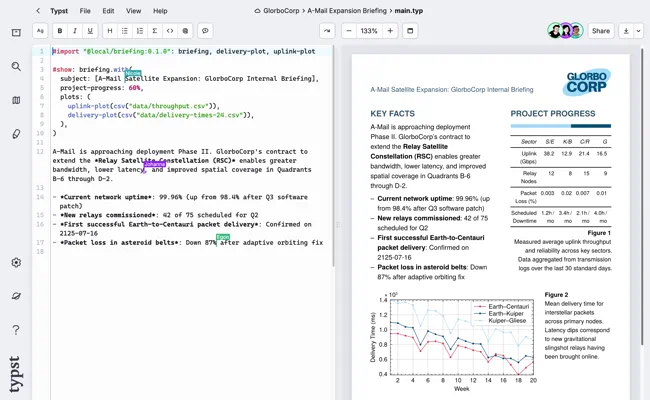
The enterprise software market is currently facing a sharp correction as strict new digital accessibility laws force users away from legacy formatting tools. Typst is emerging as a streamlined alternative to Microsoft Word and the notoriously complex LaTeX typesetting system. The software ditches standard ribbon menus entirely. It relies on a straightforward syntax where users type equals signs for headers and asterisks for bold text.
The core experience revolves around a minimalist split-screen UI. One half of the monitor acts as a distraction-free writing environment. The other half generates a real-time visual preview of the final document.
Developer updates recently pushed Typst to version 0.14 in 2026. This release introduces HTML exports, native PDF image support, and precise character-level justification. The program features a built-in scripting language. Writers can write functions, run loops, and execute conditional logic directly inside their text. Users can skip spreadsheet software altogether since the program allows for live CSV data integration to build complex tables automatically.
Performance issues usually plague long Microsoft Word documents heavily loaded with images. Typst bypasses this lag through incremental compilation. The compiler only updates the exact sentence or image you just modified. The preview renders instantly even on academic papers hundreds of pages long.
How Typst 0.14 Meets the 2026 European Accessibility Act Guidelines
The underlying architecture of digital publishing changed sharply in 2025 and 2026. The enforcement of the European Accessibility Act mandates that digital documents meet specific screen-reader and formatting guidelines. Traditional word processors often export PDFs with broken reading orders or missing image tags unless users manually restructure the file.
Typst version 0.14 solves this compliance hurdle by generating tagged, accessible PDFs by default. The compiler automatically structures the underlying code of the document to meet these new legal requirements without requiring extra input from the writer. Organizations and researchers are moving to the platform to ensure their public-facing reports avoid regulatory penalties while keeping the writing process fast.