
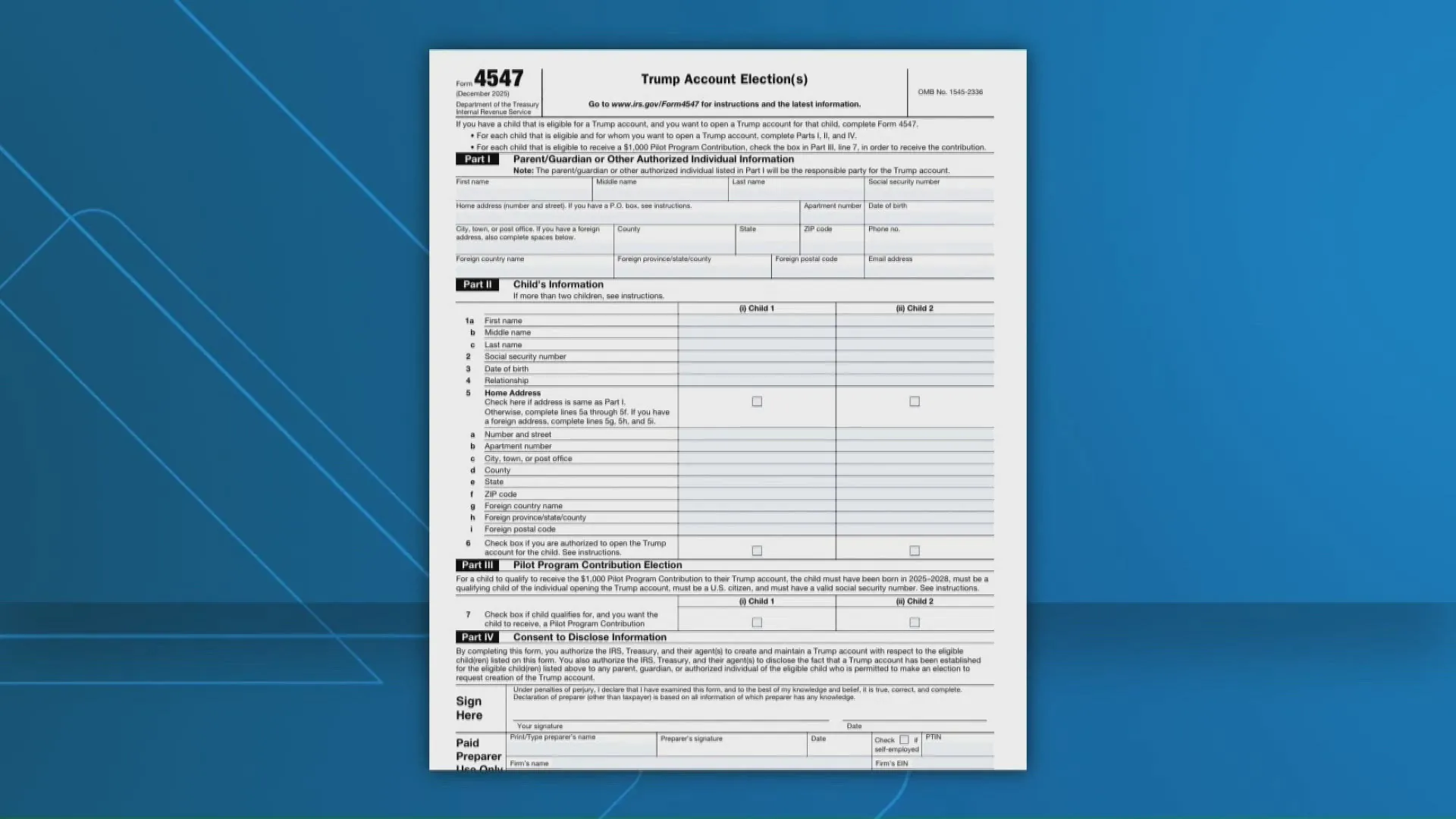
Parents of young children rushing to secure the new $1,000 federal seed deposit have more time than they realize. The newly implemented “Trump Accounts”—officially known as Section 530A accounts under last year’s Working Families Tax Cuts—provide a one-time federal contribution for eligible U.S. citizens born between January 1, 2025, and December 31, 2028. There is no immediate 2026 deadline to lock in the funds. Instead, parents or guardians can claim the money at any point during the account’s designated growth period.
Key Details
- The claiming window: Families have until December 31 of the year the beneficiary turns 17 to process the federal deposit.
- Application methods: Claims require IRS Form 4547, which can be attached to an annual tax return or submitted digitally via TrumpAccounts.gov.
- Contribution limits: Parents and employers can deposit an additional $5,000 annually per child, a cap that will adjust for inflation starting in 2028.
- Investment restrictions: Account balances must be parked in low-cost U.S. index funds or ETFs with a strict 0.10% expense ratio cap.
When the “One Big Beautiful Bill” took effect on July 4, 2025, it established these custodial-style traditional IRAs for minors to kickstart tax-deferred investing. But confusion surrounding the application window has left many households scrambling. The tax code actually extends a generous runway. Eligible families have until December 31 of the year the beneficiary turns 17 to initiate the deposit.
Processing the claim requires filing IRS Form 4547 (the Trump Account Election). Parents can attach this document to their standard annual income tax return. If they prefer to skip the tax-season paperwork, they can process it independently via the federal portal. The Treasury Department is heavily pushing this digital route. The push seems to be working, as recent pilot program enrollment data indicates robust early adoption across the country.
What about children born before the 2025 cutoff? They miss out on the federal $1,000 seed. But the private sector is stepping in to bridge that gap. The Michael & Susan Dell Foundation recently allocated a $6.25 billion grant to fund alternative $250 charitable deposits for older qualifying children in designated ZIP codes.
The money cannot be touched immediately. Withdrawals remain strictly prohibited until the beneficiary turns 18. During that entire growth phase, the portfolio is legally restricted to specific asset classes. This ensures Wall Street fees do not eat into the principal over two decades of compounding interest. Once the child turns 18, the vehicle seamlessly converts into a standard traditional IRA.
What the $5,000 Cap Means for Generational Wealth
The structural design of Section 530A accounts creates a distinct economic advantage for middle-to-high income households over the next 18 years. By allowing up to $5,000 in combined annual after-tax contributions from both parents and employers, the policy functions as a backdoor wealth-transfer mechanism. If a family maxes out that $5,000 limit every year from birth to age 18, the child enters adulthood with $90,000 in principal alone, entirely shielded from capital gains taxes during its growth phase.
This mirrors the aggressive early-stage compounding seen in 529 college savings plans, but with the added flexibility of a traditional IRA conversion at age 18. Untethering the funds from educational expenses allows beneficiaries to utilize the money for retirement compounding or specific penalty-free early withdrawals, fundamentally shifting how working-class families approach early investing.