
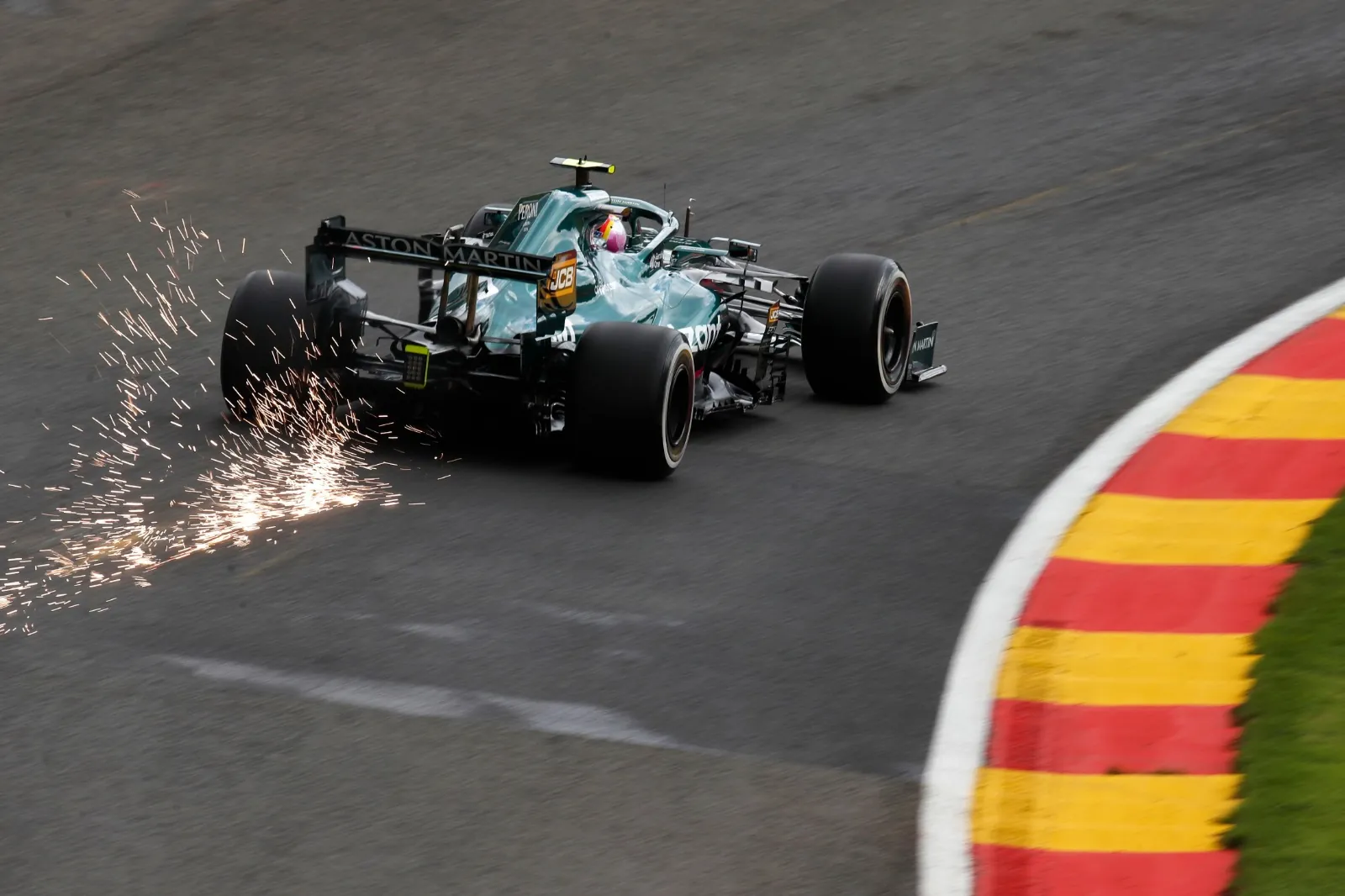
Ground effect aerodynamics is a method of generating immense vehicular grip by shaping the underside of a racing car to create a powerful low-pressure region between the chassis and the track. Instead of relying solely on top-mounted wings to push the car down from above, engineers use the floor itself to literally suck the vehicle onto the tarmac. You see this physics concept applied in high-level motorsport categories to increase cornering speeds without adding excessive straight-line drag.
Traditional aerodynamic wings work by forcing oncoming air upward, which pushes the car downward. This is highly effective for generating load, but it comes with a severe penalty: drag. Pushing a massive aerodynamic profile through the air requires tremendous engine power to overcome the resistance. Ground effect bypasses much of this drag penalty. By sculpting the underbody of the car, engineers manipulate the air squeezing underneath the vehicle. The magic lies in creating a pressure differential between the high-pressure air sitting on top of the car and the low-pressure air rushing underneath it.
You can see the difference on the stopwatch. Cars utilizing shaped underfloors achieve grip levels that flat-bottomed vehicles simply cannot match at the same engine output. The underlying physics dictate that nature abhors a pressure imbalance. The ambient atmosphere naturally pushes down on the car, trying to fill the void of low pressure created beneath it. This invisible hand presses the tires into the asphalt, allowing drivers to carry unbelievable speeds through corners.
Step-by-Step Mechanics of the Venturi Underfloor
To understand how this suction is created, you have to look at the geometry of the car’s floor. Modern ground-effect cars do not have flat bellies. They feature deep, contoured channels called Venturi tunnels running lengthwise under the sidepods. These tunnels manipulate the volume of space the air can occupy as it travels from the front axle to the rear.
This entire process relies on Bernoulli’s principle, a fluid dynamics concept dictating that an increase in fluid speed results in a simultaneous drop in static pressure. Here is exactly how the floor dictates that airflow:
- The Inlet (Gathering Air): The front of the underfloor features a wide, relatively tall opening just behind the front wheels. This inlet scoops up clean, undisturbed air as the car drives forward. The goal here is to ingest a massive volume of air and direct it cleanly under the floorboards.
- The Throat (Violent Acceleration): As the air moves rearward, the floor dips down, drastically narrowing the gap between the car and the track. Because the same volume of air must now squeeze through a much smaller space, it is forced to accelerate violently. As the air accelerates, static pressure drops, creating a low-pressure zone that actively pulls the vehicle down for faster cornering.
- The Diffuser (Controlled Expansion): At the rear axle, the floor aggressively curves upward. This section is called the diffuser. The diffuser expands the volume of the tunnel, allowing the highly accelerated, low-pressure air to gradually slow down and return to ambient atmospheric pressure. If the air expands too rapidly, the airflow detaches from the roof of the tunnel—a phenomenon known as boundary layer separation—which instantly kills the suction effect.
A properly functioning diffuser acts like an aerodynamic pump. By efficiently reintroducing the underfloor air to the ambient air behind the car, it actively pulls more air through the throat of the Venturi tunnels. The faster the air is extracted out the back, the faster it flows through the middle, multiplying the overall suction force.
Feature Comparison: Ground Effect vs. Traditional Wings
Racing series frequently debate whether to rely on top-surface wings or underfloor ground effects to generate grip. The choice completely dictates how cars behave around one another on the track.
When cars rely purely on front and rear wings, they punch a massive hole in the air. The wings aggressively churn the atmosphere, leaving behind a violently turbulent wake known as “dirty air.” Before recent rule changes in top-tier open-wheel racing, a trailing car routinely lost nearly half of its aerodynamic grip when following closely behind a leader. The turbulent wake deprived the chasing car’s wings of the smooth, high-energy airflow they needed to function.
Ground effect solves this. Generating load underneath the car creates a much cleaner aerodynamic wake. Following the reintroduction of shaped underfloors in recent motorsport regulations, the downforce deficit for a closely following car dropped to under a fifth of its total grip. This engineering choice directly dictates the quality of the racing product.
- Downforce Generation Location: Wings generate load on the top surfaces. Ground effect generates load underneath the chassis.
- Drag Penalty: Wings create high drag, lowering top speed on straights. Venturi tunnels create very low drag, allowing for higher top speeds.
- Wake Turbulence: Wings throw dirty air outward and backward, ruining the grip of following cars. Ground effect keeps the wake centralized and relatively clean.
- Ride Height Sensitivity: Wings function consistently regardless of minor suspension movements. Venturi tunnels are highly sensitive and require the floor to be perfectly parallel to the track.
Common Issues and Fixes: The Porpoising Phenomenon
Using the floor for grip comes with severe mechanical headaches. Because the suction is entirely dependent on the gap between the floor and the track, any change to that gap alters the aerodynamic balance. This leads to a violent, rapid bouncing effect known as porpoising.
Engineers spend hundreds of hours analyzing the mechanics of porpoising to prevent the floor from stalling at high speeds. The bouncing is not a mechanical failure of the suspension; it is a purely aerodynamic stall cycle. It happens in a very specific sequence:
- The car accelerates down a long straight. As speed increases, the Venturi tunnels generate exponentially more suction.
- This suction compresses the suspension, pulling the chassis closer and closer to the asphalt.
- The gap between the floor and the track becomes too narrow. The airflow literally chokes and the aerodynamic boundary layer detaches.
- With the airflow stalled, the low-pressure zone instantly vanishes. The car loses its downforce.
- Free from the aerodynamic load, the springs immediately push the chassis back up to its normal ride height.
- Once the car is raised, the airflow reattaches to the floor, the suction returns, and the car is violently yanked back down to the track.
This loop repeats several times a second, shaking the vehicle violently. To stop the floor from hitting the track and triggering the stall, teams resort to super-stiff suspension setups that heavily punish the driver’s spine over bumps. By making the springs practically immobile, the ride height remains static, preventing the floor from choking. The trade-off is an incredibly harsh ride quality that transmits every single track imperfection directly into the cockpit.
Alternative Methods and Historical Evolutions
Aerodynamicists have been chasing the perfect underfloor seal for decades. The effectiveness of a Venturi tunnel depends entirely on keeping the low-pressure air trapped beneath the car. If high-pressure ambient air leaks in from the sides of the vehicle, the pressure equalizes and the grip disappears.
In the late 1970s, engineers at Lotus solved this by attaching physical sliding skirts to the edges of the sidepods. These rigid panels dropped down to physically scrape the track surface, creating an impenetrable mechanical seal. The cornering speeds achieved with skirts were mind-boggling for the era. Severe bouncing was also a well-documented headache during the early ground-effect era before the FIA banned shaped underbodies entirely in 1983 due to safety concerns. If a car with sliding skirts hit a curb and the skirt broke, the aerodynamic seal was instantly destroyed. The car would lose all cornering grip in a fraction of a second, resulting in high-speed crashes.
The most extreme alternative method belonged to the 1978 Brabham BT46B, widely known as the “Fan Car.” Instead of relying on forward motion to force air through a narrowed throat, designer Gordon Murray installed a massive fan at the rear of the chassis. Driven by the engine’s gearbox, the fan physically sucked air out from beneath the car. This meant the vehicle generated peak downforce even when sitting completely stationary in the pit lane. The fan car won its debut race in Sweden with humiliating ease before being swiftly withdrawn from competition following protests from rival teams.
Modern racing series forbid physical sliding skirts and active fan extraction. Teams must rely entirely on airflow manipulation to seal the floor edges. They use complex vortex generators—small aerodynamic fins near the front of the floor—to spin the air into tight, high-speed spirals. These invisible tornadoes run down the outside edges of the floor, acting as a virtual air-curtain that keeps the high-pressure ambient air from leaking underneath the car.
Key Takeaways
- Venturi tunnels accelerate airflow underneath the chassis to drop static pressure, literally sucking the vehicle into the track using Bernoulli’s principle.
- Unlike top-mounted wings that create turbulent wakes and hinder overtaking, shaped underfloors generate grip efficiently without heavily disrupting the air for following cars.
- Maintaining the aerodynamic seal requires the floor to run extremely close to the track, forcing engineers to use highly rigid suspension systems to prevent violent bouncing and aerodynamic stalling.